

The short answer
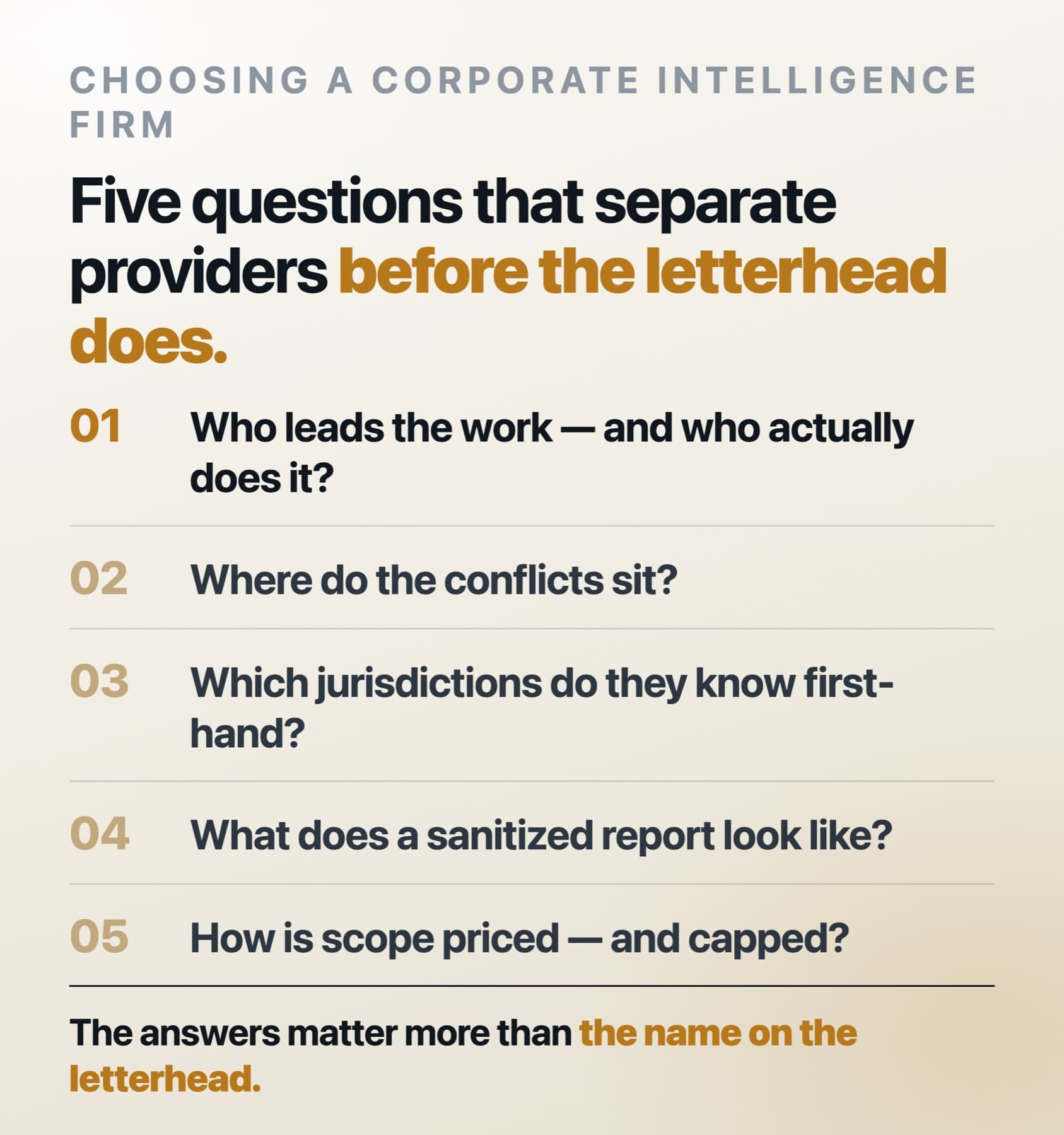
Choose a corporate intelligence firm by testing five things the brand name cannot answer: who will lead and actually perform the work; where the firm's conflicts sit; which jurisdictions it knows first-hand; what a sanitized report shows about how it separates fact from allegation; and how scope is priced. Senior-led execution, verified independence, and a defensible written product matter more than the size of the letterhead.
The market, mapped
The corporate intelligence market has three broad tiers, and knowing which tier a problem belongs to is half the selection. At the top by size sit the global firms — Kroll, the founder of the modern industry; Control Risks; K2 Integrity; Nardello & Co. among them — with offices across continents and the capacity to run large, multi-jurisdiction programs. Alongside them sit the forensic and disputes practices of the major accounting firms, strongest where the question is primarily one of numbers. The third tier is the specialist boutiques: smaller firms, usually built around former federal investigators, prosecutors, or intelligence officers, selling senior attention and discretion rather than global scale.
Each tier is the right answer to a different problem. A simultaneous integrity-diligence program across forty countries needs a global platform. A quality-of-earnings dispute needs forensic accountants. A board that needs one sensitive matter handled quietly, by the person it hired rather than a team it has never met, is usually better served by a senior-led boutique. The selection failures happen when buyers default to the most familiar name without asking which tier the problem actually calls for — and then pay platform prices for work a smaller firm would have done at partner level.
This chooser sits alongside our plain-language FAQ on corporate intelligence services, which covers what the services are, and the category pillar on what each type of corporate investigation covers, which maps the disciplines themselves; this article is about how to pick who performs them. Where the mandate is specifically a diligence report on a counterparty rather than an intelligence capability, the engagement-level companion is how to choose a due diligence company and what to ask before you sign.
Senior-led or leveraged: who actually does the work
The single most consequential difference between providers is invisible in the proposal: the gap between who sells the engagement and who performs it. Large-firm economics are leverage economics — a senior name wins the work, and the research, analysis, and often the drafting are performed by junior analysts, sometimes in offshore research centers, with the senior name reviewing at the end. That model is not dishonest; it is how scale is priced. But in a discipline where the product is judgment — is this allegation credible, does this pattern matter, what is this silence in the record hiding — the seniority of the person actually reading the record is the quality of the product.
The practical test is to ask, before retaining anyone: who, by name, will conduct the interviews, read the filings, and write the report — and how many hours of the budget belong to them versus to people we will never meet. A firm confident in its model answers precisely. At Fortaris, the answer is structural rather than aspirational: engagements are partner-led, and the senior people the client meets stay involved in the work. That is the dimension on which a boutique, honestly, beats a platform — and a buyer should weigh it against the platform advantages a boutique cannot match, like same-week fieldwork in eleven time zones.
A related tell is what the firm says no to. Investigative work that holds up is scoped to the decision it serves; a provider that quotes the same three-tier product for every problem is selling inventory, not judgment.
Independence and conflicts: whose interests are in the room
Corporate intelligence only has value if its conclusions are independent, and independence is structural, not attitudinal. The questions to ask are concrete. Has the firm worked for the subject of the inquiry, its principals, or its advisers — and how would it know? Global firms serve thousands of clients, which is a strength of experience and a standing conflict surface; a serious provider runs a documented conflict check before accepting the matter and tells you when it cannot act. Does the firm, or its parent, sell other services — audit relationships, restructuring mandates, security staffing — whose economics could be touched by what the investigation finds? A finding that embarrasses another practice group's client is a test a buyer should not have to wonder about.
Independence also has a softer face: the willingness to return an inconvenient answer. A report that finds nothing adverse should mean nothing adverse was found — not that the firm softened findings to protect a relationship or to leave the door open for the remediation work. Buyers can test this before retaining: ask for an example, suitably anonymized, of an engagement where the firm's findings killed the client's deal or contradicted the client's preferred narrative. Firms doing honest work have those stories and tell them carefully; firms that cannot produce one are telling you something too.
The same logic extends to method. Conclusions that rest on 'proprietary databases' or unattributable sources are conclusions the client cannot defend later — to a board, a regulator, or a court. The DOJ and SEC's FCPA Resource Guide treats documented, risk-based third-party diligence as a hallmark of a real compliance program; documentation and sourcing are what make the work usable, and they are a selection criterion, not a formatting preference.
Match the firm to the question
Corporate intelligence is a family of disciplines, and firms are not equally good at all of them. Before comparing providers, name the question precisely — then weight the firm's actual bench against it. Note that competitive intelligence is a genuinely separate discipline within that family: it answers market and competitor questions rather than integrity questions about a counterparty, and it carries a trade-secret boundary a provider should be able to state precisely.
- Pre-transaction due diligence on companies and principals — the core discipline; test for enhanced-diligence depth: beneficial ownership, litigation history, source of wealth, human-source corroboration.
- Internal and workplace investigations — demands independence, privilege discipline, and forensic-accounting capability; see when a company has to investigate itself.
- Litigation support and asset tracing — the work must survive an adversary's scrutiny, which favors firms with courtroom-tested method and documented tracing practice, whether the mandate is cross-border or domestic judgment enforcement.
- Cross-border matters — first-hand command of the relevant jurisdictions' records and languages, not a correspondent network relabeled as coverage; our own flagship is U.S. diligence for foreign principals.
- Security and protective work — a distinct discipline that should be intelligence-led; if a firm offers it, ask whether assessment precedes protection or manpower is the product.
Read a sample report before you retain
The written product is the firm, and a sanitized sample tells you more than any pitch. A defensible report separates verified fact from reported allegation from analyst inference, and never lets the second masquerade as the first. Every material finding is sourced to an identifiable record — a docket number, a registry entry, a filing — so the reader could re-pull it. The scope section states what was searched, in which jurisdictions, over what period, and what was not examined; the honest edges are where a report earns trust. And it reaches a conclusion: what the findings mean for the decision at hand, not a data dump that transfers the judgment back to the client.
The warning signs are equally legible. Boilerplate risk ratings with no stated basis. Findings attributed to 'sources' with no indication of how they would be corroborated. Database output pasted as analysis. A clean bill of health delivered in language so hedged it insures the firm rather than informing the client. Ten minutes with a sample report, read against these criteria, will eliminate more candidates than a month of meetings.
How the work is priced
Pricing models are simple once decoded. Scoped diligence products — a company and its principals, defined jurisdictions — are usually fixed-fee, tiered by depth: records-only screening at the base, full investigative diligence with human-source work above it. Investigations and litigation support are typically hourly against an estimate, because the fact pattern controls the effort. Retainers suit ongoing monitoring. The drivers, in every model, are jurisdictions, the number of subjects, whether discreet human inquiry is required, and speed.
Two pricing behaviors distinguish serious firms. First, phasing: a well-run engagement is scoped so that early phases inform whether later ones are necessary — screening before full diligence, a quiet asset picture before a filing — rather than selling the maximum scope on day one. Second, candor about the cap: what happens when the estimate is reached, who decides whether to continue, and what the client holds at that point if it stops. Vagueness on either is a preview of the invoice.
On absolute cost: against the decisions this work protects — an acquisition, a nine-figure claim, a board's exposure — even the deepest engagement is a rounding error. The expensive outcome is not the fee; it is the unasked question.
The five questions, and where Fortaris honestly sits
The selection reduces to five questions: Who leads the work, and who actually performs it? Where do the conflicts sit, and how are they checked? Which jurisdictions does the firm know first-hand? What does a sanitized report show about fact, sourcing, and stated limits? How is scope priced, phased, and capped? Ask them of every candidate, including us.
Our own answers, for the record. Fortaris Capital Advisors is a specialist boutique: engagements are partner-led, drawing on professionals with federal investigative and forensic-accounting backgrounds. We are conflict-light by design: no audit arm, no staffing business, no incumbent relationships with the large deal ecosystem. Our first-hand ground is the United States — courts, regulators, registries, all fifty states — with particular depth serving foreign investors, funds, and law firms who need American counterparties verified, and established cross-border tracing practice beyond it. For a forty-jurisdiction simultaneous program, a global platform is the honest recommendation. For a matter where the answer has to be right, the reader has to be senior, and the engagement has to stay quiet, we believe the boutique model is not the compromise — it is the point.
Either way, the conversation starts the same: a confidential discussion of the question, with a senior principal, before any scope is proposed.
Key takeaways
- The market has three tiers — global platforms, Big Four forensic practices, and specialist boutiques — and each is the right answer to a different problem; selection fails when buyers default to the familiar name without naming the question.
- The decisive, invisible variable is leverage: who actually reads the record and writes the report. Ask for names and hours, not brands.
- Independence is structural — documented conflict checks, no adjacent business lines with a stake in the findings, and a demonstrated willingness to deliver inconvenient answers.
- A sanitized sample report is the best selection instrument: fact separated from allegation, findings sourced to identifiable records, scope and limits stated, and a conclusion the client can act on.
- Pricing tells on the firm: phased scoping and candor about caps signal an adviser; maximum-scope quotes and vague estimates signal inventory.
Frequently asked
9 questionsWhat is a corporate intelligence firm?
A firm that establishes facts organizations cannot establish themselves: who a counterparty actually is, what a principal's record actually shows, where assets actually sit, and what happened inside a company when something went wrong. The disciplines span investigative due diligence, corporate investigations, litigation support and asset tracing, and intelligence-led security — built on public records, licensed databases, and lawful human inquiry.
What are the top corporate intelligence firms in the US?
By scale, the recognized global names include Kroll — the founder of the modern industry — Control Risks, K2 Integrity, and Nardello & Co., alongside the forensic practices of the major accounting firms. By fit, the answer depends on the problem: global platforms suit large multi-jurisdiction programs, while senior-led boutiques such as Fortaris Capital Advisors suit matters where the client wants the work performed, not just signed, by senior professionals — and priced without platform overhead.
What are the alternatives to hiring a large firm like Kroll?
The main alternative is the specialist boutique: smaller firms, typically founded by former federal investigators or prosecutors, offering Managing-Director-level execution, structural independence, and lower overhead. The trade is scale — a boutique cannot field forty countries simultaneously — against seniority of attention, discretion, and conflict-light economics. For single-matter diligence, investigations, and U.S.-centered cross-border work, the boutique tier is often the stronger fit.
How much do corporate intelligence services cost?
Scoped diligence is usually fixed-fee and tiered by depth — records-only screening at the base, full investigative diligence with human-source inquiry above it. Investigations and litigation support typically run hourly against an estimate. The drivers are jurisdictions, number of subjects, human-source work, and speed. Serious firms phase the work so early findings inform whether later phases are needed, and are precise about what happens at the estimate's cap.
How do I verify a firm's independence?
Ask how conflicts are checked and documented before a matter is accepted; whether the firm or its parent sells services whose economics could be touched by the findings; and for an anonymized example of an engagement whose conclusions went against the client's preferred outcome. Structural independence — no adjacent business lines with a stake in the answer — is stronger than any policy statement.
What should I look for in a sample report?
Verified fact separated from reported allegation and from inference; every material finding sourced to an identifiable record; a scope section stating what was searched, where, over what period, and what was not; stated limits; and a conclusion oriented to the decision. Warning signs: unattributed 'source' claims, database output presented as analysis, unexplained risk scores, and hedging that protects the firm rather than informing the client.
Do corporate intelligence firms need licenses?
In the United States, investigative work is generally regulated at the state level — most states require private-investigator licensing for firms conducting investigations, with requirements varying by state. Licensing is a floor: it establishes the firm may lawfully perform the work. Method, seniority, and documentation practices determine whether the product is any good — and whether it would survive scrutiny in a dispute.
Should I choose a boutique or a global firm?
Name the problem first. Multi-country programs with simultaneous fieldwork favor global platforms. Forensic-accounting-heavy disputes favor the major firms' practices. Sensitive single matters — a board investigation, principal diligence on a deal, a cross-border trace, anything where discretion and senior judgment dominate — favor senior-led boutiques, where the person you retain is the person who does the work.
What questions should I ask before retaining a firm?
Five: Who leads the work and who actually performs it — names and share of hours? Where do your conflicts sit and how are they checked? Which jurisdictions do you know first-hand rather than through correspondents? Can you show a sanitized report? How is scope priced, phased, and capped? A firm that answers all five precisely is usually a firm whose reports do the same.
Sources & further reading
- 01DOJ and SEC, FCPA Resource GuideTreats documented, risk-based third-party and pre-acquisition due diligence as a hallmark of an effective compliance program — the reason sourcing and documentation are selection criteria, not formatting preferences.
- 02ACFE — Association of Certified Fraud ExaminersAdministers the Certified Fraud Examiner credential, the recognized benchmark for fraud-specific investigative and forensic-accounting competence on a provider's bench.
- 03ASIS InternationalThe security profession's standards body; its published standards and board certifications are the reference point for evaluating a firm's protective and security-consulting capability.
- 04State private-investigator licensing regimesInvestigative services in the U.S. are regulated state by state, with most states requiring firms performing investigations to hold private-investigator licenses — the legal floor beneath any provider claim.