

The short answer
Asset tracing for judgment enforcement identifies what a judgment debtor actually owns, and which of it a creditor can reach. It combines post-judgment discovery with independent research into property, business interests, security filings and transfers made once litigation became likely. A judgment is a right to collect, not money; tracing is how that right becomes recovery.
The judgment is not the money
Every litigator knows the client conversation that follows a win, and it is rarely the one the client expects. The judgment is entered, and then nothing happens. The defendant does not pay. There is no mechanism by which a court transfers money on entry of judgment; what the creditor has acquired is a legal right to pursue property, exercised through processes the creditor must run and fund.
That distinction is where enforcement work actually begins, and it explains why a well-argued case can end in an uncollected judgment. The question that determines the outcome is not whether the debtor owes the money. It is whether the debtor owns anything the law will let you take, whether you can prove they own it, and whether it is still there.
This piece deals with domestic post-judgment enforcement. Where the value has left the country, the sequencing is different and considerably less forgiving — that is the subject of inside a cross-border asset trace and, for the remedies themselves, cross-border fraud and the legal remedies that recover the money.
What post-judgment discovery reaches, and where it stops
The formal tools are real and should always be used. Under Federal Rule of Civil Procedure 69(a), a judgment creditor may obtain discovery in aid of execution from the judgment debtor or any other person, using either federal procedure or the procedure of the state where the court sits. In practice that means written interrogatories about assets, document demands, subpoenas to third parties including banks and employers, and the debtor's examination — testimony under oath about what they own.
These tools have one structural weakness: with the partial exception of third-party subpoenas, they depend on the debtor's own account of their affairs. A debtor motivated enough to have moved assets before judgment is not usually a debtor who completes an asset schedule candidly. Answers arrive late, incomplete, or technically true and substantively useless — the vehicle is leased, the house is in a spouse's name, the business was sold, the accounts are empty.
Independent tracing is what makes those answers testable. Its purpose is not to replace discovery but to arrive at the debtor's examination already knowing a substantial part of the answer, so that an incomplete disclosure becomes a provable one. That is a materially stronger position: an evasive answer given under oath against a record the creditor already holds is itself leverage, and in many cases it is the thing that produces a settlement.
The records that establish what is really owned
Domestic asset tracing is largely a records discipline, and the records are more informative than most people expect — provided you know which ones actually establish ownership rather than merely suggesting it.
- Real property — county recorder and register of deeds filings establish title, the chain of transfers, and every mortgage, lien and encumbrance recorded against it. This is the single most productive source in domestic enforcement, and it is also where transfers to relatives and newly formed entities become visible.
- UCC financing statements — filed with the secretary of state, these show which lenders hold security interests in a business debtor's equipment, inventory and receivables. They tell you both what the business owns and how much of it is already pledged to somebody ahead of you.
- Corporate and entity records — state registrations, officers, registered agents and formation dates. A cluster of entities formed shortly before or during the litigation is one of the more reliable signals in this work.
- Titled personal property — vehicles, vessels and aircraft, recorded in state and federal registries, each carrying its own lien record.
- Business interests and receivables — ownership of operating companies, distributions, and money owed to the debtor. A judgment debtor who is themselves a creditor holds an asset that can be reached.
- Litigation and lien records — other judgments against the debtor establish where you sit in the queue, and judgments in the debtor's favour are collectible property.
- Employment and income — the basis for wage garnishment where the debtor is an individual, subject to the federal limits described below.
Located is not the same as collectible
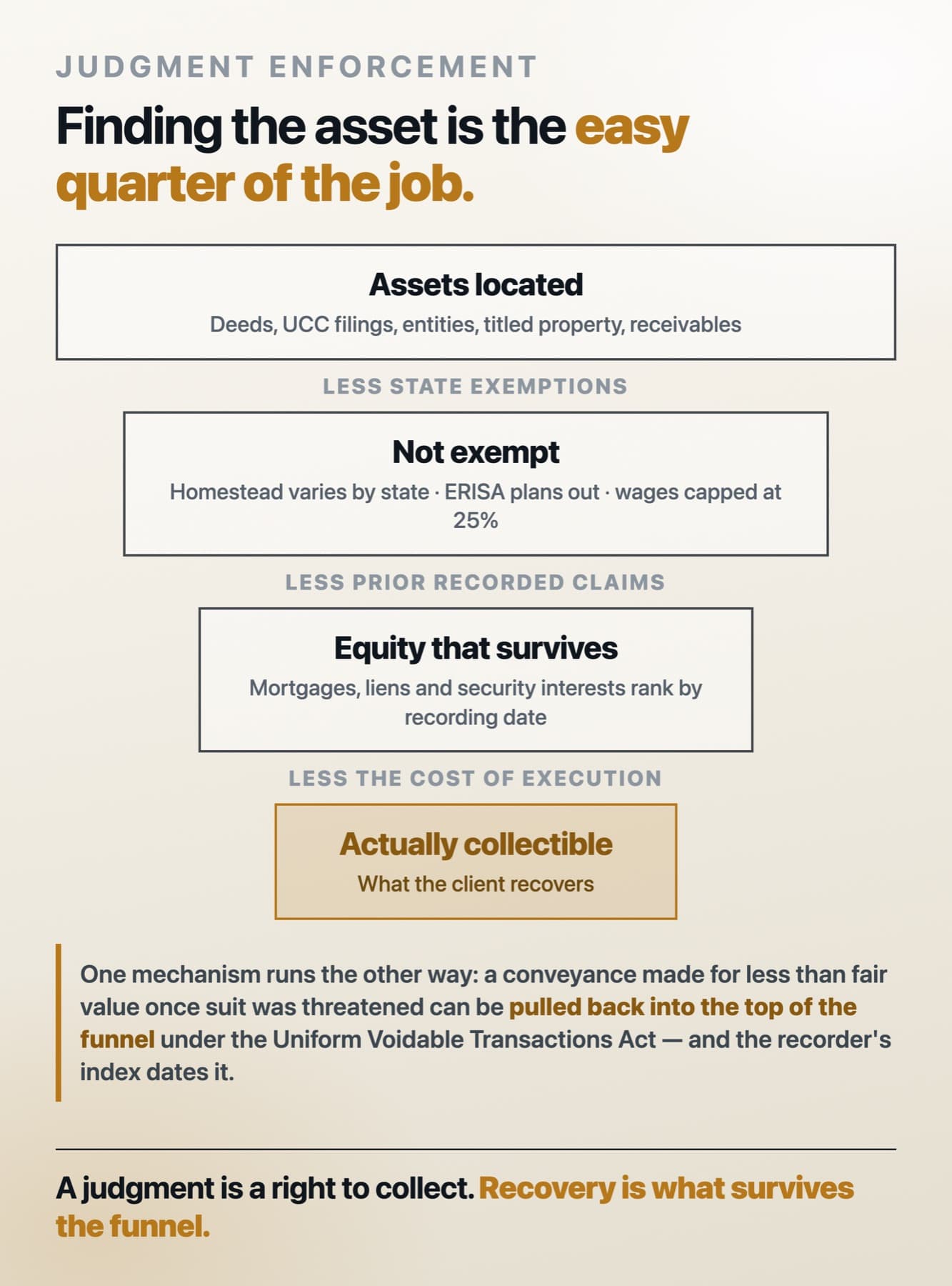
This is the part of the analysis most often skipped, and skipping it is how enforcement budgets get spent producing an inventory of assets the creditor can never touch. An asset has to survive three reductions before it is worth pursuing.
First, exemptions. State law protects categories of property from execution, and the variation between states is extreme rather than marginal — homestead protection ranges from a few thousand dollars of equity in some states to unlimited acreage in others, and the debtor's state of residence therefore does much of the work in determining what is recoverable. Qualified retirement plans carry federal anti-alienation protection under ERISA and are generally beyond reach. For wages, the Consumer Credit Protection Act caps garnishment at the lesser of twenty-five per cent of disposable earnings or the amount by which those earnings exceed thirty times the federal minimum hourly wage, with state law often more protective still.
Second, prior claims. A property worth two million dollars carrying a mortgage of one million eight hundred thousand and a prior judgment lien is not a two-million-dollar asset; it is an equity position that may be worth nothing after costs. Priority is established by recording date, which is exactly what the recorder's index shows.
Third, cost and time. Execution, levy, garnishment and receivership each carry filing fees, sheriff's costs, professional time and delay. An asset whose realisable equity is smaller than the cost of reaching it is a finding, not a recovery — and saying so early is one of the more valuable things an investigator does for a client.
Transfers made while the case was pending
The most consequential enforcement findings are usually not assets the debtor still holds. They are assets the debtor moved, and the law has a well-developed answer for them.
The Uniform Voidable Transactions Act — adopted in most states, and the successor to the Uniform Fraudulent Transfer Act — allows a creditor to have a transfer set aside where it was made with actual intent to hinder, delay or defraud a creditor, or where the debtor did not receive reasonably equivalent value and was insolvent or rendered insolvent by it. The second limb matters enormously in practice: it does not require proof of intent, which is difficult, only proof of inadequate consideration and insolvency, which is provable from records.
Because intent is hard to establish directly, the statute and the case law work through badges of fraud — a transfer to an insider, the debtor retaining possession or control after transferring title, concealment, a transfer made after being sued or threatened with suit, a transfer of substantially all assets, and consideration that does not match value. A deed transferring the family home to a spouse or an LLC for nominal consideration, recorded three weeks after the complaint was served, is a documented and dated fact sitting in a public index.
This is where the recorder's chain of title earns its place at the centre of the work. The transfer is not merely discoverable; it is timestamped against the litigation, which is precisely what a voidable-transfer claim needs.
The legal limits, stated plainly
There is a persistent market for services that promise a judgment debtor's bank balances and account numbers, and any attorney commissioning this work should understand why a serious firm will not supply them that way.
The Gramm-Leach-Bliley Act makes it unlawful to obtain, or attempt to obtain, customer information of a financial institution by false pretences — the practice known as pretexting. Unauthorised access to accounts, devices or online banking is separately unlawful. Evidence obtained by these routes is not merely inadmissible; it creates exposure for the lawyer and the client who commissioned it, and it can compromise the very judgment the exercise was meant to enforce.
The legitimate routes to account information are the ones the enforcement process already provides: third-party subpoenas to identified institutions, the debtor's examination, and garnishment proceedings. The investigator's contribution is to identify which institutions to subpoena — from recorded mortgages and their lenders, UCC filings, litigation exhibits, closing documents and the corporate record — so that the subpoena is aimed rather than speculative. That is a research problem, and it is entirely lawful.
The same discipline applies to the work product. Findings have to be sourced and dated to survive a contested hearing, which is the standard the wider litigation support practice is built to — the service-level view is set out in litigation support services.
Doing it before you file
Everything above describes work done after judgment, which is when most of it is commissioned. It is more valuable before filing, and materially cheaper.
A collectability read taken before the complaint answers a different question: not how do we collect, but is this defendant worth suing at all. A defendant with no equity, no recorded property, a heavily encumbered business and a history of dissolved entities is a defendant against whom a client can spend two years and substantial fees to obtain a judgment that will never be paid. Establishing that at the outset is not pessimism; it is the information on which a rational client decides whether to litigate, settle early, or decline the matter.
Filing also has a second effect worth planning for. Once a defendant knows litigation is coming, transfers begin — which is an argument for capturing a baseline picture of the defendant's holdings early, so that later movement is provable against a documented starting position. That pre-filing exercise is set out in pre-litigation due diligence, and the general discipline it belongs to in what investigative due diligence is.
What recovery realistically looks like
Honest expectations are part of the deliverable. Most enforcement matters do not end with a dramatic levy on a hidden account. They end in one of three ways, and each is a legitimate result.
The first is a settlement. A debtor who understands that the creditor has the deed, the entity chart, the UCC filings and the transfer dates usually reaches a different view of what the judgment is worth than a debtor who believes their affairs are opaque. A substantial share of enforcement recovery comes from this shift rather than from execution itself.
The second is a structured realisation against identified property — a lien on real estate that is paid on refinancing or sale, wage garnishment within the statutory cap, a charging order against a business interest, or a receiver appointed over an operating entity. Slower than a levy, but it is where most collected money actually comes from.
The third is a documented conclusion that there is nothing collectible, and there is real value in reaching it deliberately rather than by exhaustion. It lets a client stop spending, take a write-off supported by evidence, and preserve the judgment — which in most states remains enforceable for years and is renewable — against the possibility that the debtor's circumstances change. A dormant judgment against someone who later inherits, sells a business or resurfaces with recorded property is not worthless. It is simply not yet due. Selecting a firm that will tell a client this plainly is one of the tests set out in how to choose a due diligence company.
Key takeaways
- A judgment confers a right to pursue property, not a transfer of money — the creditor must run and fund the enforcement process, and the case's merits have no further bearing on whether anything is recovered.
- Rule 69(a) discovery depends substantially on the debtor's own account of their affairs; independent tracing exists to make that account testable, so an evasive answer given under oath becomes provable rather than merely suspected.
- A located asset is not a collectible one until it has survived exemptions, prior recorded claims and the cost of execution — and state homestead protection varies so widely that the debtor's state of residence does much of the work.
- The Uniform Voidable Transactions Act reaches transfers made without reasonably equivalent value by an insolvent debtor without requiring proof of intent — and the recorder's index timestamps those transfers against the litigation.
- Bank balances obtained by pretexting are unlawful under the Gramm-Leach-Bliley Act and create exposure for the lawyer who commissioned them; the lawful route is to identify which institutions to subpoena and let the enforcement process do the rest.
Frequently asked
10 questionsWhat is asset tracing in judgment enforcement?
The investigative process of establishing what a judgment debtor owns, what it is genuinely worth after prior claims, and whether property has been transferred away since the dispute arose. It draws on recorded real property records, UCC financing statements, corporate registrations, titled personal property, litigation and lien records, and business interests, and it runs alongside formal post-judgment discovery rather than replacing it.
Why do so many judgments go uncollected?
Because entry of judgment moves no money. The creditor acquires a right to pursue property and must fund and run the process of doing so. Collection then fails for practical reasons rather than legal ones: the debtor has no equity after prior liens, the property is exempt under state law, assets were moved before judgment, or the cost of execution exceeds the realisable value. None of these is affected by how strong the underlying case was.
What can post-judgment discovery actually get me?
Under Rule 69(a) a judgment creditor may take discovery in aid of execution using federal or applicable state procedure — asset interrogatories, document demands, third-party subpoenas including to banks and employers, and the debtor's examination under oath. The limitation is that most of it relies on the debtor's own disclosure. Its value rises sharply when the creditor already holds an independent record against which that disclosure can be tested.
Can an investigator find a judgment debtor's bank accounts?
Not by obtaining balances or account numbers directly, and you should decline any provider offering to. The Gramm-Leach-Bliley Act prohibits obtaining customer information from a financial institution under false pretences, and unauthorised account access is separately unlawful; evidence obtained that way creates exposure for the attorney and client. What an investigator lawfully does is identify which institutions the debtor banks with — from recorded mortgages and their lenders, UCC filings, litigation exhibits and closing documents — so that a subpoena or garnishment can be aimed rather than guessed.
What assets are exempt from a judgment?
It depends heavily on the debtor's state. Homestead exemptions protect equity in a primary residence and range from a modest fixed sum in some states to effectively unlimited protection in others. Qualified retirement plans carry federal anti-alienation protection under ERISA. Wage garnishment is capped by the Consumer Credit Protection Act at the lesser of twenty-five per cent of disposable earnings or the amount by which they exceed thirty times the federal minimum hourly wage, with many states more protective. Establishing the debtor's state of residence is therefore an early and consequential step.
What if the debtor transferred assets before the judgment?
That is often the most valuable finding. The Uniform Voidable Transactions Act, adopted in most states, allows a transfer to be set aside where it was made with actual intent to hinder, delay or defraud a creditor, or where the debtor received less than reasonably equivalent value while insolvent. The second route requires no proof of intent. Courts assess intent through badges of fraud — transfers to insiders, retention of control after transfer, concealment, transfers made after suit was threatened, and consideration that does not match value — and recorded deeds date those transfers precisely against the litigation.
When should asset tracing be done — before or after judgment?
Ideally both, and the pre-filing work is the more valuable of the two. A collectability read before the complaint answers whether the defendant is worth suing at all, which is the information a client needs before committing to years of fees. It also captures a documented baseline of holdings, so that any movement after the defendant learns of the claim is provable against a dated starting position rather than merely suspected.
How long does a judgment remain enforceable?
It varies by state, but judgments typically remain enforceable for a period of years and are renewable, and a properly recorded judgment lien attaches to real property the debtor owns or later acquires in that county. This is why a documented finding of no present collectability is a useful outcome rather than a failure — a debtor who later inherits, sells a business, or acquires recorded property becomes collectible against a judgment that was preserved.
What does asset tracing cost relative to what it recovers?
It is normally quoted as a fixed fee against a defined scope, and the drivers are the number of subjects, the number of jurisdictions where the debtor and their entities have genuinely operated, and whether business-interest analysis is in scope. The relevant comparison is not the fee against the judgment but the fee against the cost of enforcement steps taken blind: an aimed subpoena and a targeted levy are far cheaper than a sequence of speculative ones, and a documented finding of no equity saves the largest sum of all by stopping the spend.
Does this differ for a corporate judgment debtor?
The record set shifts rather than shrinks. UCC financing statements become central because they show what is already pledged and to whom; corporate registrations, officer overlaps and formation dates expose successor and alter-ego structures; and receivables and business interests become the principal targets, reached by charging order or receivership rather than by levy. A cluster of entities formed during the litigation, or an operating business transferred to a newly formed company with the same officers and premises, is a well-recognised pattern with established remedies.
Sources & further reading (6)
- 01Federal Rule of Civil Procedure 69(a)Provides that a judgment creditor may obtain discovery in aid of execution from any person, including the judgment debtor, using federal procedure or the procedure of the state where the court is located — the formal mechanism that independent tracing is designed to make effective.
- 02Uniform Voidable Transactions Act (2014 amendments to the Uniform Fraudulent Transfer Act)Permits a creditor to avoid a transfer made with actual intent to hinder, delay or defraud, or made without reasonably equivalent value while the debtor was insolvent. Its badges of fraud — insider transfers, retained control, concealment, transfers after suit was threatened — are the analytical frame for post-complaint conveyances.
- 03Gramm-Leach-Bliley Act, 15 U.S.C. § 6821Makes it unlawful to obtain or attempt to obtain customer information of a financial institution by false, fictitious or fraudulent statements — the provision that puts bank-balance pretexting outside the scope of any legitimate engagement, and the reason account information is reached by subpoena instead.
- 04Consumer Credit Protection Act, Title III, 15 U.S.C. § 1673Caps federal wage garnishment at the lesser of 25% of disposable earnings or the amount by which weekly disposable earnings exceed thirty times the federal minimum hourly wage; many states impose stricter limits, which is why the debtor's state of residence materially changes the recovery model.
- 05Employee Retirement Income Security Act — anti-alienation provisionQualified retirement plan benefits are generally protected from assignment or alienation, placing a substantial and often the largest asset class held by individual debtors beyond the reach of ordinary execution.
- 06County recorder / register of deeds and secretary of state UCC filing systemsThe primary records of real property title, encumbrances and priority by recording date, and of security interests in business assets. These are the sources that establish not only what a debtor owns but what equity survives prior claims — and that date any transfer against the litigation timeline.