

The short answer
Corporate intelligence services are the professional gathering, verification, and analysis of information about companies and the people behind them — ownership, background, litigation, regulatory standing, reputation, and risk — to support a specific decision. Commissioned by private equity funds, law firms, family offices, corporations, and insurers, they turn fragmented public records and discreet human inquiry into a defensible assessment a board or deal team can act on.
What Corporate Intelligence Services Are
Corporate intelligence is decision-support, not data retrieval. Its purpose is to answer a question a principal actually faces — should we buy this company, back this founder, sue this counterparty, insure this risk, or hire this executive — by independently establishing who and what is really on the other side of the table. That means verifying identity and ownership, reconstructing history, surfacing litigation and regulatory exposure, and testing reputation against sources that a polished pitch deck and a clean website do not reveal. Everything on this page concerns the integrity of a named counterparty; the separate discipline that answers market and competitor questions for deal teams and boards is set out in competitive intelligence for deal teams and boards.
The discipline sits at the intersection of research, investigation, and analysis. Public records — corporate registries, courts, regulators, sanctions and watchlists, property and media — form the foundation, but the value is in the reconciliation: closing the gap between the story being told and the verifiable record, and flagging every gap that cannot be closed. Where the stakes justify it, public-record work is corroborated by discreet investigative and human-source inquiry. The output is a reasoned, sourced assessment, not a database printout.
Who Commissions the Work, and When
Corporate intelligence is commissioned at moments of consequence, when a decision carries enough money, liability, or reputational exposure that being wrong is expensive. The common buyers share a pattern: they are about to rely on someone they cannot fully see.
- Private equity and M&A buyers, on management integrity, beneficial ownership, and reputational risk before a private-equity investment or acquisition
- Law firms, for litigation intelligence — asset tracing, witness and adversary background, and judgment-enforcement support
- Family offices, vetting a direct investment, a co-investor, a manager, or a sensitive personal or reputational matter for the family and its principals — up to and including executive protection where a principal's safety is at stake
- Corporations, screening partners, distributors, acquisition targets, and senior hires, and meeting anti-bribery and sanctions obligations
- Insurers and underwriters, assessing the integrity of an insured, a claim, or a counterparty
The U.S. Landscape: Global Risk Advisers and Senior-Led Boutiques
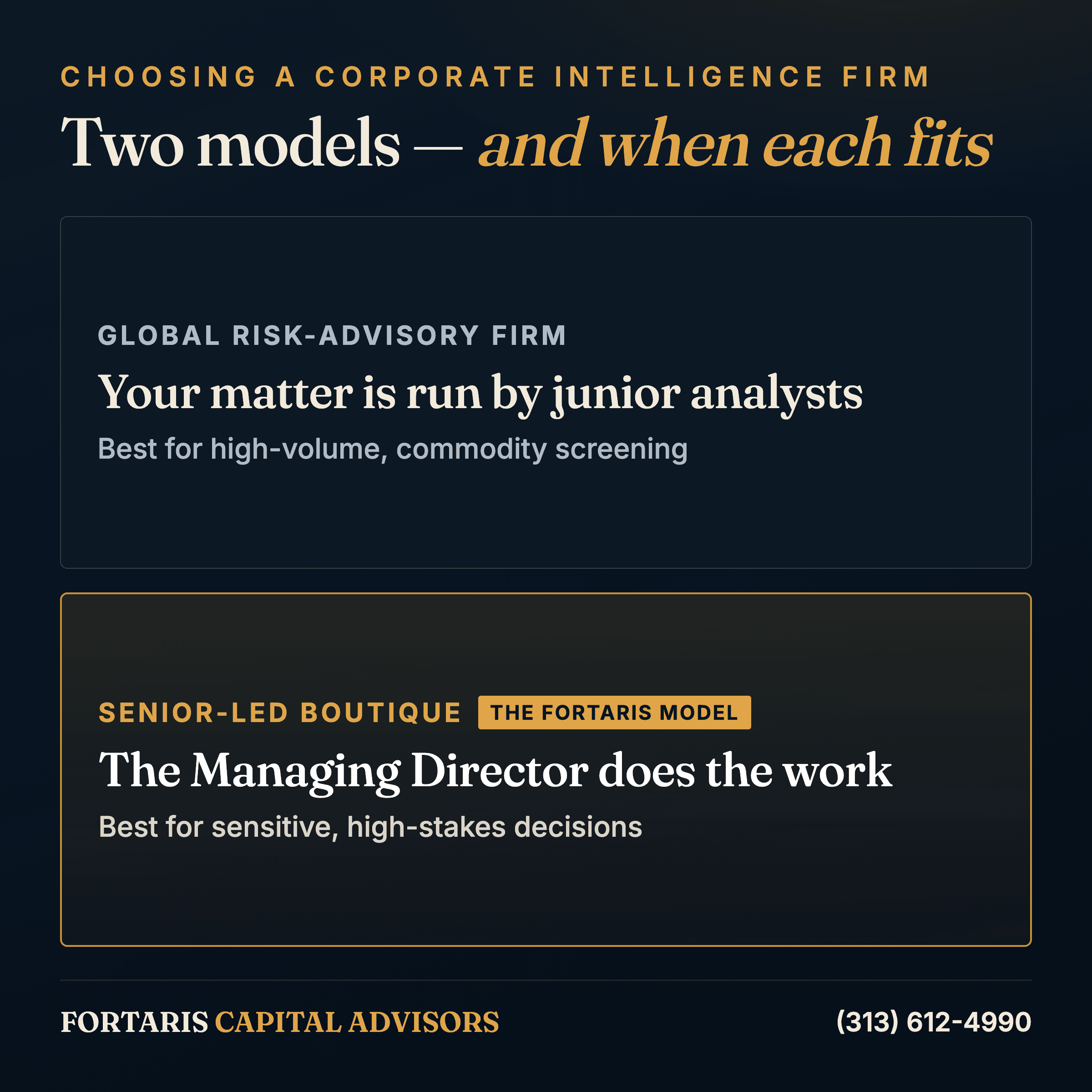
There is no single "top" corporate intelligence firm in the United States, because the market is not one market. It divides into two models. At one end are the large global risk-advisory firms — broad service menus, international offices, and recognizable brands, where a specific engagement is often staffed and run by junior analysts under a partner's name. At the other are senior-led boutiques, where the person who scopes the matter is the person who conducts it, discretion is structural rather than promised, and the work is built around direct principal-to-principal trust. The full selection method — the market's tiers, the conflict questions, and the five questions to ask any candidate — is set out in our guide to choosing a corporate intelligence firm.
Which model fits depends on the matter. Commodity screening at volume favors scale. A sensitive, high-stakes inquiry — where judgment, confidentiality, and the seniority of the people doing the work decide the outcome — favors the boutique. Fortaris Capital Advisors operates deliberately in the second model: engagements are led at the Managing Director level, grounded in federal investigative and forensic-accounting experience, and run with the discretion and cross-border reach that sensitive corporate intelligence demands. The senior person you meet is the senior person who does the work.
Key takeaways
- Corporate intelligence services independently verify the people, ownership, history, and reputation behind a company to support a specific high-stakes decision — they are decision-support, not data retrieval.
- The core buyers are private equity, law firms, family offices, corporations, and insurers, and they commission the work at moments of consequence, when relying on an unverified counterparty is expensive.
- It differs from a background check in depth and purpose: a background check confirms records on a person; corporate intelligence reconstructs and analyzes the full risk picture around an entity and its principals.
- The US market splits into large global risk-advisory firms and senior-led boutiques; the right choice depends on whether the matter rewards scale or seniority, discretion, and judgment.
- Reputable findings are confidential, sourced, and built to withstand later scrutiny by a board, a regulator, or a court.
Frequently asked
10 questionsWhat are corporate intelligence services?
Corporate intelligence services are the professional gathering, verification, and analysis of information about companies and the people behind them — ownership, background, litigation, regulatory standing, reputation, and risk — to support a specific decision. Rather than simply retrieving records, the work reconciles what a counterparty represents against independent sources and delivers a reasoned, sourced assessment a board or deal team can rely on.
How is corporate intelligence different from a background check?
A background check confirms discrete facts about an individual — identity, criminal record, employment, credentials — usually against a defined set of databases. Corporate intelligence is broader and analytical: it maps entities and ownership chains, reconstructs business history, tests reputation and source of wealth, screens for sanctions and litigation, and interprets what the findings mean for the decision at hand. A background check answers "does this record exist?"; corporate intelligence answers "who is this really, and what is the risk?"
How does corporate intelligence differ from investigative due diligence?
The two overlap heavily and are often the same work under different names. Corporate intelligence is the broad discipline of gathering and analyzing information on companies and people; investigative due diligence is that discipline applied to a specific transaction or counterparty — for example, the enhanced due diligence a buyer runs before an acquisition. Put simply, investigative due diligence is corporate intelligence in service of a deal decision.
Who uses corporate intelligence services?
The principal users are private equity and M&A buyers vetting targets and management, law firms running litigation intelligence and asset tracing, family offices assessing investments and sensitive matters, corporations screening partners and senior hires and meeting anti-corruption obligations, and insurers evaluating the integrity of insureds and claims. What they share is a consequential decision that depends on someone they cannot fully verify on their own.
What does a corporate intelligence engagement typically include?
A typical engagement verifies the legal entity and its beneficial ownership; reconstructs the backgrounds and track records of key principals; searches federal and state litigation, judgments, and liens; confirms regulatory and licensing standing; screens the parties against OFAC and global sanctions and watchlists; and conducts a reputational and adverse-media review. Higher-stakes matters add discreet human-source inquiry and on-the-ground corroboration. The engagement is scoped to the decision and delivered as a sourced findings report.
Who are the leading corporate intelligence firms in the United States?
There is no single leader, because the market divides into two models. Large global risk-advisory firms offer scale, international coverage, and broad service menus, but a given matter is often run by junior staff under a senior name. Senior-led boutiques offer direct principal attention, structural discretion, and continuity — the person who scopes the work conducts it. For sensitive, high-stakes matters where judgment and confidentiality decide the outcome, a Managing-Director-led boutique with federal investigative and forensic-accounting pedigree and cross-border reach — the model Fortaris Capital Advisors operates — is often the better fit than volume-driven scale.
How much do corporate intelligence services cost?
Cost scales with scope, jurisdictions, and depth. A focused, single-jurisdiction background and litigation review is a modest fixed fee; a full enhanced-due-diligence investigation across multiple jurisdictions with human-source corroboration is a larger project-based engagement. Reputable firms scope and price the work to the specific decision rather than quoting a one-size figure, so the cost is proportionate to what is at stake in the transaction or dispute.
Are the findings confidential?
Yes. Confidentiality is fundamental to the discipline. Engagements are conducted discreetly, the existence of the inquiry is protected, and findings are shared only with the client and those the client authorizes. Where the work is commissioned through counsel, it may also be structured to fall within attorney work-product or privilege. A firm's ability to work without alerting the subject or the market is often as important as what it finds.
Can I rely on the findings for a board, regulator, or court?
Reputable corporate intelligence is produced to a defensible standard: every material conclusion is sourced, methods are lawful and documented, and gaps are disclosed rather than papered over. That makes the findings suitable to support a board or investment-committee decision, to evidence the anti-bribery and sanctions diligence regulators expect, and — in litigation-support matters — to underpin filings and testimony. The evidentiary discipline is what separates professional intelligence from an unverifiable database dump.
How long does a corporate intelligence engagement take?
It depends on scope and geography. A focused domestic review can be completed in a few business days to two weeks; a complex or cross-border investigation involving multiple jurisdictions, foreign-language records, and human-source corroboration takes several weeks. Well-run engagements deliver an early read on the most decision-critical questions first, so a client is not waiting on the full report to learn whether there is a serious problem.
Sources & further reading
- 01ACFE Report to the NationsThe Association of Certified Fraud Examiners' biennial global study on occupational fraud, including the outsized losses caused by owner and executive schemes that integrity-focused intelligence is designed to surface.
- 02U.S. Treasury, Office of Foreign Assets Control (OFAC)Administers US sanctions programs and publishes the SDN List; screening the parties and their ownership chains against OFAC lists is a standard element of a corporate intelligence engagement.
- 03U.S. Courts PACER and SEC EDGARPACER provides public access to federal civil, criminal, and bankruptcy dockets; EDGAR provides public-company registration and disclosure filings — core public-record sources for verifying an entity's history.
- 04FinCEN — Corporate Transparency Act beneficial ownership regimeEstablishes a federal beneficial-ownership reporting framework administered by FinCEN; access is restricted, so establishing ultimate ownership in practice still relies on combined records and investigation.