

The short answer
Choosing a due diligence company starts with naming which diligence you need: financial, legal, commercial, or investigative. They are different professions sold under one phrase. Then test the shortlist on scope definition, who performs the work, sourcing standards, conflicts, and what the written deliverable will actually say — and confirm each answer in the engagement letter before signing.
Four professions, one phrase
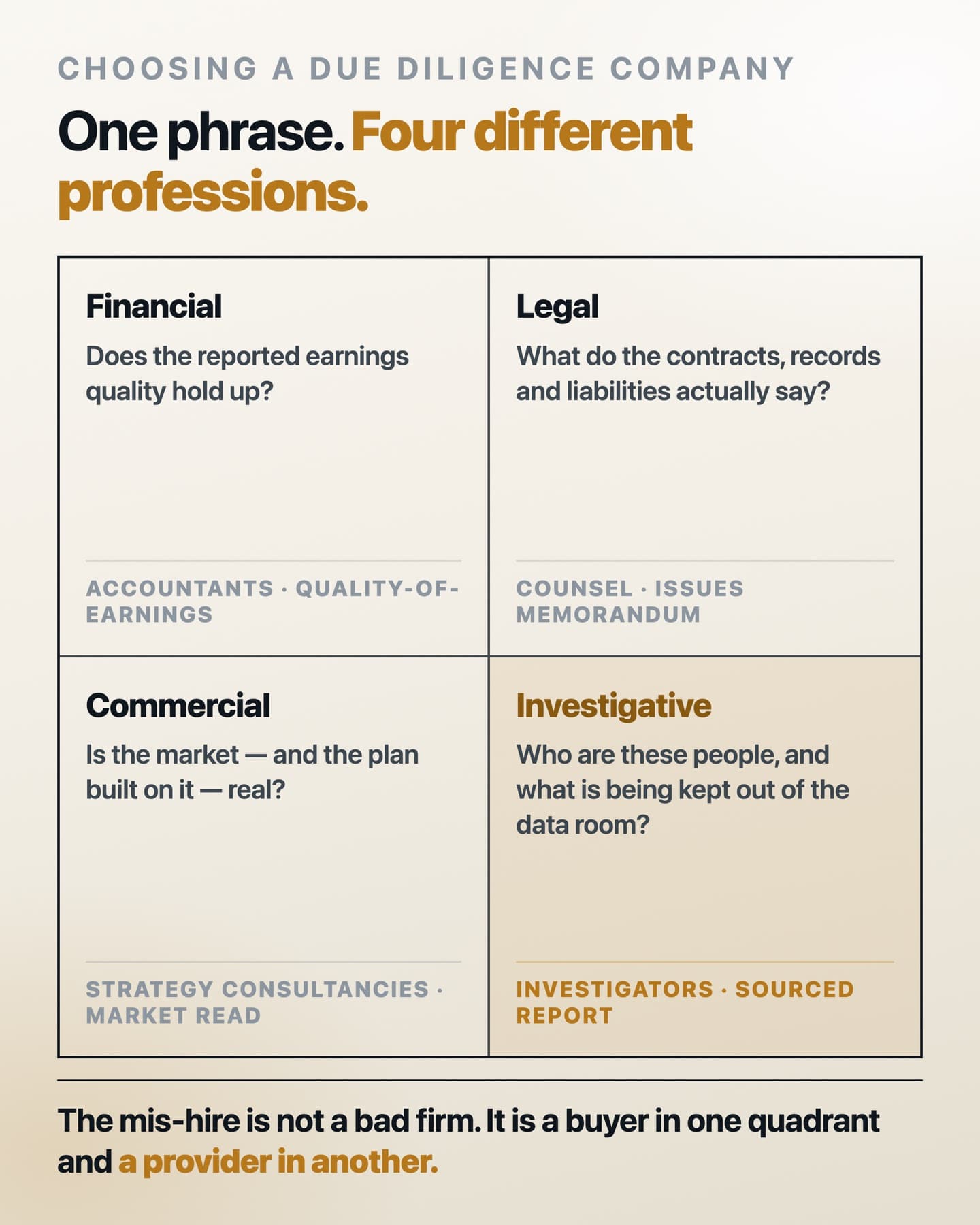
The most expensive mistake in this market is made before a provider is chosen. A buyer says "we need due diligence" and the provider on the other end of the call hears one of four different things — and because all four are sold under the same two words, nobody notices the mismatch until the report lands and answers a question the buyer was not asking.
These are not competing approaches to one discipline. They are separate professions with separate evidence bases, separate practitioners and separate deliverables. A quality-of-earnings analysis and a management background investigation are no more interchangeable than an audit and a survey. Both are legitimate; only one of them will tell you whether the CFO has a judgment against him in a county the databases do not index.
This is also why search results for the phrase look so incoherent. A single page of results will put a global strategy consultancy beside a sanctions-screening data vendor beside a boutique investigative firm, and present them as a ranked list of the same thing. They are not substitutes for one another, and no ranking can be meaningful until you have decided which of the four you are buying. If the answer is the fourth, investigative due diligence is the discipline you are actually shopping for.
- Financial due diligence — does the reported earnings quality hold up? Performed by accountants, usually as an agreed-upon-procedures engagement. Deliverable: a quality-of-earnings analysis and working-capital read.
- Legal due diligence — what do the contracts, corporate records, IP and liabilities actually say? Performed by counsel. Deliverable: a legal issues memorandum tied to representations and warranties.
- Commercial due diligence — is the market and the plan real? Performed by strategy consultancies. Deliverable: a market, customer and competitive assessment.
- Investigative due diligence — who are these people, and is anything material being kept out of the data room? Performed by investigators and corporate intelligence firms. Deliverable: a sourced factual report on entities, principals, litigation, regulatory exposure and reputation.
How the provider market is actually shaped
Once you know which discipline you need, the provider landscape resolves into four tiers that are genuinely different businesses, not four price points for the same service.
At the top sit the global brands — the large accounting networks and the international risk consultancies. They offer breadth, a name that satisfies an investment committee, and coverage in most jurisdictions. The trade-off is structural: work is leveraged down to junior teams, the senior people who won the engagement are rarely the ones performing it, and conflicts across a firm with thousands of clients are a real constraint on who they can act against.
Below them are mid-market specialist firms, usually deep in one or two disciplines and senior-led, where the person you meet is the person who does the work. Then the data and screening vendors, who sell access to databases and continuous monitoring rather than judgment — an important distinction, and the same one that separates a screening platform from a vendor investigation. Finally, individual investigators and regional licensed firms, often excellent inside their own state and thin the moment a subject or an asset crosses a border.
A word about the roundup pages. Searching this category returns a great many articles titled some variant of "the top due diligence companies", and it is worth knowing what most of them are: content marketing, listing firms by profile rather than by any tested criterion, frequently published by a company that appears in its own ranking. They are a reasonable way to assemble a longlist of names. They are not evidence about any of them. The firm-level tests — independence, seniority, first-hand jurisdictional knowledge — are the subject of the companion piece on how to choose a corporate intelligence firm; what follows here is the engagement itself.
Define the scope before you shop
The single highest-return thing a buyer can do is write the scope before speaking to providers. Ask a provider to define your scope and they will define it in the shape of what they sell — not dishonestly, but inevitably. The screening vendor's version of your problem involves a lot of screening.
A usable scope fits on one page and answers five questions. What decision does this support — an acquisition, a hire, a credit line, a lawsuit, a partnership? On what date is that decision made? What findings would actually change it? Which jurisdictions are genuinely in play, for both the entities and the individuals? And which subjects are named — because a scope written around a company name, when the risk sits with two of its shareholders, is a scope that will come back clean and useless.
For deal work, the transaction-specific version of this exercise is set out in the enhanced due diligence checklist; where the subjects are principals rather than entities, the individual-level scope is closer to source of wealth and source of funds verification.
Then apply the test that removes most wasted spend. For every workstream on the list, ask what you would do differently under each possible outcome. If a positive finding and a negative finding lead to the same decision, that workstream is decoration — it will lengthen the report, raise the fee, and change nothing. Cut it and put the money into the jurisdictions and the people where the answer would actually move you.
The questions to ask before you sign
Every question below is chosen because the answer is difficult to fake and predicts the quality of the eventual report. Ask them on a call, not by email, and listen for specificity rather than reassurance.
- Who will actually perform this work, and what is their background? You want a named individual and a real seniority level, not the credentials of the partner on the pitch. The gap between who sells the work and who does it is the single largest driver of disappointment in this market.
- What proportion of this is desk research, and what proportion is primary source work? Both are legitimate. A firm that cannot separate them in its own answer is unlikely to separate them in the report.
- Which of these jurisdictions do you cover first-hand, and which through correspondents? Correspondent networks are normal and necessary. Undisclosed correspondent work sold as in-house capability is not.
- How does the report distinguish an established fact from an allegation? This is the question that separates a professional product from a search-results dump. The good answer describes a stated sourcing and confidence convention; the bad answer is that everything in the report is verified.
- Will you tell me what you could not establish? A report with no negative space is a report that has stopped looking. The absence of a finding and the inability to reach a source are different things, and only one of them is reassuring.
- What is your conflict check process, and will you run it against the counterparty as well as against us? Independence is worth nothing unchecked. Ask for the representation in writing.
- What is the lawful basis for what you are collecting, and does any part of this constitute a consumer report? Where an inquiry into an individual is used for employment, credit or insurance purposes, the Fair Credit Reporting Act applies and brings notice, consent and dispute obligations with it. Corporate transactional diligence usually sits outside that regime — but the boundary is a legal one, and a provider who has never considered it is telling you something.
- Who owns the work product, and may it be shared with a lender, a co-investor or the board? Decide this before the report exists, not when someone asks for a copy.
- What happens if you find something serious mid-engagement? You want a defined escalation path and a named contact, not a discovery that waited three weeks for the scheduled delivery date.
- What does the fee include, and what specifically triggers a change order? Ask for the two or three most common reasons scope expands on engagements like yours. A candid answer here is one of the better proxies for how the firm behaves generally.
What belongs in the engagement letter
Verbal answers are worth what they cost. Everything that matters should appear in the engagement letter, and a provider's willingness to write it down is itself a test — the questions above are cheap to answer well on a call and expensive to answer falsely in a contract.
The scope should be specific rather than categorical: named subject entities and named individuals, the jurisdictions to be searched, and the record classes to be covered. "Comprehensive background research" is not a scope; it is an invitation to disagree later about what was promised. The deliverable should be described — written report, its approximate length, whether an oral read-out precedes it, and whether an interim read is available before the final version.
Then the terms that are easy to omit and painful to lack: the sourcing convention the report will follow; a conflicts representation covering both sides; a data protection and lawful-purpose statement; the fee basis with named change-order triggers; confidentiality and work-product ownership; and the retention and destruction schedule for the underlying material.
One structural point deserves its own decision. Where a matter is reasonably likely to end in litigation, engaging the investigator through counsel rather than directly can preserve privilege over the work product in a way that a direct engagement may not — a choice that has to be made at the outset, because it cannot be applied retrospectively. The same logic governs pre-litigation due diligence, where the investigative work exists precisely to inform a filing decision.
How to read a sample report
Ask every shortlisted provider for a sanitized specimen report. Most will supply one; a firm that will not is worth asking why. Then read it as a buyer rather than as a reader, looking for five things.
Does every material assertion carry a source, and can you tell from the page whether that source is a court record, a registry filing, a media report or a human interview? Is there a stated confidence level, or at minimum a visible difference in language between what is established and what is reported? Is there an explicit section covering what could not be established or verified? Does the executive summary state a conclusion a decision-maker can act on, or does it merely summarise the sections below it? And is the length proportionate to the signal — a hundred pages of database output is a common way to disguise the absence of judgment.
The same reading test applies to any specialist product a firm sells. The public version of a well-constructed answer set is visible in a piece like the reputational due diligence playbook: claims are attributed, limits are stated, and nothing is asserted that a source could not carry.
Pricing, and what actually drives it
Most credible investigative diligence is quoted as a fixed fee against a defined scope, tiered by depth, because that is the only structure a compliance or deal budget can plan around. Hourly billing is normal for open-ended matters and for work that escalates into an investigation, but for a scoped diligence report it transfers the estimating risk to the buyer. How one firm sets scope, timeline and fee in writing is shown on Fortaris's due diligence investigation services page.
Four things drive the number, and none of them is report length. The number of subjects — entities and named individuals — because each one is a separate research thread. The number of jurisdictions, because each adds a distinct set of registries, courts and languages. Whether human-source inquiry is in scope, which is the most expensive and usually the most valuable component. And speed, because compressing a three-week scope into five days means running threads in parallel rather than sequentially.
Be suspicious of pricing that looks cheap per subject. It is usually achievable only through database aggregation — running names against subscription sources and reporting the matches. That is a real service and it has its place at the screening end of a programme, as the tiering in a private equity diligence programme illustrates. It is not an investigation, and it should not be priced or presented as one.
The red flags
Some signals are reliable enough to end a conversation early.
A provider who guarantees a finding, or guarantees a clean result, is describing an outcome they cannot know in advance. A provider who will not name who performs the work is protecting a leverage model. No conflict check, or a check run only against your side, means independence has not been tested. Pricing by page count or by number of database records rewards volume over judgment, and you will receive volume.
Then the subtler ones: a firm that cannot describe what it failed to establish on a past matter; a specimen report with no visible sourcing; subcontracting that only emerges in the fine print; and scope recommendations that cannot be tied back to a decision you actually have to make. None of these is proof of a bad firm. Each is a question that deserves a straight answer before money changes hands.
Key takeaways
- "Due diligence" covers four separate professions — financial, legal, commercial and investigative. Naming which one you need is the decision that determines whether the engagement can succeed at all.
- Write the scope before you speak to providers. A provider asked to define your scope will define it in the shape of what they sell.
- Apply the so-what test to every workstream: if a positive and a negative finding lead to the same decision, the workstream is decoration.
- The gap between who sells the work and who performs it is the largest single driver of disappointing reports — ask for the named individual and their seniority, and put it in the engagement letter.
- Where a matter may end in litigation, engaging the investigator through counsel can preserve privilege over the work product. That choice has to be made at the outset; it cannot be applied retrospectively.
Frequently asked
10 questionsWhat is a due diligence company?
A firm engaged to independently verify facts about a counterparty before a decision is committed. The phrase covers four distinct services: financial due diligence (quality of earnings, performed by accountants), legal due diligence (contracts and liabilities, performed by counsel), commercial due diligence (market and plan, performed by strategy consultancies) and investigative due diligence (ownership, principals, litigation, regulatory exposure and reputation, performed by investigators and corporate intelligence firms).
What is the difference between a due diligence company and a background screening company?
Screening companies run names against databases and watchlists at volume, on a standardised product, and where the purpose is employment, credit or insurance they operate under the Fair Credit Reporting Act with its notice, consent and dispute obligations. Investigative due diligence firms establish facts about a specific subject for a specific decision, using registries, courts, regulatory records and human sources, and produce a written report with judgment in it. Screening answers a matching question; diligence answers an identity and conduct question.
How do I choose between a global firm and a boutique?
Test three things rather than size. Who performs the work — global firms leverage work down to junior teams, so the seniority that won the engagement may not appear in it. Conflicts — a firm with thousands of clients has real constraints on who it can act against, and a boutique often does not. And first-hand jurisdictional coverage — ask which countries are covered in-house and which through correspondents. Choose the global firm for genuine multi-jurisdictional breadth and committee comfort; choose the boutique for senior-led execution on a defined problem.
What should a due diligence engagement letter contain?
Named subject entities and individuals, the jurisdictions and record classes to be searched, the deliverable format and whether an interim read is available, the sourcing convention the report will follow, a conflicts representation covering both sides, a data protection and lawful-purpose statement, the fee basis with named change-order triggers, confidentiality and work-product ownership, and the retention and destruction schedule. Categorical language such as "comprehensive background research" is not a scope.
How much does due diligence cost?
Investigative diligence is normally a fixed fee against a defined scope, tiered by depth. The cost drivers are the number of subjects (each entity and named individual is a separate research thread), the number of jurisdictions, whether discreet human-source inquiry is in scope, and speed. Report length is not a driver. Pricing that looks unusually cheap per subject generally indicates database aggregation rather than investigation.
How long does due diligence take?
A records-level verification on a domestic subject typically closes within days. Fuller investigative diligence usually runs one to three weeks, and longer where foreign registries, foreign courts or site verification are involved, because those sources answer on their own timetable. Where the decision cannot wait, competent firms phase the work so an early read is available while deeper threads continue in parallel.
Should I engage a due diligence firm directly or through counsel?
Directly is normal for ordinary commercial diligence. Where the matter is reasonably likely to end in litigation or a regulatory process, engaging the investigator through counsel can preserve privilege over the work product in a way a direct engagement may not. The decision has to be made before the work starts, because the structure cannot be applied retrospectively — which is why it belongs in the first conversation rather than the last.
What questions should I ask before signing?
Who will actually perform the work and at what seniority; the split between desk research and primary source work; which jurisdictions are covered first-hand versus through correspondents; how the report distinguishes established fact from allegation; whether the firm will report what it could not establish; the conflict check process and whether it runs against both sides; the lawful basis for collection and whether any part is a consumer report; who owns the work product; the escalation path for a serious mid-engagement finding; and what specifically triggers a change order.
How do I evaluate a sample due diligence report?
Check whether every material assertion carries an identifiable source and whether you can tell a court record from a media report from an interview; whether established facts are linguistically distinguished from allegations; whether there is an explicit section on what could not be established; whether the executive summary states an actionable conclusion rather than summarising the sections; and whether the length is proportionate to the signal. Volume is the usual disguise for absent judgment.
What are the warning signs of a weak due diligence provider?
A guaranteed finding or a guaranteed clean result; refusal to name who performs the work; no conflict check, or one run only against your side; pricing by page count or database record; an inability to describe what a past engagement failed to establish; a specimen report with no visible sourcing; subcontracting disclosed only in the fine print; and scope recommendations that cannot be tied to a decision you actually have to make.
Sources & further reading (6)
- 01DOJ and SEC — A Resource Guide to the U.S. Foreign Corrupt Practices ActTreats documented, risk-based third-party due diligence as a hallmark of an effective compliance program, and declines to prescribe a checklist — which is why scope has to be argued from the decision rather than bought off a menu.
- 02U.S. Department of Justice, Criminal Division — Evaluation of Corporate Compliance ProgramsAsks whether a company understands the business rationale for engaging a third party and whether its diligence is risk-based, documented and refreshed. The same three tests work as a buyer's checklist for its own diligence provider.
- 03Fair Credit Reporting Act, 15 U.S.C. § 1681Defines the consumer report and its permissible purposes. Where an inquiry into an individual is used for employment, credit or insurance decisions it falls inside this regime with notice, consent and dispute obligations attached; most corporate transactional diligence sits outside it. The boundary is legal, not stylistic.
- 04FinCEN — Customer Due Diligence Requirements for Financial Institutions, 31 CFR 1010.230Sets the beneficial-ownership identification standard for covered institutions — a 25% equity prong plus a control prong — which is the benchmark most commercial diligence scopes borrow when defining who counts as an owner.
- 05OFAC — Revised Guidance on Entities Owned by Blocked Persons (the 50 Percent Rule)Property of an entity owned 50% or more in the aggregate by blocked persons is itself blocked even where the entity is not named on the SDN List — an exposure that name-matching against a list cannot detect, and a reason scope must reach ownership rather than names.
- 06ACFE — Report to the NationsThe global occupational-fraud study consistently finds tips the leading detection channel, ahead of audit and automated controls — the empirical case for scoping human-source inquiry rather than treating diligence as a records exercise.