

The short answer
Enhanced due diligence before an acquisition is the deeper, investigative layer of pre-deal vetting that goes beyond financial and legal review to test the integrity, ownership, history, and reputation of the target and its principals. It verifies management background, beneficial ownership, litigation and regulatory exposure, sanctions and corruption risk, and source of wealth — surfacing the deal-changing facts a data room does not contain.
What "Enhanced" Due Diligence Actually Adds
Most acquisitions are diligenced along two well-worn tracks. Financial diligence asks whether the numbers are real and sustainable. Legal diligence asks whether the contracts, title, and corporate housekeeping are sound. Both are essential, and both work almost entirely from material the seller chooses to place in the data room. Enhanced due diligence asks the question those two tracks are not designed to answer: are the people and the company behind this deal who they claim to be, and is there anything in their history, ownership, or conduct that should change the price, the structure, or the decision to proceed at all.
This is the investigative layer, and it is adversarial by design. It does not accept the seller's representations at face value; it tests them against independent sources — court records, regulatory filings, corporate registries across jurisdictions, sanctions and watchlists, media, and discreet human inquiry. The distinction matters because the facts that most often derail a transaction after closing are precisely the ones a motivated seller has an incentive to keep out of the data room: undisclosed litigation, a principal's prior business failure or regulatory sanction, opaque beneficial ownership, or a source of wealth that does not withstand scrutiny. Enhanced due diligence is simply investigative due diligence — one application of corporate intelligence — applied with the rigor an acquisition warrants.
The case for it is economic, not academic. The Association of Certified Fraud Examiners' Report to the Nations has consistently found that occupational fraud schemes run for a meaningful period before they are detected and that the median scheme causes substantial loss, much of which is never recovered. In an acquisition, you are not just buying a balance sheet; you are buying a management team, a litigation history, a compliance culture, and an ownership chain. Verifying all four before you sign is the cheapest insurance available on the deal — and where the buyer is a fund, the management half of that verification is set out in investigative due diligence for private equity. The same logic applies one tier down, to the suppliers a target depends on — that is the case for vendor due diligence investigations.
When to Trigger Enhanced Due Diligence
Not every transaction needs the full investigative treatment, and a disciplined buyer scales the work to the risk. Enhanced due diligence earns its place the moment a deal carries one or more risk signals that standard diligence is structurally poor at catching. The presence of any single trigger is reason to widen the scope; a combination is reason to treat the integrity layer as load-bearing.
The common triggers are well understood by experienced deal teams. They tend to cluster around opacity, cross-border exposure, regulatory sensitivity, and key-person dependence — exactly the conditions under which a clean data room can coexist with a serious undisclosed problem.
- Cross-border targets, foreign owners, or operations in higher-risk jurisdictions, where records are fragmented and harder to verify
- Opaque or layered beneficial ownership — holding companies, nominees, or trusts that obscure who ultimately controls the target
- Any nexus to government contracts, licenses, or politically exposed persons, which raises corruption and sanctions exposure — noting that PEP status is a risk category calling for enhanced scrutiny, never in itself a finding against the individual
- Regulated, cash-intensive, or licensing-dependent sectors where conduct history is decisive
- Founder- or key-person-dependent businesses, where one individual's integrity and reputation effectively is the asset
- Unusually rapid growth, distressed financials, or a complex restructuring history that can mask earlier failures or disputes
- Prior litigation, regulatory inquiries, or adverse media that appear in a first-pass search and warrant being run to ground
The Buyer's Checklist: Eight Areas to Clear Before You Sign
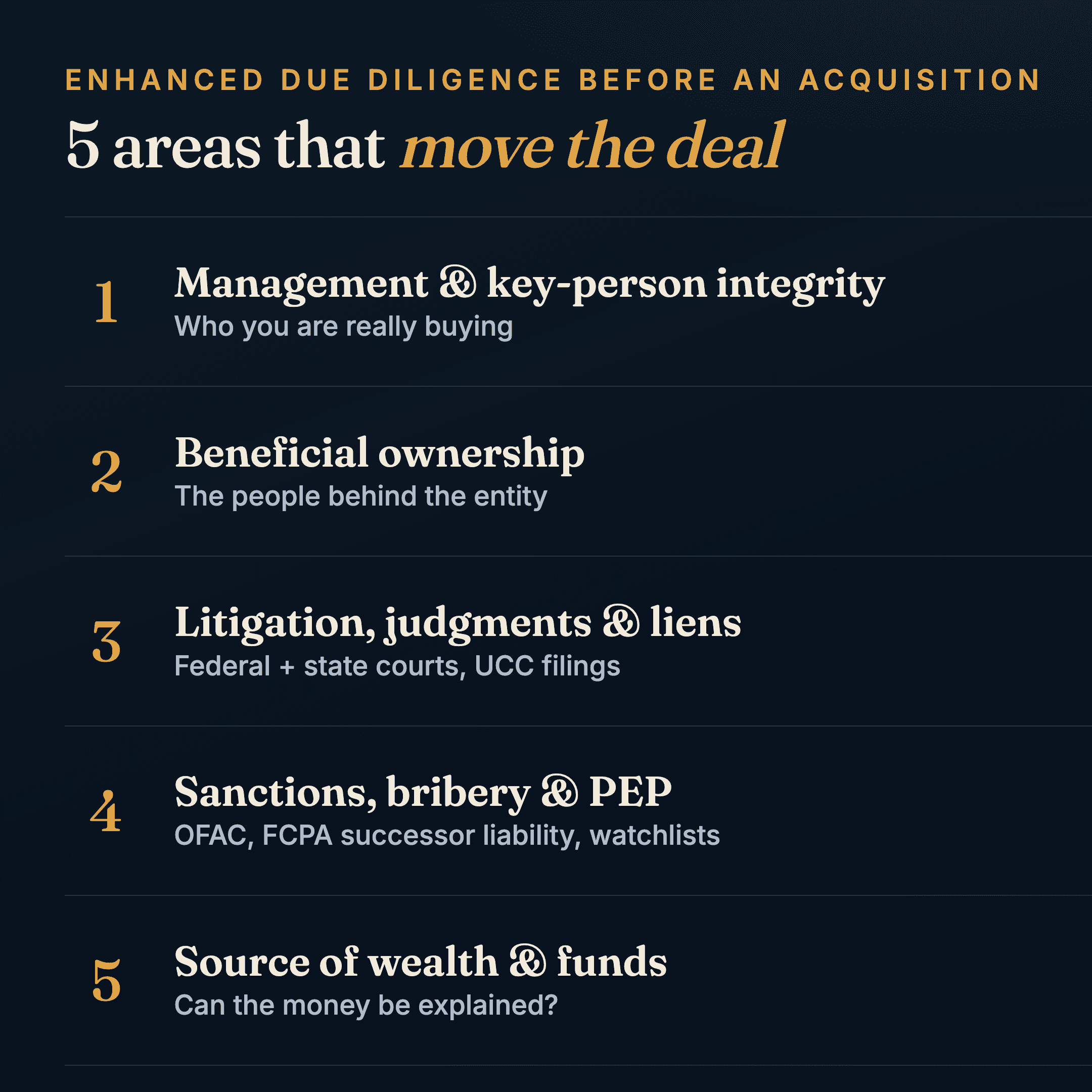
Enhanced due diligence is a sequence, not a single report. The eight areas below form the spine of a defensible pre-acquisition investigation. Each is run against independent sources and reconciled against the seller's representations; the goal is not to assemble a database printout but to close the gap between the story being told and the verifiable record, and to flag every gap that cannot be closed.
Where stakes are high, this checklist is paired with discreet on-the-ground corroboration — confirming premises, operations, and key relationships actually exist as represented. For a cross-border target, the same checklist applies, with the added discipline of independently verifying the U.S. or foreign entity itself before relying on any of its filings.
- Management and key-person integrity — verify the backgrounds, credentials, prior roles, and track record of founders, executives, and key managers; surface undisclosed prior failures, terminations, or disputes
- Beneficial ownership and corporate structure — map the entity chain to the natural persons who ultimately own and control the target, including silent or nominee interests
- Litigation, judgments, and liens — search federal and state courts, judgments, and UCC financing statements for the entity and its principals personally
- Regulatory and licensing standing — confirm required licenses are current and check for enforcement actions, consent orders, or revocations
- Sanctions, anti-bribery, and PEP exposure — screen the target, owners, and key counterparties against OFAC and global watchlists, and assess corruption and FCPA risk
- Reputational and adverse-media review — systematic media, source, and market-reputation inquiry across relevant languages and jurisdictions
- Cyber, operational, and asset reality — confirm the business operates, employs, and holds the assets it represents, and assess obvious operational and data-security red flags
- Financial-crime indicators and source of wealth — test that the principals' wealth and the company's funding have a legitimate, explicable origin
Management Integrity and Source of Wealth: The Two That Move Deals
Of the eight areas, two change outcomes more often than the rest combined: the integrity of the people you are buying, and the origin of the money behind them. Financial and legal diligence largely assume good faith on both; enhanced due diligence does not. The ACFE's research has long shown that a substantial share of occupational fraud is committed by owners and executives — the very people whose representations anchor a deal — and that these schemes, while less frequent than lower-level fraud, cause by far the largest losses. In an acquisition, that risk is not abstract; it is the counterparty across the table.
Management vetting goes well beyond a criminal record check. It reconstructs the real career history, tests claimed credentials and prior roles, and looks specifically for the patterns a polished biography is built to hide: a quietly failed prior venture, a regulatory sanction, a pattern of litigation, or a role at a company that later collapsed. This is the heart of investigative work, and it is where the decisive fact most often surfaces.
Source-of-wealth and source-of-funds analysis asks a parallel question about the money: can the principals' wealth and the company's capital be explained by a legitimate, documented history. Where it cannot — where funding traces to opaque offshore vehicles, unexplained inflows, or counterparties that do not survive screening — the buyer is looking at money-laundering, sanctions, or fraud exposure that will not stay the seller's problem after closing.
Sanctions, Corruption, and the Successor-Liability Trap
There is a feature of acquisitions that makes enhanced due diligence on integrity issues categorically more important than it is in an arm's-length contract: in a stock acquisition, the buyer generally inherits the target's liabilities, including its past misconduct. United States enforcement authorities apply successor liability in precisely this way. The Department of Justice's long-standing guidance on the Foreign Corrupt Practices Act makes clear that an acquirer can inherit FCPA exposure for a target's pre-closing bribery, which is why pre-acquisition anti-corruption diligence — and prompt post-closing remediation — is treated as a mitigating factor when problems are found and disclosed.
Sanctions exposure transfers the same way, and the screening must follow ownership rather than names alone. Under OFAC's framework, an entity owned 50 percent or more, directly or indirectly, by one or more blocked persons is itself treated as blocked even if it is not named on any list — the 50 Percent Rule. A buyer who screens only the named target, and not the beneficial-ownership chain behind it, can acquire a sanctions problem that no representation in the purchase agreement will cure. Because US sanctions liability is generally strict, intent is not a defense, and the penalties are severe.
The practical conclusion is that beneficial ownership (area two of the checklist) and sanctions and corruption screening (area five) are not separate exercises. They are the same inquiry run from two directions, and in an acquisition they protect the buyer from inheriting the seller's worst, least-visible liabilities.
Fitting Enhanced Due Diligence Into the Deal Timeline
The most common mistake is treating the investigative layer as a confirmatory afterthought, run in the final days before signing when there is no time left to act on what it finds. Done well, enhanced due diligence is staged across the deal. A focused early pass — management integrity, ownership, sanctions, and a first reputational sweep — belongs before the letter of intent or before exclusivity, while the buyer still has leverage and the option to walk. The fuller investigation then runs in parallel with financial and legal confirmatory diligence, not after it.
The deal calendar usually allows for this. Larger US transactions are subject to a statutory premerger notification and waiting period under the Hart-Scott-Rodino Act — commonly thirty days — during which the parties cannot close, and that window is well spent completing the integrity work rather than waiting idly. Cross-border targets add time, not less: fragmented foreign records, language, and local verification mean the international due diligence should start earlier, not be compressed at the end — and an overseas buyer entering the U.S. market has its mirror image to run as well.
For acquirers who run this repeatedly — corporate development teams and private equity sponsors in particular — the efficient model is a tiered playbook: a light, fast screen on every target at the indication-of-interest stage, escalating to the full eight-area checklist once a deal is real. Scaling the work to the deal keeps cost proportionate while ensuring the high-stakes transactions get the scrutiny they warrant — the approach set out in our due-diligence playbook for private equity.
Red Flags That Warrant a Pause
Enhanced due diligence rarely produces a single dramatic disqualifier. More often it surfaces a pattern of smaller signals that, taken together, change the risk picture. The findings below are the ones that most reliably justify slowing down, widening the scope, repricing, or restructuring the deal — and occasionally walking away.
- Beneficial ownership that cannot be fully established, or that resolves into nominees, shells, or opaque offshore vehicles
- A principal's undisclosed prior business failure, termination for cause, regulatory sanction, or pattern of litigation
- Source of wealth or company funding that cannot be explained by a legitimate, documented history
- Any party in the ownership or counterparty chain that surfaces on a sanctions, PEP, or watchlist screen
- A gap between the company's represented operations and what on-the-ground corroboration can confirm
- Regulatory enforcement history, lapsed required licenses, or an evasive response to direct diligence questions
- Adverse media or source intelligence that a first-pass search raises and the seller cannot satisfactorily explain
Turning the Checklist Into a Defensible Record
The output of enhanced due diligence is not a folder of raw search results; it is a reasoned, sourced assessment a deal committee, a board, a lender, or an insurer can rely on, and that will stand up later if a dispute arises. Documenting the work serves two purposes. It imposes discipline, ensuring no area of the checklist is quietly skipped under deal pressure, and it creates an evidentiary record that supports the decision and any future claim — including the pre-acquisition diligence that regulators expect to see if a problem later emerges.
Scale the documentation to the deal. A modest acquisition may warrant management, ownership, litigation, and sanctions checks with a concise findings memo. A platform investment, a cross-border acquisition, or a deal in a regulated sector warrants the full eight-area sequence with on-the-ground corroboration and a board-ready report. In every case, a gap that cannot be closed is itself a finding and belongs in the record, not in a footnote.
Fortaris Capital Advisors built its corporate intelligence and investigative due diligence practice around exactly this problem: independently testing the people, ownership, and history behind a transaction, led at the Managing Director level and grounded in federal investigative and forensic-accounting experience. Whether the work is run in-house or with a specialist, the principle is the same. Verify before you sign, document what you find, and treat every gap you cannot close as a finding in its own right.
Key takeaways
- Enhanced due diligence is the investigative integrity layer that financial and legal review do not reach — it tests the people, ownership, history, and reputation behind a target, not just its data room.
- Trigger it on risk signals: cross-border exposure, opaque beneficial ownership, government or PEP nexus, regulated or cash-intensive sectors, and key-person dependence.
- Management integrity and source of wealth are the two areas that most often change price or kill a deal; the ACFE finds owner and executive fraud is the costliest category by far.
- In an acquisition the buyer inherits the target's liabilities — FCPA successor liability and OFAC sanctions exposure transfer with the deal, so screening must follow the ownership chain, not just names.
- Start the integrity work before exclusivity, run it in parallel with confirmatory diligence, and document findings into a board-ready, defensible record.
Frequently asked
6 questionsWhat is the difference between due diligence and enhanced due diligence?
Standard due diligence — financial and legal — works largely from the material the seller provides and asks whether the numbers and contracts are sound. Enhanced due diligence is the investigative layer that independently verifies the integrity, ownership, history, and reputation of the target and its principals, testing the seller's representations against external sources rather than accepting them.
When in the deal should enhanced due diligence start?
A focused early pass — management integrity, beneficial ownership, sanctions, and a first reputational sweep — should run before the letter of intent or before exclusivity, while the buyer still has leverage to renegotiate or walk. The fuller investigation then runs in parallel with confirmatory financial and legal diligence, not compressed into the final days before signing.
Does enhanced due diligence replace financial and legal due diligence?
No. It complements them. Financial diligence tests the numbers and legal diligence tests the contracts; enhanced due diligence tests the people, ownership, and conduct that the other two tracks largely assume in good faith. The three together give a deal committee a complete picture; any one alone leaves a structural blind spot.
Can a buyer inherit the target's legal or sanctions problems?
Yes. In a stock acquisition the buyer generally inherits the target's liabilities. US authorities apply successor liability to FCPA violations, and OFAC sanctions exposure transfers with the entity — including under the 50 Percent Rule, where a company owned 50 percent or more by blocked persons is itself treated as blocked. Pre-acquisition diligence is the buyer's primary protection.
How long does enhanced due diligence take?
It scales with the deal. A focused domestic review can be completed in days to a couple of weeks; a complex or cross-border investigation with on-the-ground corroboration takes longer. The statutory premerger waiting period on larger US deals — commonly thirty days under the Hart-Scott-Rodino Act — usually provides ample room when the work is started early rather than left to the end.
How much of this can a deal team do in-house versus with a specialist?
Entity, litigation, and sanctions checks can be started from public sources by a capable deal team. A specialist becomes worthwhile when ownership is opaque, the target is cross-border, source-of-wealth or reputational questions arise, on-the-ground corroboration is needed, or the buyer requires a documented, defensible report that will withstand later scrutiny by a board, a regulator, or a court.
Sources & further reading
- 01ACFE Report to the NationsThe Association of Certified Fraud Examiners' biennial global study on occupational fraud, including median losses, scheme duration, and the outsized cost of owner and executive schemes.
- 02U.S. Department of Justice — FCPA Resource GuideDOJ and SEC guidance on the Foreign Corrupt Practices Act, including successor liability in mergers and acquisitions and the value of pre-acquisition anti-corruption due diligence.
- 03U.S. Treasury, Office of Foreign Assets Control (OFAC)Administers US sanctions programs; publishes the SDN List and guidance on the 50 Percent Rule governing sanctioned ownership chains.
- 04U.S. Federal Trade Commission — Hart-Scott-Rodino (HSR) Premerger NotificationEstablishes the premerger notification and statutory waiting period (commonly 30 days) for transactions above the reporting thresholds, during which parties cannot close.
- 05U.S. Courts PACER and SEC EDGARPACER provides public access to federal civil, criminal, and bankruptcy dockets; EDGAR provides public-company registration and disclosure filings used to corroborate a target's history.