
The short answer
Close protection services are the day-to-day work of a protective detail: advance work on every venue and route, secure movement and travel, coverage at the residence, and planning around events — all sized by a threat assessment that decides how much of it is warranted. They are engaged when a leader's exposure, a specific threat, or a high-risk trip outruns what ordinary security addresses.
Close protection, executive protection, and a bodyguard
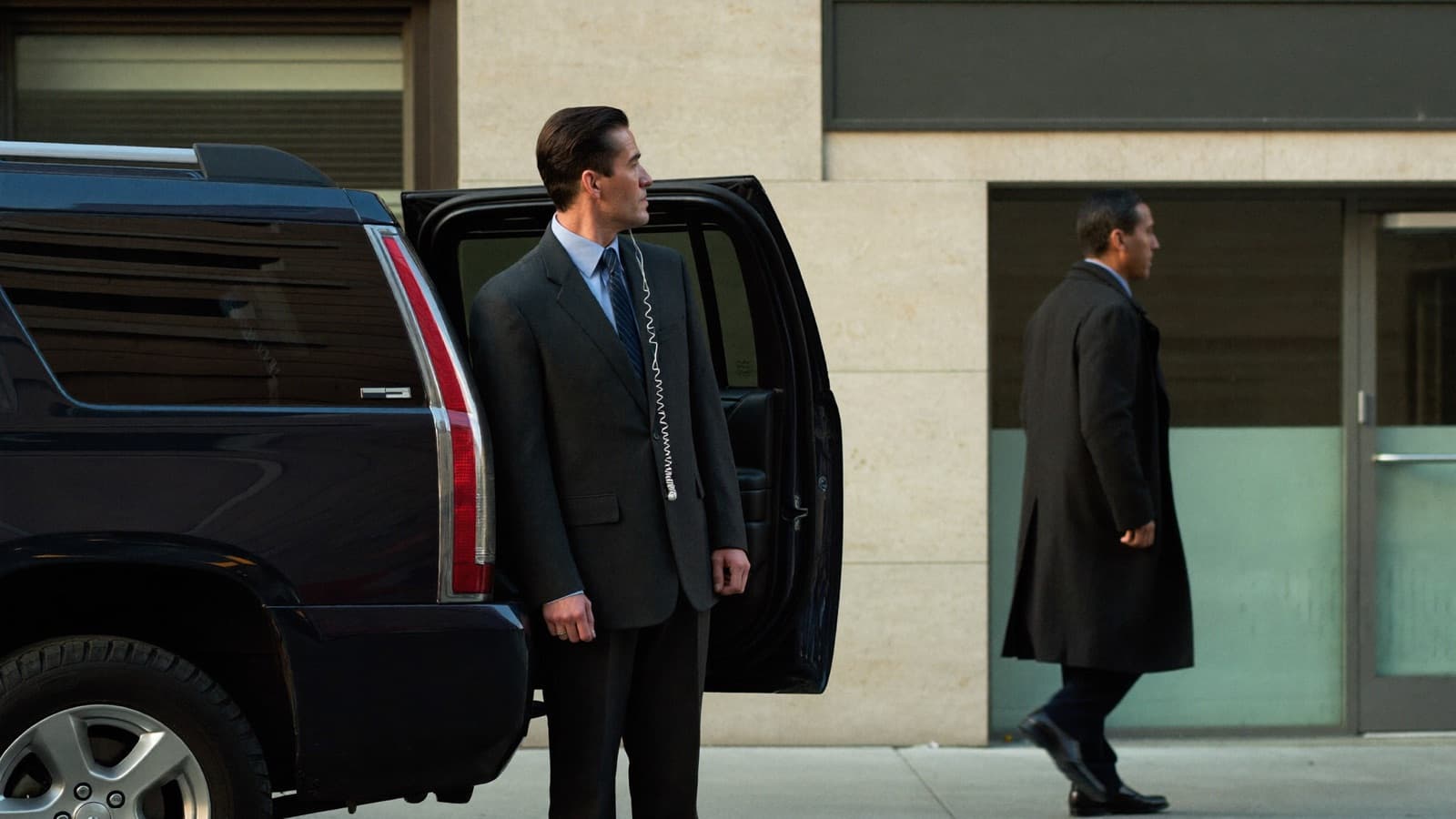
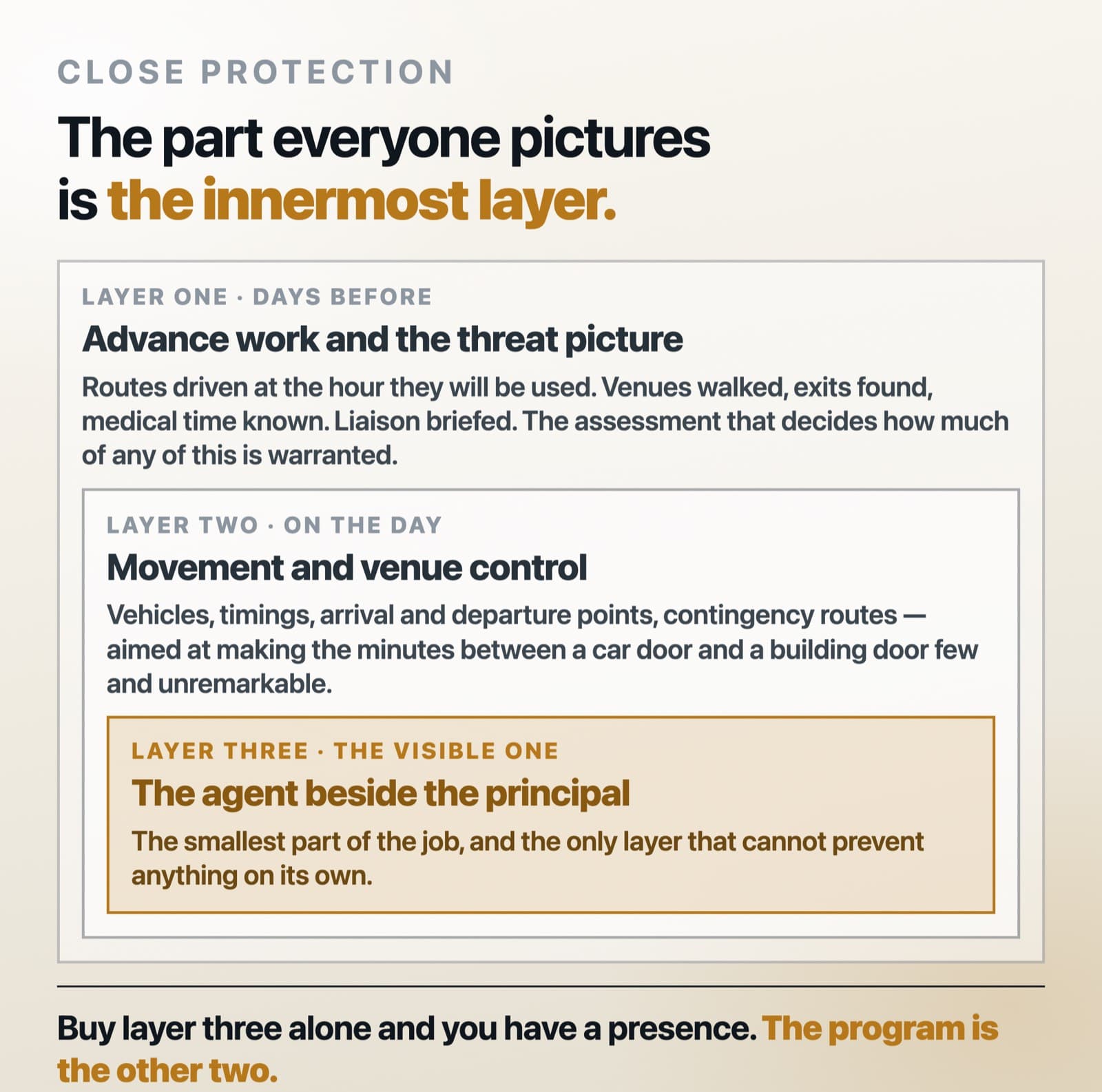
The three terms are used interchangeably in marketing and mean quite different things in practice, and the difference decides what you are actually buying. Executive protection is the program: the threat assessment, the intelligence, the planning, the logistics and the people. Close protection is the part of that program conducted in the principal's immediate proximity — the detail that travels with them, accompanies them and stands post. A bodyguard, in the sense most people picture, is somebody hired to be physically present, a word that carries no implication of assessment, planning, licensing or training. That is precisely why the industry's better operators avoid it.
A close protection detail with no program behind it is a cost without a method. It can respond to what arrives at the door, and it cannot prevent what a competent advance would have removed a week earlier. The full program — the engagement models, what a qualified agent is trained and licensed to do, and what drives the cost — is set out in executive protection for corporate leaders. This piece is about the narrower question that buyers ask second: what does the detail inside that program actually do, hour by hour, and when is it worth having one.
One framing is worth keeping throughout. A detail's success is measured in things that did not happen, which makes the work almost impossible to evidence and very easy to under-scope. That is why the assessment that sizes it matters considerably more than the number of people standing on it.
The advance: the work that happens before anyone arrives
Advance work is the largest single component of a detail's week and the one buyers most consistently fail to price. Before a principal goes anywhere that matters, somebody goes first — walks the building, drives the route, meets the people who control the doors, and comes back with a plan that has already removed most of the exposure the visit would otherwise have carried.
The point of an advance is not to produce a document. It is to convert unknowns into decisions while they are still cheap to make. Which door, at which time, with which vehicle waiting where; who holds the key to the room the principal will wait in; what happens if the elevator is out; how long it takes to reach appropriate medical care. Every one of those answers is trivial to obtain three days early and impossible to obtain in the moment.
An advance also establishes the relationships the day will run on. Building security, event organizers, venue managers and, where appropriate, local law enforcement all behave differently toward someone who introduced themselves on Tuesday than toward a stranger in a suit on Friday. Much of what looks like smooth execution on the day is simply the product of somebody having already had the conversation.
- Routes driven in both directions at the hour the movement will actually happen, with at least one alternate that does not share the same choke points
- Arrival and departure points chosen to keep the distance between vehicle door and building door as short as the site allows
- Every entrance, exit, stairwell and elevator identified, with a way out that does not depend on the way in
- The nearest appropriate medical facility identified and the travel time to it known rather than assumed
- Local liaison briefed and reachable: building security, venue staff, event organizers, and law enforcement where the situation warrants it
- Communications tested inside the actual building, because coverage in a basement garage is not coverage in a lobby
- A holding area and a contingency room agreed, so that a delay in the schedule does not turn into time spent standing in a public space
A day on a detail
No two days are alike; the structure of them is. The day is set the night before, when the movement plan is confirmed against the principal's schedule and anything that changed during the day is worked back through the advance. Schedules move constantly, and a detail that learns about a new meeting when the principal walks toward the car has already lost the advantage the plan was supposed to give it.
Morning begins before the principal does: the vehicle is checked and positioned, the route is confirmed against current conditions rather than last week's, and the first destination is reconfirmed with whoever is holding the door at the other end. The pickup itself is short and deliberately unremarkable. Between locations the detail is mostly watching the environment and the schedule at the same time, because the schedule is what creates exposure and the environment is where it lands.
At the destination, the visible part of the job begins and is, if everything upstream worked, uneventful. The agent's attention is on approach paths, on who is waiting and why, and on the departure that has not happened yet. The greater part of the effort is invisible: keeping the principal moving, keeping the gap between vehicle and door short, and keeping the detail's own presence low enough that the meeting is about the meeting.
The day ends with the part most buyers never see. What changed, what did not work, who behaved oddly, which assumption in the advance turned out to be wrong, and what tomorrow's plan now has to account for. A detail that does not close the loop in writing is running on memory, and memory is not a handover.
Secure movement: the minutes that actually matter
If a day on a detail has a sharp end, it is the transition between a vehicle and a building. That is where a principal is predictable, static, and visible, and where a principal is most exposed. Most of what a detail does about movement is aimed at making those minutes as few and as unremarkable as possible.
In practice that means routes and timings that do not repeat, arrival points that are not the ones a stranger would guess, and a vehicle that is where it is supposed to be at the moment the principal reaches the door rather than three minutes later. It also means an agreed response to the ordinary failures — a blocked entrance, a delayed departure, a crowd that was not there yesterday — decided in advance rather than improvised in front of the principal.
Pattern is the adversary. A principal who leaves the same door at the same time in the same car is doing the reconnaissance on somebody else's behalf. Breaking that pattern costs almost nothing and removes the cheapest way for anyone to plan around them, which is why a detail that never varies a routine is not really doing the job it is being paid for.
The residence, the household, and the family
Residence coverage is where close protection stops being about one person. A private home has staff, contractors, deliveries, neighbors and a family who did not ask to be protected and will not tolerate being managed. The work here is quieter and more procedural than anything that happens in a car: who has keys, who is expected, what happens when somebody arrives who is not, and how the household raises an alarm without a rehearsal it has never had.
It also reaches the family's information rather than only its perimeter. A great deal of what an adversary would need to approach a principal at home is assembled from property records, social accounts belonging to other family members, school and club affiliations, and the routine visible to anybody who watches a street for a week. That surface is the subject of security and threat assessment for family offices, and most of what it recommends changes posture rather than headcount.
The practical test of residential coverage is whether it survives being lived with. A program a family circumvents within a month because it is intrusive has made them less safe than no program at all, because everybody now believes the problem is handled.
Travel, and why abroad is a different job
Domestic movement and international movement are related disciplines rather than the same one. Abroad, almost every assumption a detail relies on has to be re-established: what protective work is licensable and by whom, whether agents may be armed and under what authority, which local partner is actually competent as opposed to well-marketed, how medical care and evacuation work, and who the principal's problem becomes if something happens at two in the morning.
The practical consequence is lead time. An advance in an unfamiliar jurisdiction is not a day's work, and a trip booked on Thursday for Monday is a trip that will be covered on assumptions. Where the regulatory and operating differences bite hardest, and how close protection abroad is normally structured, is covered in the executive protection guide alongside the rest of the program.
None of this argues against travel. It argues for deciding early which trips warrant coverage, because the trips that warrant it most are rarely the ones on the calendar longest.
The threat assessment that sizes all of it
Everything above can be bought in almost any quantity, which is exactly the problem. A detail sized by anxiety is expensive, conspicuous and usually wrong in shape; a detail sized by assessment is proportionate, explainable to a board, and far more likely to be aimed at the risk that actually exists.
Two different assessments are sold under similar names, and buying the wrong one is the most common mistake in this category. A behavioral threat assessment asks whether an identified person is moving along a path toward violence. A security risk assessment asks how exposed a person, a site or an operation currently is. A protective program usually needs both, and the distinction between them is set out in security risk and threat assessments for corporations, executives and families.
The assessment is also what makes the spend defensible. Boards are increasingly asked to justify personal security for executives as a governance matter rather than a perquisite, and "we assessed the exposure and this is the proportionate response" is an answer. "The chief executive asked for it" is not. That is one of several reasons the assessment belongs before the detail rather than after it, and it is described in full in the executive protection program Fortaris operates.
When a detail is worth engaging — and when it is not
The honest answer is that most executives, most of the time, do not need a standing close protection detail, and a firm that tells you otherwise before assessing anything is selling headcount. What changes the answer is usually a specific event, a specific person, or a specific window of exposure rather than seniority on its own.
The corollary matters as much. Episodic coverage — a detail for a trip, an event, a contested announcement, or the weeks around a termination or a verdict — is often the proportionate response where a permanent detail would be theater. Scoping it that way is not a downgrade; it is what an assessment-led program looks like when the assessment comes back moderate.
- Worth engaging: a credible, articulated threat, or an identified person of concern whose behavior is escalating
- Worth engaging: a high-visibility moment — a public announcement, a contested vote, a layoff, an activist campaign, a hostile transaction, a verdict
- Worth engaging: travel to a jurisdiction where the principal's usual assumptions about policing, medical care and local partners do not hold
- Worth engaging: a principal whose home address, routine and family are trivially assembled from public sources
- Not worth it: status, seniority, or a general sense of unease with nothing assessed behind it
- Not worth it: a detail bought as a substitute for the threat assessment that would have told you what shape the problem is
- Not worth it: a standing detail where episodic coverage around identified windows is proportionate and far more sustainable
How a detail is staffed and scoped
Scope is usually expressed in three variables rather than in a headcount: how many hours of the day are covered, how many of the principal's environments are covered, and how much advance capacity sits behind the coverage. A single agent accompanying a principal to scheduled commitments is a different engagement from a team covering residence, movement, travel and events across a rotation, and the difference is mostly the third variable rather than the first.
Roles inside a detail tend to separate along the same lines. Somebody leads it and owns the plan and the liaison. Somebody drives, which is a protective skill rather than a transport one. Somebody runs advances, often on tomorrow's movements rather than today's. On a small engagement one person may hold more than one of those roles, which is workable — but a detail where the same person is expected to run the advance and stand the post on the same day is really a detail with no advance.
The scoping conversation worth having with any provider is therefore not "how many people" but "who is doing the advance, when, and what happens to it when the schedule changes at four in the afternoon." The answer to that question separates a program from a presence faster than any credential list. The broader security practice this sits within, and how it connects to intelligence work on the people behind a threat, is described under security services and corporate intelligence.
Key takeaways
- Close protection is the proximity part of an executive protection program, not a synonym for it. Bought without the program behind it, a detail can respond to what arrives and cannot prevent what an advance would have removed.
- Advance work — routes, entrances, medical, communications, liaison, holding areas — is the largest part of a detail's week and the part buyers most consistently fail to price.
- The sharp end of any day is the transition between a vehicle and a building. Most of secure movement exists to make those minutes few, short and unpredictable.
- Residence coverage reaches the household and the family's information surface, not just the perimeter — and a program a family circumvents because it is intrusive is worse than none.
- International movement is a different job with a different lead time; a trip booked Thursday for Monday will be covered on assumptions.
- A threat assessment sizes the whole thing, and it is also what makes the spend explainable to a board. Episodic coverage around identified windows is frequently the proportionate answer.
Frequently asked
8 questionsWhat are close protection services?
Close protection services are the proximity element of a protective program: a trained detail that conducts advance work on venues and routes, moves a principal securely between locations, provides coverage at the residence and at events, and travels with them where the assessed risk warrants it. The work is planning-led rather than presence-led, and the agent standing beside the principal is its smallest and last component.
What is the difference between close protection and executive protection?
Executive protection is the whole program — threat assessment, intelligence, planning, logistics and people. Close protection is the part of that program carried out in the principal's immediate proximity. In practice the terms are used interchangeably in marketing, and the distinction matters because a close protection detail bought without the program behind it has no method for preventing anything, only for reacting to it.
What does a close protection detail actually do on a normal day?
It confirms the day's movements against the schedule and reworks anything that changed; checks and positions vehicles; confirms routes against current conditions; conducts or updates advances on the day's destinations; moves the principal with the shortest practical exposure between vehicle and door; holds position at each location while planning the departure; and closes the day with a written account of what changed and what tomorrow's plan must account for.
What is advance work, and why does it matter so much?
An advance is the reconnaissance and coordination done before a principal arrives anywhere: driving the route at the right hour, walking the venue, identifying exits and medical facilities, testing communications inside the building, and briefing whoever controls the doors. It matters because it converts unknowns into decisions while they are still cheap. Most of what looks like smooth execution on the day is simply the product of an advance done days earlier.
Does a close protection agent carry a weapon?
It depends entirely on jurisdiction, licensing and the assessed requirement, and it is one of the first questions to settle in scoping rather than an assumption to carry into an engagement. Armed status is licensable and regulated differently from state to state and country to country, and a great deal of competent protective work is unarmed. A provider who cannot state precisely what their agents are licensed to do, where, is answering the wrong question.
When is a close protection detail actually worth engaging?
Usually when something specific changes: a credible articulated threat or an identified person of concern; a high-visibility moment such as a contested announcement, layoff, activist campaign or verdict; travel to a jurisdiction where the principal's usual assumptions do not hold; or a principal whose address, routine and family are trivially assembled from public sources. Seniority on its own is not a reason, and episodic coverage is frequently the proportionate answer.
Should a threat assessment come before engaging a detail?
Yes, in almost every case. The assessment decides the shape and size of what is warranted, which is the difference between a proportionate program and an expensive one aimed at the wrong risk. It also gives a board a defensible basis for the spend. Commissioning a detail first and assessing afterward tends to produce coverage sized by anxiety rather than by exposure.
How is a close protection engagement scoped?
By hours covered, environments covered, and how much advance capacity sits behind the coverage — not by headcount. The most useful question to ask any provider is who runs the advance, when they run it, and what happens to it when the schedule changes late in the afternoon. A detail where the same person is expected to run tomorrow's advance and stand today's post is a detail without an advance.
Sources & further reading
- 01U.S. Cybersecurity and Infrastructure Security Agency (CISA)Federal guidance on preventing targeted violence and on de-escalation, including the behavioral indicators that a protective intelligence function is watching for.
- 02Federal Bureau of Investigation — behavioral threat assessment researchThe federal research base for pathway-to-violence models, which is what separates a behavioral threat assessment from a general security review.
- 03SEC, Executive Compensation Disclosure (Item 402, Regulation S-K)The framework under which personal security provided to executives of U.S. public companies is generally reported as a perquisite — the governance context that makes an assessment-led program defensible to a board.
- 04UK Security Industry Authority (SIA)The statutory regulator under which close protection is a licensable activity in the United Kingdom — a useful anchor for how differently protective work is regulated outside the United States.
- 05U.S. state private security and armed-guard licensing regimesLicensing of protective personnel, and of armed status in particular, is set state by state rather than federally, which is why scoping has to establish what a provider's agents are licensed to do in each place they will operate.