

The short answer
Executive protection is a risk-based, intelligence-led security program that safeguards a company's leaders — and often their families — from targeted threats, harassment, and violence. It ranges from a protective threat assessment and secure travel to full-time close protection, and it is engaged when a leader's visibility, a specific threat, a high-risk event, or a sensitive corporate situation elevates their personal risk beyond what ordinary security addresses.
What Executive Protection Actually Is — and Isn't
Executive protection is often pictured as a bodyguard standing behind a principal, and that image gets it almost entirely wrong. Professional executive protection is a risk-management discipline, not a show of force. Its purpose is to identify and reduce the specific threats a leader faces and to keep them safe, productive, and unbothered — ideally without anyone noticing protection is there at all. The visible agent is the smallest, last part of a much larger program built on assessment and intelligence.
The distinction matters because it changes what a buyer should expect and pay for. Muscle without intelligence protects against nothing that has not already arrived at the door. A real program works upstream: it assesses who might pose a risk and why, monitors for warning signs, plans movements and venues to remove exposure, and positions trained agents only where the assessed risk warrants them. It is closer to corporate intelligence applied to physical safety than it is to security-guard staffing.
For a corporate leader, that reframing is the whole point. The goal is not to look protected; it is to be protected while continuing to travel, speak, lead, and live normally. The best programs are the ones a principal barely feels — and that quietly prevent the situation that would have required force in the first place.
When to Engage Executive Protection
Not every executive needs protection, and a disciplined provider will say so. Executive protection earns its place when a leader's personal risk rises above the ordinary — because of who they are, what the company is doing, or a specific threat that has surfaced. The presence of any single trigger is reason to run a threat assessment; a combination is reason to treat protection as active, not theoretical.
The common triggers are well understood by corporate security and legal teams, and they tend to cluster around visibility, conflict, and transition — exactly the moments when a motivated person is most likely to act.
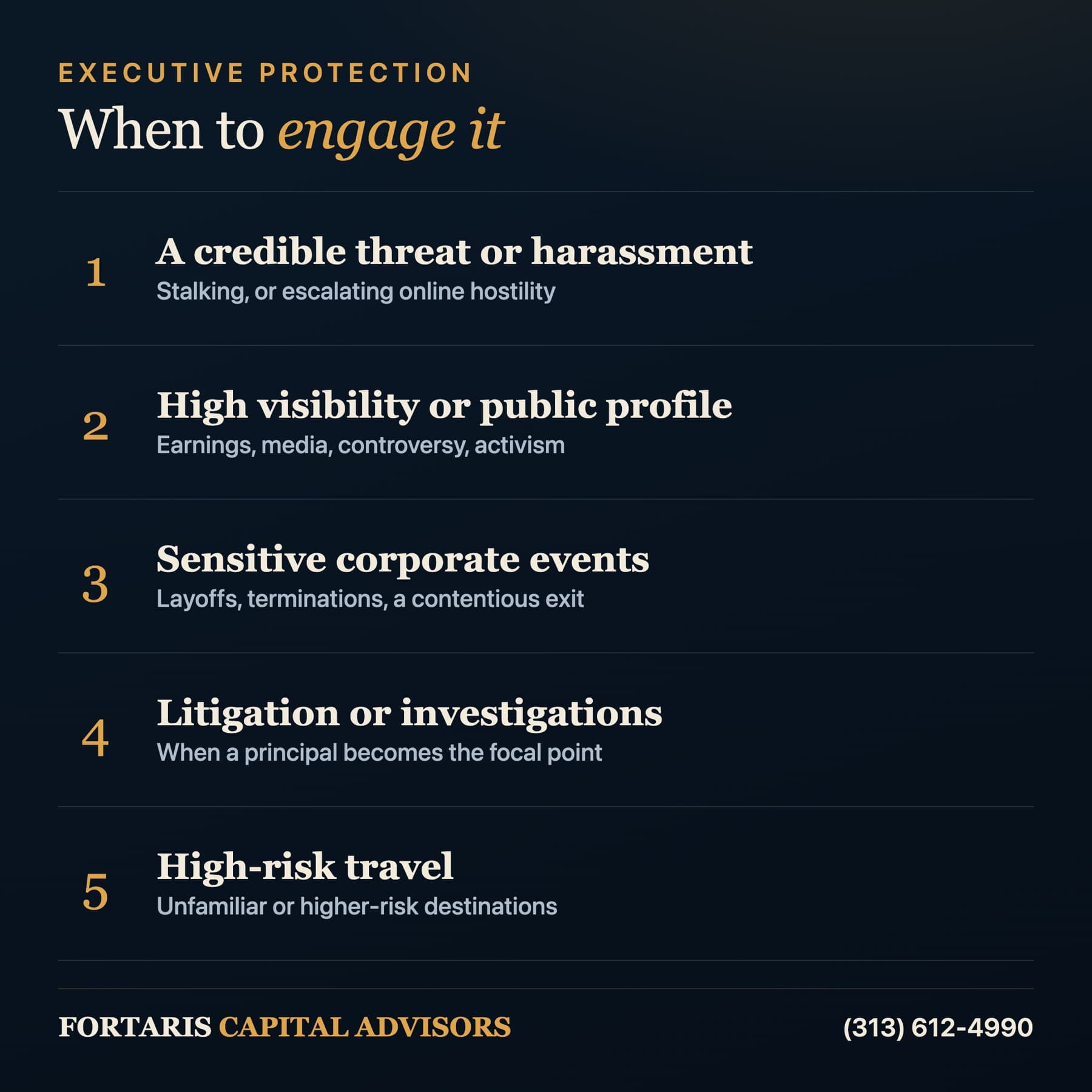
- A specific, credible threat, harassment campaign, stalking, or escalating online hostility directed at a leader or their family
- High-visibility moments — earnings, public controversy, media exposure, activism, or a leader who is himself the face of the brand
- Sensitive corporate events — layoffs, terminations, plant closures, labor disputes, or a contentious executive departure
- Litigation, regulatory action, or investigations where a principal becomes a focal point of anger or attention
- Travel to higher-risk locations, unfamiliar jurisdictions, or regions with kidnapping, unrest, or targeting risk
- Significant personal wealth, a public profile, or a family whose exposure creates its own risk
- A merger, acquisition, or activist situation that concentrates hostility on named individuals
What a Program Includes
Executive protection is scaled to the assessed risk, which is why two programs for two leaders can look nothing alike. At the light end, it may be a one-time threat assessment and a secure travel plan; at the full end, a standing detail with residential, transportation, and event coverage. The components below are the building blocks a provider draws from, adding only what the risk justifies.
The through-line is that every physical measure is driven by investigative and intelligence work, not the other way around. The assessment decides what protection is needed; the protection is never the starting point.
- Protective threat and risk assessment — the foundation that scopes everything else
- Protective intelligence — ongoing monitoring of threats, adverse actors, and online hostility, including doxxing and exposure of home addresses
- Close protection — trained, licensed agents positioned according to the assessed risk, from a single agent to a full detail
- Secure transportation — vetted drivers, route planning, and advance work to remove predictable exposure
- Residential and family security — securing the home environment and, where warranted, extending protection to family members
- Travel and event security — advance work, venue assessment, and coverage for trips, conferences, earnings, and public appearances
- Coordination with cyber and privacy — because physical and digital exposure are increasingly the same problem
Standing Detail, Travel Coverage, or Event Coverage: the Three Engagement Models
Almost every executive protection engagement resolves into one of three models, and knowing which one a situation actually calls for is most of the buying decision. A standing detail is continuous protection — an agent or team integrated into the principal's daily life across office, home, and movement. It is the right instrument for a leader with persistent, assessed exposure: an active threat case, a profile that attracts fixation, or a role that has made them a symbol as much as a person. It is also the most expensive model and the most intrusive, which is why it should follow from a threat assessment finding rather than from status.
Travel coverage is episodic: protection assembled around a specific itinerary — advance work on venues and routes, a vetted driver, local support, an agent sized to the destination's risk — and stood down when the principal is home. For most corporate leaders this is the workhorse model, because travel is where routine, ground familiarity, and control all drop at once. Event coverage is narrower still: protection built around a single high-exposure moment — an annual meeting, an earnings day in a hostile news cycle, a plant closure, a termination with a known risk attached, a public appearance after controversy. Advance work dominates; the visible presence is small and, done well, unnoticed.
The models compose. A common corporate program is a baseline of protective intelligence — monitoring, no physical presence — with travel and event coverage layered on as the calendar and the threat picture warrant, and a standing detail held in reserve as the escalation step. That architecture spends money where the exposure is and keeps the principal's daily life unencumbered, which is what most principals actually want.
Threat Assessment: the Foundation Everything Rests On
The single most important part of executive protection is the part no one sees: the threat assessment. Before an agent is ever assigned, a competent provider establishes what the actual risks are — who might pose a threat, what their capability and intent look like, where and when the principal is exposed, and which measures would meaningfully reduce that exposure. Everything downstream is calibrated to that finding.
This is where an investigative pedigree separates real executive protection from guard staffing. Assessing a threat is investigative work: identifying and researching persons of concern, evaluating a harassment or stalking pattern, monitoring adverse media and online activity, and distinguishing a genuine danger from noise. The discipline of threat assessment and management is recognized across the security profession, and bodies such as ASIS International publish standards precisely because getting it right requires method, not instinct.
The practical consequence is that a program grounded in assessment spends the client's money where it matters and nowhere else. It is also what allows a provider to scale protection up the moment a situation escalates and down the moment it resolves — because the decisions are tied to evidence, not to a fixed roster of guards.
What Executive Protection Costs
There is no single price for executive protection, and any provider who quotes one before assessing the risk is selling a product rather than protecting a person. Cost is a function of scope, and scope is a function of the threat. The honest way to think about it is in terms of what drives the number, not a headline figure.
The main cost drivers are straightforward: how many agents are required, how many hours and days of coverage, whether protection is a one-time event or a standing program, how much travel and advance work is involved, the risk level of the locations, and whether residential, family, and secure-transportation elements are added. A focused engagement — a threat assessment plus coverage for a single high-risk event or trip — sits at the entry point. A full-time detail protecting a high-profile leader and their family across work, travel, and home is a materially larger, ongoing commitment.
- Number of agents and the coverage model (single agent, shift, or full detail)
- Hours and duration — a one-time event versus a continuous program
- Travel, advance work, and the risk level of the destinations
- Added elements — secure transportation, residential security, family coverage
- Depth of protective intelligence and ongoing monitoring required
The Executive Protection Agent: What Qualified Actually Means
The phrase 'executive protection agent' covers an enormous range of competence, and the difference is not visible from a suit and an earpiece. In the United States, protective work is regulated state by state: agents and the firms that field them typically operate under state private-security or private-investigator licensing regimes, with separate endorsements required to work armed, and requirements that differ materially across jurisdictions. Licensing is the floor, not the qualification — it establishes that an agent may legally do the work, not that they are good at it.
What actually distinguishes a professional agent is training and temperament. The craft skills are teachable and testable: protective advances and route planning, surveillance detection, defensive driving, emergency medical response — the medical training is used far more often than anything defensive — and the judgment to de-escalate rather than perform. The professional infrastructure around the discipline is real: ASIS International publishes the standards and board certifications the security profession recognizes, and serious providers train against them. The temperament is harder to hire for and matters more: the best agents are low-ego, invisible in a boardroom or a school pickup line, and comfortable spending years being unnecessary so that they are present the one day they are not.
For a buyer, the practical screen is simple. Ask how agents are licensed in the states where the principal lives and travels, what their medical and driving training actually is, and who supervises the detail — and be suspicious of any answer that leads with physique or a special-forces biography rather than with assessment, advance work, and restraint.
Close Protection Abroad: the International Angle
Outside the United States the same discipline usually travels under the name close protection, and the regulatory ground shifts under it. In the United Kingdom, close protection is a licensable activity under the Security Industry Authority; across Europe, the Gulf, Latin America, and Asia, licensing, firearms law, and the practical role of local partners vary country by country. An American detail cannot simply fly with the principal and operate as it does at home — in most jurisdictions its agents have no legal authority to work, and in many they cannot be armed at all. Competent international protection is therefore a coordination exercise: a lead agent who knows the principal, local licensed providers who know the ground, and advance work that establishes routes, venues, medical options, and failure plans before wheels-down. What that advance work consists of, and how a detail's week is actually spent, is set out in close protection services: what a detail actually does day to day.
The risk picture abroad is also graded differently. The U.S. State Department's four-level travel advisories and OSAC's country reporting provide the public baseline; on top of that sits destination-specific judgment about kidnap risk, unrest, surveillance by hostile actors, and the simple operational question of how far the principal will be from competent medical care. For most business travel the finding is that no visible protection is needed — a vetted driver and a good advance are the appropriate scale. For the harder destinations, protection should arrive with the itinerary, not after the first incident.
This international layer is where executive protection connects back to the rest of a firm's cross-border capability: the same intelligence work that supports due diligence in unfamiliar jurisdictions — who the counterparties are, what the local environment actually looks like beyond the advisory level — is what makes a protective advance accurate rather than generic.
Why Boards Are Re-Examining Executive Security
For years, executive security was a quiet line item that boards approved without much analysis, and often only for the chief executive. That changed abruptly after the targeted killing of UnitedHealthcare's chief executive in Manhattan in December 2024 — an attack on a named leader of a public company, at a public event, over corporate grievances. In the proxy seasons since, disclosed spending on executive security has risen sharply across the large-cap landscape, and boards that had never discussed the topic now field questions about it from directors, insurers, and executives themselves.
The governance mechanics matter for how a program is structured. For U.S. public companies, personal security provided to executives is generally disclosed in the proxy statement as compensation — a perquisite reported under SEC executive-compensation disclosure rules — which places security decisions inside a disclosure and justification framework, not just a budget. The defensible position, for compensation committees as for security professionals, is the same one this article has argued throughout: spending grounded in a documented threat assessment, scaled to the assessed risk, and reviewed as that risk changes. 'The board felt it was prudent' is a weak disclosure; 'an independent assessment found specific, persistent exposure and the program is calibrated to it' is a strong one.
The governance shift has a second-order effect worth naming: it has moved protection downward and outward — beyond the CEO to other named officers, and beyond the office to homes, families, and online exposure, where the actual pre-attack research happens. Boards asking 'are we doing enough' are usually asking the wrong first question. The right one is: has anyone assessed, recently and independently, who is exposed and to what.
Choosing a Provider: Intelligence Over Muscle
Because executive protection is a risk discipline, the right provider is the one that leads with assessment and intelligence, not headcount. The questions that separate a serious firm from a staffing vendor are simple: does the engagement begin with a threat assessment, or with a quote for guards? Is the work led by people with real investigative and intelligence experience? Are the agents properly licensed and trained? And is the whole program discreet by design, protecting the principal's privacy as carefully as their person?
Fortaris Capital Advisors approaches executive protection from exactly this direction. Our protective work is senior-led and grounded in federal investigative and forensic experience — the same investigative capability that underpins our corporate intelligence practice, applied to physical safety. Threat assessment comes first; protection is scaled to what that assessment finds; and the entire engagement is handled with the discretion our clients expect. For leaders, families, and the boards responsible for them, that intelligence-led model is what turns protection from a visible cost into a quiet, effective safeguard.
Where Executive Protection Meets Investigations and Due Diligence
Executive protection rarely exists in isolation. The same conditions that raise a leader's physical risk — a contentious departure, a hostile counterparty, litigation, a threatening individual — are usually the conditions that call for investigative work as well. A threat that arrives by email may need to be traced to a person; a stalking pattern may need to be documented for a protective order; a high-stakes acquisition may pair a protective detail with enhanced due diligence on the parties involved.
This is the advantage of engaging a firm that does both under one roof. Protective intelligence and corporate investigation are the same craft pointed at different outcomes, and for families and principals whose safety and interests are intertwined, keeping them together means faster escalation, a single trusted team, and no gap between knowing about a threat and acting on it. Where the client is a family office rather than a corporation, the assessment side of that work has its own shape — mapped in our guide to security and threat assessment for family offices. Protection informed by investigation is simply more effective than protection that stops at the door.
Key takeaways
- Executive protection is a risk-based, intelligence-led discipline — not bodyguard staffing; the visible agent is the smallest part of a program built on assessment.
- Engagements resolve into three models — standing detail, travel coverage, and event coverage — and most corporate programs layer travel and event coverage over a protective-intelligence baseline, holding a standing detail as the escalation step.
- An agent's licence is the floor, not the qualification: the differentiators are advance work, surveillance detection, driving and medical training, and the temperament to stay invisible — with ASIS standards as the professional benchmark.
- Abroad the discipline becomes close protection and the legal ground shifts — a U.S. detail cannot simply operate overseas, so international coverage is a coordination exercise between a lead agent and licensed local providers.
- Since December 2024, boards have moved executive security from a quiet line item to a governance question; for public companies the spend is a disclosed perquisite, and the defensible structure is a program calibrated to a documented, independent threat assessment.
Frequently asked
13 questionsWhat is executive protection?
Executive protection is a risk-based security program that safeguards a company's leaders, and often their families, from targeted threats, harassment, and violence. It combines a threat assessment, protective intelligence, and — where the risk warrants — trained close-protection agents, secure transportation, and residential or travel security. The goal is to reduce a leader's specific risks discreetly, keeping them safe and productive rather than simply placing a guard beside them.
How is executive protection different from a bodyguard?
A bodyguard is a physical presence; executive protection is a program. The difference is the assessment and intelligence behind it — identifying who poses a risk, monitoring for warning signs, and planning movements to remove exposure before force is ever needed. The trained agent is one component, deployed according to an assessed risk, not the whole service. Professional executive protection is closer to risk management than to guarding.
When should a company engage executive protection?
When a leader's personal risk rises above the ordinary: a specific or credible threat, a harassment or stalking campaign, high visibility around earnings or controversy, sensitive events like layoffs or a contentious departure, litigation or investigations that make a principal a focal point, travel to higher-risk locations, or significant wealth and public profile. Any one of these warrants a threat assessment; a combination warrants active protection.
What does an executive protection program include?
Scaled to the assessed risk, a program can include a protective threat assessment, ongoing protective intelligence and threat monitoring, close-protection agents, secure transportation with route and advance planning, residential and family security, and travel and event coverage. Lighter engagements may be a single threat assessment plus coverage for one high-risk trip or event; fuller programs add standing coverage across work, travel, and home.
How much does executive protection cost?
There is no single price — cost is driven by scope, which is driven by the threat. The main factors are the number of agents, the hours and duration of coverage, whether it is a one-time event or an ongoing program, the amount of travel and advance work, the risk level of the locations, and whether residential, family, and transportation elements are added. A reputable provider assesses the risk first and scopes the program to it, rather than quoting a flat figure.
Who are the best executive protection companies in the United States?
The market ranges from large national security-staffing firms to specialist, senior-led boutiques. For corporate leaders, the more important question than size is approach: the strongest providers lead with a threat assessment and protective intelligence rather than headcount, employ properly licensed and trained agents, and operate with discretion. A firm with genuine investigative and intelligence pedigree — able to trace a threat, not just stand against it — offers protection that ordinary guard staffing cannot. Fortaris Capital Advisors provides this intelligence-led model.
Does executive protection cover travel and international trips?
Yes. Travel is one of the most common reasons to engage protection, because it moves a leader into unfamiliar and sometimes higher-risk environments. Coverage typically includes advance work on venues and routes, secure transportation, local risk assessment, and an agent or detail sized to the destination's risk — for domestic trips and, with the right capability, international travel to higher-risk regions.
How is a threat assessed before protection is put in place?
Through investigative work: identifying and researching persons of concern, evaluating the capability and intent behind a threat, reviewing harassment or stalking patterns, and monitoring adverse media and online activity. The assessment establishes where and when the principal is exposed and which measures would meaningfully reduce that risk. This is why an investigative pedigree matters — assessing a threat correctly is the foundation the entire program rests on.
Can executive protection be combined with investigations?
Yes, and it often should be. The conditions that raise a leader's physical risk — a hostile counterparty, a contentious departure, litigation, a threatening individual — usually call for investigative work too, such as tracing a threat to a person or documenting a pattern for a protective order. Engaging a firm that does both means faster escalation, a single trusted team, and no gap between identifying a threat and acting on it.
What is the difference between a standing detail, travel coverage, and event coverage?
A standing detail is continuous protection integrated into the principal's daily life — the right instrument for persistent, assessed exposure. Travel coverage is episodic protection built around specific itineraries and stood down at home. Event coverage protects a single high-exposure moment — an annual meeting, a termination, a public appearance. Most corporate programs combine a protective-intelligence baseline with travel and event coverage, holding a standing detail as the escalation step.
What training and licensing should an executive protection agent have?
In the U.S., agents operate under state private-security or private-investigator licensing, with separate endorsements to work armed — requirements vary by state, and licensing is the floor, not the qualification. Beyond it, look for tested craft skills: protective advances, surveillance detection, defensive driving, and emergency medical training, which is used far more often than anything defensive. ASIS International publishes the standards and certifications the profession recognizes.
What is close protection, and how does it differ from executive protection?
Close protection is largely the international term for the same discipline — in the UK it is a licensable activity under the Security Industry Authority. The practical difference appears abroad: an American detail generally has no legal authority to operate in another jurisdiction and often cannot be armed, so international protection is built as a coordination exercise between a lead agent who knows the principal and licensed local providers who know the ground.
How is executive security handled for public companies?
Personal security provided to executives of U.S. public companies is generally disclosed as a perquisite in the proxy statement under SEC executive-compensation rules, which places the program inside a disclosure and justification framework. The defensible structure is a documented, independent threat assessment with spending calibrated to the assessed risk — a materially stronger disclosure position than an unassessed allowance.
Sources & further reading
- 01ASIS InternationalThe leading professional body for security management; publishes standards and guidance on protective operations and threat assessment and management that underpin professional executive protection.
- 02U.S. Occupational Safety and Health Administration (OSHA)Provides guidance on preventing workplace violence, a core risk executive protection programs are designed to mitigate for leaders and staff.
- 03U.S. Federal Bureau of Investigation (FBI)Publishes research on targeted and workplace violence and pre-attack behaviors, informing the protective-intelligence and threat-assessment discipline.
- 04U.S. Cybersecurity and Infrastructure Security Agency (CISA)Issues guidance on de-escalation and preventing targeted violence, relevant to the intersection of physical and digital exposure for executives.
- 05SEC, Executive Compensation Disclosure (Item 402, Regulation S-K)The disclosure framework under which personal security provided to executives of U.S. public companies is generally reported as a perquisite in the proxy statement — the governance context for board-approved protection programs.
- 06UK Security Industry Authority (SIA)The statutory regulator under which close protection is a licensable activity in the United Kingdom; an anchor point for how protective work is regulated outside the United States.