

The short answer
Investigative due diligence is the discreet, evidence-based vetting of a company, executive or counterparty before a transaction. It establishes who someone actually is, what they have actually done, and what they are actually worth — using corporate registries, court records, regulatory filings, media and human inquiry. It answers the questions financial and legal review cannot: undisclosed ownership, litigation history, reputation, and source of wealth.
Investigative Due Diligence, Defined
Investigative due diligence is the independent verification of who you are dealing with before money, equity, or reputation changes hands. Where financial diligence asks whether the numbers are accurate and legal diligence asks whether the contracts are sound, investigative due diligence asks a different and often decisive question: are the people and the company behind the deal who they claim to be, and is there anything in their history that should change the terms or kill the transaction. It is one of six disciplines inside the wider category — the prospective one; the rest are mapped in what each type of corporate investigation covers.
The work blends public-records research, litigation and regulatory analysis, media and reputational review, corporate-structure mapping, and, where appropriate, discreet source inquiry. The output is not a database printout. It is a reasoned, sourced assessment of identity, track record, integrity, and risk, written so that a deal committee, a board, an insurer, or a court can rely on it.
Crucially, investigative due diligence is adversarial in the analytical sense. It does not take the counterparty's representations at face value. It tests them against the documentary record and looks specifically for what a motivated subject would prefer to keep buried: undisclosed litigation, prior business failures, regulatory sanctions, undisclosed affiliations, and gaps between the story being told and the verifiable facts.
How It Differs From a Background Check
The most common misconception is that investigative due diligence is a background check with a fancier name. It is not. A background check is a largely automated, checklist-driven screen, typically governed in the United States by the Fair Credit Reporting Act when used for employment, tenancy, or credit decisions. It returns standardized data points: criminal records, credit history, employment and education verification, and watchlist hits.
Investigative due diligence is analytical rather than transactional. It starts where the checklist ends. A watchlist screen might return a clean result; investigative diligence asks whether the subject is operating through nominees, shell entities, or family members precisely to stay off those lists. It reads the underlying court documents rather than logging a docket number. It interprets a dismissed lawsuit, a quietly settled fraud claim, or a pattern of dissolved companies in the same line of business — the interpretive judgment that separates professional corporate intelligence from a database lookup.
- A background check confirms data points; investigative due diligence interprets them in context and tests the counterparty's narrative.
- Background checks are typically FCRA-regulated, consent-based, and standardized; investigative diligence is bespoke, scoped to the specific deal, and built on primary-source records. The litigation equivalent is pre-litigation due diligence, run before a complaint rather than before a closing.
- A clean background check can coexist with serious undisclosed risk that only investigative work surfaces.
How It Differs From Financial and Legal Due Diligence
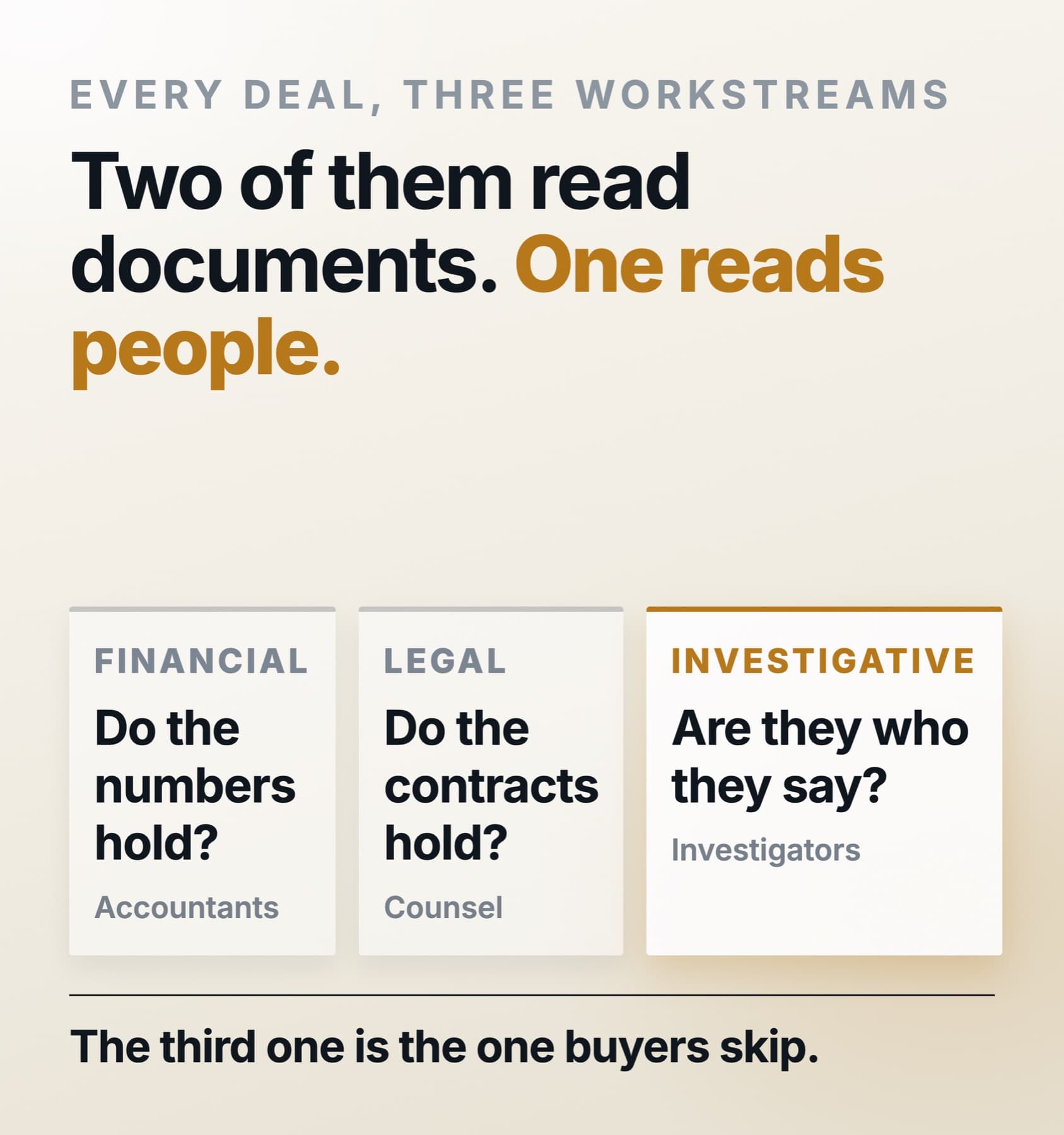
Financial, legal, and investigative due diligence are complementary, not interchangeable. Financial diligence, usually led by accountants, tests the quality of earnings, the balance sheet, working capital, and the reliability of the numbers. Legal diligence, led by counsel, examines corporate organization, material contracts, intellectual property, employment matters, and litigation exposure as disclosed in the data room.
Both disciplines largely work inside the information the target chooses to provide. That is their structural blind spot. They are superb at analyzing what is in the data room and far less equipped to find what was deliberately left out of it. Investigative due diligence works outside the data room, on independent sources the counterparty does not control: court files across multiple jurisdictions, regulatory and licensing bodies, media archives, corporate registries, property records, and human sources who knew the principals in prior ventures. How that public-record layer is actually collected, corroborated and preserved — and where it stops being able to answer the question — is set out in how an OSINT investigation actually works.
In practice the three run in parallel and inform one another. A discrepancy investigators find between a CEO's stated track record and the litigation record can redirect the accountants toward a specific revenue line. A pattern of related-party entities investigators map can tell counsel where to focus their contract review. The most expensive failures in M&A are rarely caused by a missed line item; they are caused by misjudging the people, which is why enhanced due diligence before an acquisition makes the integrity of the people its priority.
Why It Matters: The Cost of Not Knowing
The case for investigative due diligence rests on documented loss data. The Association of Certified Fraud Examiners, in its biennial Report to the Nations, the most widely cited study of occupational fraud, has consistently found that organizations lose roughly five percent of revenue to fraud each year, with a median loss per case well into six figures and a long tail of catastrophic, multimillion-dollar schemes. The ACFE also reports that the longer a scheme runs undetected, the larger the loss, which is precisely the risk that pre-transaction vetting exists to compress.
Counterparty and corruption risk carry their own price. The U.S. Foreign Corrupt Practices Act exposes acquirers to successor liability for the conduct of companies they buy, and the Department of Justice and Securities and Exchange Commission have repeatedly emphasized in their FCPA Resource Guide that pre-acquisition due diligence on third parties and targets is a core element of an effective compliance program. Sanctions exposure is equally unforgiving: the Treasury Department's Office of Foreign Assets Control enforces its programs on a strict-liability basis, meaning a party can face penalties even without knowledge that a counterparty was sanctioned. For the deal-team view of how this fits an acquirer's process, see our due-diligence playbook for private equity.
The reputational dimension is harder to quantify but no less real. A single undisclosed affiliation or a principal with a history of fraud can impair a fund's standing with its own limited partners, trigger regulatory scrutiny, or unwind a transaction after close. Investigative due diligence is, in this sense, an insurance-grade decision: a comparatively small spend against asymmetric downside.
What Investigative Due Diligence Covers
Scope is calibrated to the deal, the jurisdiction, and the risk appetite, but a thorough engagement on a company and its key principals typically spans the following dimensions. Not every matter requires all of them; a senior-led team scopes to the questions that actually move the decision.
- Identity and corporate verification: confirming the entity exists as represented, mapping ownership and beneficial ownership, and reconciling the corporate structure with what is being disclosed.
- Litigation and regulatory history: civil, criminal, and bankruptcy filings across relevant jurisdictions; regulatory actions, license status, and enforcement history with bodies such as the SEC, FINRA, and state regulators.
- Reputation and track record: prior ventures, business failures, partnership disputes, and how the principals are regarded by those who have dealt with them.
- Financial integrity and source of wealth: liens, judgments, undisclosed assets or insolvencies, and whether the stated source of funds is consistent with the record.
- Sanctions, watchlist, and adverse-media screening: OFAC and international sanctions lists, politically exposed person status, and negative news across languages and jurisdictions.
- Conflicts and hidden affiliations: undisclosed related parties, nominee arrangements, and connections that signal self-dealing or concealment.
When Deal Teams Commission It
Investigative due diligence is most associated with M&A, but it is commissioned across a far wider set of decisions where capital or reputation is exposed to an unfamiliar counterparty. The common thread is asymmetry of information: one side knows far more than the other, and that gap has to be closed before commitment.
Typical triggers include private-equity and venture investment, particularly into founder-led or family-controlled companies where the principals are the asset; pre-acquisition vetting of a target and its management; onboarding of significant vendors, distributors, joint-venture partners, or agents, especially in higher-corruption-risk markets; large credit or insurance underwriting decisions; family-office direct investments and co-investments; and litigation, where understanding an adversary's assets and conduct shapes strategy.
A distinct and growing trigger is cross-border. When a foreign investor, fund, or law firm is evaluating an American company or executive, the very public-records and litigation infrastructure that domestic teams take for granted is unfamiliar and hard to navigate from abroad. Verifying a U.S. counterparty for an overseas principal is the kind of work that demands on-the-ground command of American court systems, regulators, and registries, the flagship specialty of Fortaris Capital Advisors' International and Cross-Border Due Diligence practice.
What a Defensible Work Product Looks Like
The value of investigative due diligence lives in the quality and defensibility of the work product, not the volume of pages. A report a board, an insurer, or a court can rely on shares several characteristics. It distinguishes clearly between verified fact, reported allegation, and analyst inference, and it never presents the second or third as the first. Every material finding is sourced to a specific, identifiable record so the reader can trace and, if necessary, re-pull it.
It is collected and assembled lawfully. Defensible diligence respects privacy and data-protection law, follows the Fair Credit Reporting Act where it applies, and avoids pretext or unlawful access to non-public information, because a finding obtained improperly can taint a transaction and create liability of its own. It is also proportionate: scoped to the decision at hand, conscious of cost, and clear about what was and was not examined.
Finally, it reaches a conclusion. A useful report does not merely catalog data; it tells the deal team what the findings mean for the decision in front of them, flags the items that warrant a second look, and states plainly where the record is silent or unresolved. At Fortaris, every engagement is led by a Managing Director and built on a federal investigative and forensic-accounting foundation, so the analysis carries the judgment, not just the data, that a high-stakes decision requires.
Who performs it, and what it costs
Investigative due diligence is carried out by specialist corporate intelligence firms rather than by the accountants and lawyers running the financial and legal workstreams. The people doing the work are typically former federal agents, prosecutors, regulators and investigative journalists — the disciplines that are trained to establish facts about people rather than to audit numbers.
Pricing tracks scope rather than deal value. A single-subject enhanced check on one executive in one jurisdiction is a modest engagement measured in days. A full pre-acquisition review of a target company, its principals, its beneficial owners and its counterparties across several jurisdictions is a substantially larger one, and the cost is driven mostly by how many jurisdictions are involved and whether human-source inquiry is required.
The economics are rarely the constraint. Set against the price of the transaction being contemplated, the diligence is a rounding error; the real constraint is calendar time, which is why the work should be commissioned when the deal timetable is set rather than when the first concern surfaces.
What it does not cover
An honest scope statement is as useful as the findings. Investigative due diligence does not access bank records, tax filings, medical information, or telephone and email accounts. It does not use pretext to obtain financial data. It does not deliver a credit decision, a valuation, or a legal opinion, and it does not replace the financial and legal workstreams that run alongside it.
It also cannot prove a negative. A report that finds nothing adverse establishes that nothing adverse was found in the sources examined, within the time available — not that nothing exists. A firm that presents a clean report as a guarantee is overselling, and a buyer who reads it that way is taking on risk they think they have retired.
How the discipline is changing
Two forces are reshaping this work. The first is beneficial-ownership transparency, which has moved in both directions at once: the EU and UK have built registers, while in the United States the Corporate Transparency Act registry was narrowed by a 2025 rule change to cover foreign-owned entities only. Ownership questions that a register might once have answered increasingly require investigation again — a shift we set out in our note on the beneficial-ownership registry.
The second is the volume of machine-generated material. Corporate biographies, press coverage and reputation-management content can now be produced at scale, which raises the value of primary-source verification — court records, regulatory filings, and human inquiry — and lowers the value of anything that can be read off a screen. The methods that are hardest to automate are the ones that increasingly decide the answer.
The Limits and the Standard of Care
Investigative due diligence reduces risk; it does not eliminate it. Records are incomplete, sealed, or unavailable in some jurisdictions; sophisticated actors structure their affairs specifically to defeat scrutiny; and any review is a snapshot in time. An honest provider states these limits rather than implying false certainty. The right standard is a reasonable, well-scoped, lawfully conducted inquiry proportionate to what is at stake, documented well enough to demonstrate that the diligence was in fact done.
That documentary discipline matters beyond the deal itself. Regulators and courts evaluating whether an organization exercised appropriate care, whether under the FCPA, sanctions regimes, or fiduciary standards, look for evidence of a deliberate, reasonable process. A defensible investigative file is often the difference between a defensible decision and an indefensible one, regardless of how the underlying transaction ultimately performs. If the matter later becomes contested, that same file is where litigation support begins.
Key takeaways
- Investigative due diligence verifies who you are actually dealing with, working outside the data room on independent records the counterparty cannot control.
- It is not a background check: it interprets and tests a counterparty's narrative against primary-source records rather than returning standardized data points.
- It complements, never replaces, financial and legal diligence, which largely analyze information the target chooses to provide.
- The ACFE's Report to the Nations consistently estimates organizations lose roughly 5% of revenue to fraud annually, with risk compounding the longer it goes undetected.
- A defensible work product separates fact from allegation, sources every finding, is collected lawfully, and reaches a usable conclusion.
Frequently asked
12 questionsIs investigative due diligence the same as a background check?
No. A background check is an automated, checklist-driven screen, often FCRA-regulated, that returns standardized data points. Investigative due diligence is a bespoke, analyst-led inquiry that interprets primary-source records, tests the counterparty's narrative, and surfaces concealed risk a clean background check can miss.
When should a deal team commission investigative due diligence?
Whenever capital or reputation is exposed to an unfamiliar counterparty: private-equity and venture investments, M&A targets, major vendors and joint-venture partners, large credit or insurance underwriting, family-office direct deals, and cross-border transactions involving an unfamiliar legal system. The common trigger is an information gap that must be closed before commitment.
How is it different from financial and legal due diligence?
Financial and legal diligence mostly analyze information the target provides in the data room. Investigative due diligence works outside the data room on independent sources, such as court files, regulators, registries, media, and human sources, to find what was deliberately left out. The disciplines run in parallel and inform one another.
What does investigative due diligence cover?
Typically: identity and beneficial-ownership verification; litigation, criminal, and bankruptcy history; regulatory and licensing status; reputation and prior track record; source of wealth and undisclosed liabilities; sanctions, watchlist, and adverse-media screening; and hidden affiliations or conflicts. Scope is calibrated to the deal, jurisdiction, and risk.
What makes an investigative due diligence report defensible?
It separates verified fact from allegation and inference, sources every material finding to an identifiable record, is collected lawfully in compliance with privacy and FCRA rules, is proportionate in scope, and reaches a clear conclusion about what the findings mean for the decision and where the record is silent.
Can investigative due diligence guarantee a counterparty is clean?
No. It materially reduces risk but cannot eliminate it. Records can be incomplete or sealed, sophisticated actors structure affairs to defeat scrutiny, and any review is a snapshot in time. A credible provider states these limits and documents a reasonable, proportionate inquiry rather than implying false certainty.
Who performs investigative due diligence?
Specialist investigative firms rather than the accountants or lawyers running the financial and legal workstreams. The practitioners are typically former federal agents, prosecutors, regulators and investigative journalists — disciplines trained to establish facts about people and their histories, rather than to audit financial statements or review contracts.
How much does investigative due diligence cost?
Cost tracks scope, not deal value. A single-subject enhanced check on one executive in one jurisdiction is a matter of days; a full pre-acquisition review across several jurisdictions, covering the target, its principals and its beneficial owners, is substantially larger. The main cost drivers are the number of jurisdictions and whether human-source inquiry is required. Against the transaction being contemplated, the figure is almost always immaterial.
How long does investigative due diligence take?
A focused single-subject review is usually delivered within a week. A multi-jurisdiction corporate review typically runs two to four weeks, and longer where records must be retrieved in person, translated, or obtained from jurisdictions with slow registries. The binding constraint is calendar time rather than budget, which is why the work should be scoped when the deal timetable is set.
What sources does investigative due diligence use?
Corporate registries and beneficial-ownership records, litigation and insolvency dockets, regulatory and licensing databases, sanctions and enforcement lists, property and lien records, archived and foreign-language media, and — where the engagement calls for it — discreet human-source inquiry with people who have dealt with the subject. Everything material is sourced to a record.
Is investigative due diligence legal?
Yes, when it is conducted within the rules that govern it. Legitimate practice relies on public records, licensed databases, media research and properly identified interviews. Obtaining bank records by pretext, accessing accounts or devices without authorisation, and operating without a required licence are unlawful — and evidence gathered that way creates exposure for the client who commissioned it.
What is enhanced due diligence, and how does it relate?
Enhanced due diligence is the elevated level of scrutiny applied under anti-money-laundering rules when a customer or counterparty presents higher risk — for example a politically exposed person or a high-risk jurisdiction. Investigative due diligence is the broader discipline used to satisfy it and to answer commercial questions that regulation does not reach, such as whether a founder's track record is what it appears to be.
Sources & further reading
- 01ACFE, Report to the NationsThe Association of Certified Fraud Examiners' biennial study of occupational fraud; widely cited for the ~5% of revenue lost to fraud estimate and median loss data.
- 02DOJ and SEC, FCPA Resource GuideIdentifies pre-acquisition and third-party due diligence as a core element of an effective compliance program and explains successor liability under the Foreign Corrupt Practices Act.
- 03U.S. Treasury, Office of Foreign Assets Control (OFAC)Administers and enforces U.S. economic sanctions on a strict-liability basis, underscoring the need for counterparty sanctions screening.
- 04U.S. Fair Credit Reporting Act (FCRA)Governs consumer-report background checks used for employment, credit, and tenancy decisions; relevant to the legal boundary between background screening and investigative diligence.
- 05FBI Internet Crime Complaint Center (IC3)Annual Internet Crime Report documenting reported fraud and business email compromise losses, context for counterparty and transaction risk.