

The short answer
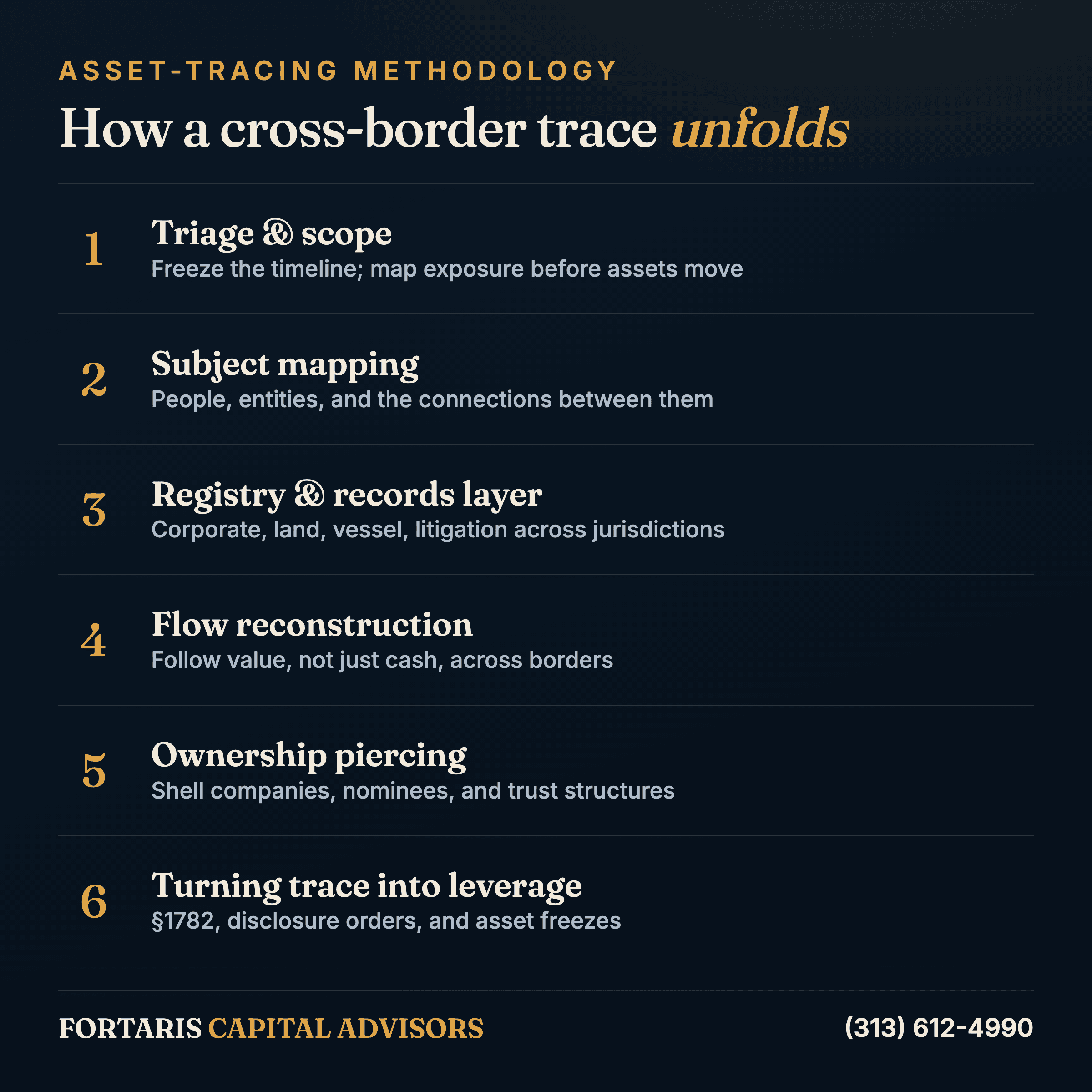
A cross-border asset trace is the structured investigation that reconstructs where money or value has gone once it moves across national borders — through shell companies, nominees, trusts, and foreign accounts — and converts that reconstruction into evidence a court can act on. It runs in disciplined phases: triage and scoping, subject mapping, registry and financial-flow analysis, beneficial-ownership piercing, and the legal instruments that freeze and recover the assets.
Why this account is anonymized — and what that tells you about the work
The engagement described here is a composite. The facts are drawn from real cross-border asset traces, but names, jurisdictions, amounts, and identifying detail have been altered or merged so that no client, subject, or matter is recognisable. That is not a disclaimer bolted onto the end — it is the first thing to understand about the discipline. Discretion is not a courtesy in this work; it is the product. A trace that leaks is a trace that fails, because the moment a subject learns they are being looked at, the assets move.
What survives anonymisation is the method, and the method is what this piece is about. Read it as a walk through how the work is sequenced and why each phase exists — the same investigative services capability applied to the specific problem of value that has crossed a border and been layered to break the trail. A trace run before a complaint is filed is a narrower exercise — see pre-litigation due diligence for what counsel commissions at that stage.
The composite: a US operating company discovers, months too late, that a trusted counterparty has diverted several million dollars through a chain of invoices to entities the company had never heard of. The money left a domestic bank, touched an account in one jurisdiction, and disappeared into a corporate structure in another. Counsel's question was the only one that matters at the outset — is any of it still reachable, and if so, how fast do we have to move.
The first 72 hours: triage before anything moves
Recovery is the exception, not the rule, and the numbers are sobering. The UN Office on Drugs and Crime has long estimated that only a fraction of laundered proceeds — on the order of 0.2%, well under 1% — is ever seized or frozen. Cross-border traces do not fail because the money cannot be found; they fail because it is found too late. So the first phase is not investigation. It is triage.
Triage answers three questions in parallel. What is the realistic exposure — how much left, and is any of it recoverable in principle. Where might it have gone — the jurisdictions in play, and what each one permits an outsider to obtain. And what is the clock — is a bank account still open, is a filing deadline looming, is there any window to freeze before the subject reacts; the remedies available after cross-border fraud narrow sharply with every hour that passes. The output is not a report; it is a decision about what to do first, made deliberately before a single subpoena or letter of request tips anyone off.
This is also where sequencing discipline is set. The single most expensive mistake in an asset trace is alerting a subject before the assets are secured — pursuing a slow formal channel while funds dissipate, or serving a demand that warns the very person you are chasing. Everything that follows is ordered around the principle that you gather quietly, and you move to freeze before you move to confront. The parallel to prevention is exact: the cheapest asset trace is the one you never need, which is why investigative due diligence before a deal is a fraction of the cost of chasing money after it.
Subject mapping: build the network before you touch the money
Before the financial reconstruction begins, the investigation maps the human and corporate network around the loss. Who are the individuals, what entities do they control or touch, and how are they connected — through directorships, shareholdings, addresses, family, prior litigation, and past business relationships. This comes first for a practical reason: money moves along the lines of the network, and if you trace funds without first understanding the relationships, you will follow a wire into an entity and have no idea whose hand is on it.
The concealment is predictable in shape even when the detail is not. The World Bank and UNODC's Stolen Asset Recovery Initiative, in its landmark study *The Puppet Masters*, found that the corporate vehicle — anonymous shell companies, layered across jurisdictions and fronted by nominee directors and shareholders or wrapped in trusts — is the dominant tool for hiding the beneficial ownership of misappropriated funds. Knowing that pattern in advance tells the investigator what to look for: not one company holding the money, but a chain, with the real party standing behind a nominee at the end of it.
In the composite, subject mapping surfaced something the client had missed — a shared registered address linking the unfamiliar invoice-recipient entity to a company the counterparty's spouse had incorporated two years earlier. That single correlation, found before any money was traced, became the thread the rest of the engagement pulled on. This is corporate intelligence doing its quiet foundational work: establishing the terrain before the pursuit.
The registry and records layer: what the public record still gives up
With the network mapped, the investigation works the documentary record across every jurisdiction in play: corporate registries, land and real-property records, vessel and aircraft registries, court dockets, insolvency filings, security interests, and regulatory disclosures. Each is a place where an owner had to leave a footprint to hold or use an asset. The craft is knowing which registry in which country is worth the effort, what it actually discloses, and how to read a filing that was written to reveal as little as possible.
The hard truth of the current landscape is that the most useful record — who really owns an entity — is getting harder to reach, not easier. In the United States, FinCEN's March 2025 interim final rule sharply narrowed the Corporate Transparency Act: reporting of beneficial ownership was removed for US-formed companies and US persons, leaving only certain foreign entities within scope. In the European Union, the Court of Justice struck down public access to beneficial-ownership registers in its November 2022 *Luxembourg Business Registers* judgment; the EU's 2024 anti-money-laundering package has since restored access on a narrower "legitimate interest" basis, phasing in through 2027. And in the Tax Justice Network's Financial Secrecy Index, the largest single supplier of financial secrecy is not a Caribbean island but the United States. We set out what the registry actually contains now — and what it no longer does — in the Corporate Transparency Act in 2026.
The point for an investigator is not to lament this but to plan around it. Where a register no longer volunteers ownership, the answer is reconstructed indirectly — through correspondence, filings made for other purposes, litigation exhibits, procurement records, and the correlations that subject mapping surfaced. The public record still gives up more than the people using it to hide assets would like; it just no longer hands it over on a single search. This is the terrain that makes credible international due diligence a specialist capability rather than a database subscription.
Financial-flow reconstruction: follow value, not just cash
The analytical core of the trace is reconstructing the movement of value from the point of loss through the layers built to obscure it. Working from available bank statements, correspondent-banking records, invoices, and accounting data, the investigation rebuilds the path: out of the origin account, through the intermediary, into the structure — and then, critically, out of cash and into whatever the proceeds were converted to.
That last step is where most traces are won or lost, because sophisticated actors rarely leave money sitting as money. Proceeds are converted into real estate, equity stakes, luxury assets, securities, or crypto-assets — each of which retains a traceable lineage if you know to follow value rather than only cash. US authorities have documented residential real estate in particular as a favoured destination for illicit funds, moved through all-cash purchases fronted by shell companies; FinCEN's analysis of that channel stands even though the specific 2024 reporting rule built on it was vacated by a federal court in 2026 and is under appeal. Where value was converted into crypto, the FATF "travel rule" — Recommendation 16, extended to virtual-asset service providers — means that regulated exchanges are increasingly obliged to hold the sender and recipient information a trace needs.
Two principles govern this phase. Follow value, not just cash, because a wire that appears to dead-end has usually just changed form. And preserve the evidentiary chain at every step, because a reconstruction that cannot be authenticated later is intelligence, not proof — the distinction that separates a trace that supports litigation support and asset recovery from one that merely satisfies curiosity. The mechanics of how this reconstruction holds up across conflicting evidence rules are covered in our companion guide to how cross-border fraud is investigated.
Piercing beneficial ownership: the layer built to stop you
Eventually the trail reaches the structure that was designed to end it — the entity or trust whose whole purpose is to sit between the assets and the person who controls them. Piercing it is the phase that most distinguishes a professional trace from a database report, because a search will tell you a company exists; it will not tell you who is really behind it.
The FATF and the Egmont Group of financial intelligence units, in their joint study on the concealment of beneficial ownership, catalogue the standard techniques: nominee directors and shareholders who lend their names, layered holding companies spread across cooperative jurisdictions, trusts that legally separate control from benefit, and bearer instruments. Against each there is a corresponding method. Nominees are exposed by the pattern of their appointments — the same handful of names sitting atop hundreds of unrelated companies. Layering is unwound by correlating the timing of incorporations and transfers against the events in the underlying dispute. Trusts are approached through the settlor's and beneficiaries' footprints elsewhere. None of it is a single decisive document; it is the weight of correlated detail, assembled until the real party's control is the only explanation that fits.
In the composite, the structure resolved not through a registry but through timing: three entities in two jurisdictions had been incorporated within a fortnight of each other, weeks before the first diverted invoice, all administered by the same corporate-services provider. The pattern was the proof.
Turning a trace into leverage: the legal instruments
A reconstruction, however complete, recovers nothing on its own. The final phase converts findings into legal leverage — the orders that compel disclosure and, above all, freeze assets before they can move again. The investigator's job here is to hand counsel a record precise enough to support the application, and to have sequenced the work so the application can be made before the subject reacts.
The toolkit is jurisdiction-specific and each instrument has its limits. In the United States, discovery under 28 U.S.C. § 1782 lets a party to a foreign proceeding obtain evidence from people and institutions found in the US — a powerful reach, though the Supreme Court in *ZF Automotive v. Luxshare* (2022) confirmed it does not extend to private commercial arbitration. In common-law jurisdictions, a Norwich Pharmacal order compels a third party innocently caught up in wrongdoing — typically a bank — to disclose what it knows about the wrongdoer, and a worldwide freezing (Mareva) injunction locks assets in place pending judgment. Formal state-to-state cooperation through Mutual Legal Assistance Treaties remains available for criminal matters but is notoriously slow, often taking many months to years — which is precisely why civil tools, deployed quickly, so often do the real work of recovery.
Speed and sequencing decide the outcome. The Stolen Asset Recovery Initiative's study *Few and Far* captured the gap starkly: across a sample period, a group of OECD countries reported freezing roughly US$1.4 billion in suspected corrupt assets while only about US$147 million was actually returned — and completed cross-border recoveries routinely run a decade or more. The lesson is not that recovery is hopeless; it is that the assets you freeze early are the assets you keep. A trace built to support that freeze, in the right order, is worth many times one that arrives after the money is gone.
What separates a trace that recovers from one that only informs
Four disciplines separate the two, and none of them is about access to exotic databases. The first is sequencing — gathering quietly and moving to freeze before confronting, so the work is never wasted by tipping off the subject. The second is evidentiary rigour — building every step to a standard that survives challenge, because tracing that cannot be authenticated is intelligence, not proof. The third is genuine cross-border capability — local counsel and local knowledge in the jurisdictions that matter, so a US-centred view does not miss what a foreign register or court actually permits. The fourth is judgement about when to stop — recognising the point at which further tracing costs more than it can recover, and saying so.
For private-equity deal teams, law firms, corporates, and family offices, the practical takeaway runs earlier than any of this. The most reliable asset trace is the one made unnecessary by diligence before the money moves — the reason verifying a counterparty before you sign is the cheapest recovery strategy there is. When that has not happened and value has already crossed a border, the work described here is what stands between a loss on paper and a recovery in fact — and its success is decided in the first days, not the last.
Fortaris runs cross-border asset traces as partner-led engagements, sequenced for recovery and built to an evidentiary standard from the first phase, through our international due diligence and investigative services practices.
Key takeaways
- A cross-border asset trace runs in disciplined phases — triage, subject mapping, registry and financial-flow analysis, ownership piercing, and legal instruments — not as a single database search.
- Recovery is decided in the first 72 hours: only a small fraction of laundered proceeds is ever seized, and traces fail because assets are found too late, not because they can't be found.
- Sequencing is everything — gather quietly and move to freeze before confronting the subject; alerting them before assets are secured is the most expensive mistake in the work.
- Beneficial-ownership data is getting harder to reach (the narrowed US Corporate Transparency Act, the EU register restrictions), so ownership is increasingly reconstructed indirectly through correlation, not a single search.
- Follow value, not just cash — proceeds are converted into real estate, securities, and crypto that retain a traceable lineage — and preserve the evidentiary chain, or a trace informs but cannot recover.
Frequently asked
8 questionsWhat is a cross-border asset trace?
It is a structured investigation that reconstructs where money or value has gone once it has moved across national borders and been layered through shell companies, nominees, trusts, or foreign accounts — then converts that reconstruction into evidence that supports freezing and recovering the assets. It combines subject mapping, multi-jurisdiction registry analysis, financial-flow reconstruction, and the legal instruments that secure assets.
How is asset tracing different from a background check?
A background check tells you what someone appears to be. An asset trace follows value — reconstructing the path of specific funds through the structures built to hide them, and doing so to an evidentiary standard that can support a court application. It is investigative and forensic, sequenced for recovery, and far more time-sensitive than a static due-diligence report.
Why does speed matter so much in an asset trace?
Because recovery is the exception. Authorities estimate that only a small fraction — on the order of a fraction of one percent — of laundered proceeds is ever seized, and the difference is almost always timing. Once a subject learns they are being investigated, movable assets move. The assets you freeze early are the assets you keep, which is why the first days of an engagement decide the outcome more than the last.
Can you find assets hidden behind shell companies and nominees?
That is the core of the work. Shell companies, nominee directors, and trusts are the standard concealment tools, and each has a corresponding method — nominees are exposed by the pattern of their appointments, layered structures by correlating the timing of incorporations and transfers, trusts through the footprints of settlors and beneficiaries. It is rarely one document; it is the weight of correlated detail until the real party's control is the only explanation that fits.
Does the narrowed US Corporate Transparency Act make tracing harder?
It makes one shortcut less available. FinCEN's March 2025 rule removed beneficial-ownership reporting for US-formed companies and US persons, so that register no longer volunteers ownership for domestic entities. It does not make tracing impossible — ownership is reconstructed indirectly through correspondence, filings made for other purposes, litigation records, and correlation — but it does reward specialist capability over a simple database lookup.
What legal tools are used to freeze and recover the assets?
The main civil instruments are US discovery under 28 U.S.C. § 1782 (to obtain evidence from parties found in the US for a foreign proceeding), Norwich Pharmacal orders (to compel disclosure from a third party such as a bank), and worldwide freezing or Mareva injunctions (to lock assets pending judgment). Mutual Legal Assistance Treaties handle formal state-to-state cooperation in criminal matters but are much slower, so civil tools deployed quickly often do the real work.
How long does a cross-border recovery take?
The trace itself can produce actionable findings in weeks; the recovery is another matter. Completed cross-border recoveries routinely run a decade or more, and the gap between assets frozen and assets actually returned is wide. This is why the strategy prioritises freezing early — securing the assets in place — rather than waiting for a full recovery to conclude before acting.
When should we engage an asset-tracing firm?
The moment you suspect value has been diverted and may cross or has crossed a border — before serving any demand that could alert the subject. Early engagement lets the work be sequenced for recovery: gathering quietly, identifying what can be frozen, and moving on it before assets dissipate. Engaging late, after a subject has been warned, often reduces the exercise to documenting a loss rather than reversing it.
Sources & further reading (8)
- 01UNODC — Money Laundering OverviewThe UN Office on Drugs and Crime's estimate that only a small fraction — on the order of 0.2%, well under 1% — of laundered proceeds is ever seized or frozen; the standard authoritative figure on how rarely illicit funds are recovered.
- 02World Bank / UNODC StAR Initiative — The Puppet Masters (2011)The Stolen Asset Recovery Initiative's landmark study establishing anonymous shell companies, nominees, and trusts as the dominant vehicles used to conceal the beneficial ownership of misappropriated funds.
- 03StAR / OECD — Few and Far: The Hard Facts on Stolen Asset Recovery (2014)Documented the gap between assets frozen and assets returned — roughly US$1.4 billion frozen against about US$147 million returned across a sample period — and the decade-plus timelines typical of completed cross-border recoveries.
- 04FATF–Egmont Group — Concealment of Beneficial Ownership (2018)Joint study cataloguing the standard concealment techniques (nominee directors and shareholders, layered structures, trusts, bearer instruments) that beneficial-ownership piercing is built to defeat; also the source of FATF Recommendation 16, the 'travel rule' extended to virtual-asset service providers.
- 05FinCEN — Corporate Transparency Act interim final rule (March 2025)Narrowed beneficial-ownership reporting to remove US-formed companies and US persons from scope, leaving only certain foreign entities — reducing the ownership data domestically available to investigators.
- 06Court of Justice of the EU — Luxembourg Business Registers (C-37/20 & C-601/20, Nov. 2022)Struck down public access to EU beneficial-ownership registers; the 2024 EU anti-money-laundering package since restored access on a narrower 'legitimate interest' basis, phasing in through 2027.
- 0728 U.S.C. § 1782; ZF Automotive US, Inc. v. Luxshare, Ltd. (2022)The US statute allowing discovery in aid of foreign proceedings; the Supreme Court confirmed in 2022 that it does not reach private commercial arbitration, defining a key limit on the tool.
- 08Tax Justice Network — Financial Secrecy IndexRanks the jurisdictions supplying the most financial secrecy; notably places the United States among the largest suppliers, a reminder that opacity is not confined to traditional offshore centres.