

The short answer
For a family office, due diligence is broader than deciding whether an investment is sound. The harder question is who you are trusting — a manager, a co-investor, a member of staff with deep access — and what happens to the family's capital and reputation if you are wrong. The largest losses come not from strangers but from the people closest to the assets, which makes independent, investigative diligence the protection that financial analysis cannot provide.
The question a family office actually has to answer
A family office is built on trust concentrated in a small number of people — a handful of staff, a circle of managers and advisers, a set of co-investors reached through relationship rather than through a formal process. That concentration is the model's strength and its exposure at the same time, and it is why a security risk and threat assessment for a family office reaches into household staff and contractors as well as investments. Financial diligence tells you whether a deal pencils out. It does not tell you whether the people and the money behind it are what they claim to be.
So the operative question is not only 'is this a good investment.' It is broader and less comfortable: who are we trusting, with what access, and what happens to the family's capital — and its name — if we are wrong. Those are investigative questions, not analytical ones, and they are answered by independent verification of people and provenance rather than by a return model.
This is investigative due diligence applied to the family's specific risk: not a background check bolted on at the end, but a deliberate read on the managers, staff, counterparties, and provenance a family office depends on — and it is what protects both the capital and the reputation that a single bad actor can damage.
A growing world, taking on more risk directly
The stakes have risen with the sector. Deloitte estimated roughly 8,030 single-family offices worldwide in 2024 and projects the number to exceed 10,720 by 2030, with their assets under management projected to climb from about $3.1 trillion to $5.4 trillion over the same period. This is a large and fast-growing pool of concentrated, multi-generational capital.
It is also capital taking on more diligence itself. Family offices have moved steadily toward direct investments in private companies and co-investments alongside others — work that, historically, they delegated to fund managers who underwrote and monitored the deals. Investing directly means owning that diligence: assessing management, ownership, and integrity risk that a fund's process used to absorb. The same discipline a fund applies is set out in our due-diligence playbook for private equity; a direct-investing family office needs it just as much, often with a leaner team.
That leanness is the third factor. Family offices run deliberately small, relationship-driven teams, so the formal control functions an institution takes for granted — independent verification, segregation of duties, standing screening — are frequently thinner. Combined with concentrated wealth, the result is that a single fraud or reputational event is not diversified away across a large book. The downside is idiosyncratic, and it can be severe.
The trusted insider: who watches the watchers
The most uncomfortable risk sits inside the office. A family office grants a small number of trusted people — a controller, a business manager, a long-tenured bookkeeper — deep, ongoing access to accounts and assets, often with limited oversight and little separation of duties. That is precisely the profile in which the largest frauds occur.
The Association of Certified Fraud Examiners, in its 2024 Report to the Nations, estimates that organisations lose about 5% of revenue to fraud each year, with a median loss of $145,000 and a typical scheme running about twelve months before it is detected. But the damage scales with authority: when the perpetrator is an owner or executive, the median loss rises to $500,000, and those schemes run longer before discovery — a median of roughly two years. The people with the most trust and the least oversight cause the most damage and take the longest to catch.
For a family office the defence is not suspicion; it is structure. Independent pre-hire screening of anyone who will touch the money, periodic re-vetting of long-tenured staff and advisers, and genuine oversight of the people who would otherwise be checking their own work. This is investigative and forensic capability applied inside the office, not only to outside deals. And when a concern does surface about someone inside, the office faces the same escalation question as any company: who can credibly run the investigation, and when it must be independent.
The manager you did not verify
The mirror risk sits outside the office: the fund, manager, or counterparty accepted on reputation and referral rather than independent verification. Concentrated private wealth is a recurring target for investment fraud, and the family-office network — which runs on trusted introductions — is exactly how such schemes reach their victims.
The Bernard Madoff collapse in December 2008 remains the archetype. It was, at its core, a due-diligence failure: feeder funds and sophisticated wealthy investors, family offices among them, suffered concentrated losses in a scheme whose account statements were fabricated, in significant part because independent verification of custody, audited returns, and basic operations had never been done. The reputation and the referral stood in for the diligence, and the diligence was the only thing that would have caught it.
The lesson is narrow and durable: verify the manager and the counterparty independently — confirm that custody, audit, and track record are real and corroborated by sources outside the manager's own materials — before the capital moves, not after. A trusted introduction is a reason to look, not a reason not to.
The principal's own story: source of wealth and reputation
Diligence at a family office also runs inward, toward the principal. Private banks, cross-border structures, and co-investors' own onboarding increasingly require documented, corroborated source-of-wealth and source-of-funds evidence for the family — and a reputational profile that anticipates what an adverse-media, litigation, and association search would surface before someone else runs it.
The standard here is the same one that governs financial-crime compliance. International guidance treats higher-risk clients, including politically exposed persons, as warranting enhanced due diligence and scrutiny of the legitimacy of their wealth, and the Wolfsberg Group's guidance sets the industry bar: source of wealth is established through the plausibility of the narrative and independent corroborating evidence, not a self-declaration. The mechanics of that work are covered in our piece on source of wealth and source of funds, and the step that precedes it — establishing whether a politically-exposed-person alert refers to your client at all — in PEP screening: what a hit actually means.
For a family office the practical value is being able to evidence the family's story on demand — before a bank, a regulator, or a counterparty asks — and to manage the reputational picture proactively rather than react to it. That is reputational due diligence turned toward the family's own protection.
The digital and physical front door
Two adjacent exposures round out the picture, because a family office protects a family, not just a portfolio. The first is cyber. Deloitte's 2024 family-office cybersecurity research found that 43% of family offices had experienced a cyberattack in the prior period, with a quarter hit three or more times and phishing the dominant vector — yet only about a quarter described their incident-response plan as robust and roughly a third had no plan at all. A lean office holding concentrated wealth is a high-value, under-defended target.
The second is the physical and personal security of the principals themselves — a dimension most acute where wealth is visible or a specific threat has emerged, and one that shares its intelligence base with the investigative work. How that exposure is actually mapped — principals, household staff, digital footprint, and travel — is the subject of our guide to security and threat assessment for family offices; the protective end of the spectrum is covered in executive protection and, at the level of what a detail does day to day, in close protection services. For a family office all of it is one question — protecting the family's people alongside its capital — drawing on the same security and risk-advisory capability.
Neither cyber nor physical security is solved by an investigation alone. But both belong in the family office's risk picture, and both are stronger when they sit on a foundation of knowing — verifiably — who has access to the family and its assets.
What family-office diligence covers — and how to run it
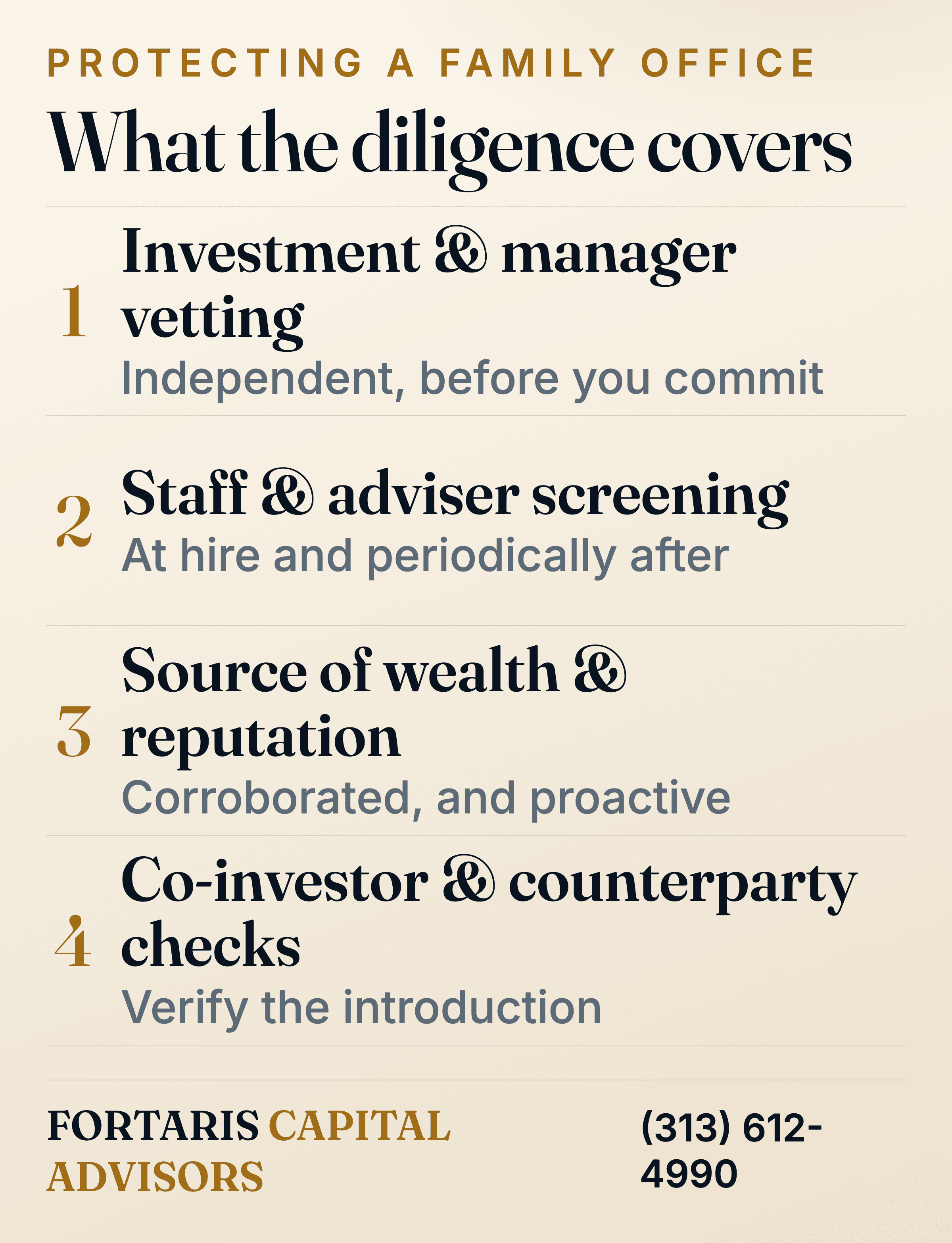
Put together, protecting a family office is a small number of disciplines applied consistently rather than a single event. Vet investments and the managers behind them independently before committing. Screen the staff and advisers who gain deep access, at hire and periodically after. Establish and be able to corroborate the family's source of wealth and manage its reputation proactively. Verify co-investors and counterparties reached through the network rather than trusting the introduction. And treat all of it as ongoing, because the trusted-insider risk in particular surfaces over years, not at a single point.
The work rewards genuine investigative capability paired with the discretion a family requires: access to corporate, litigation, and property records across jurisdictions, forensic-accounting judgement, cross-border reach, and the confidentiality these matters demand. Fortaris performs this work for family offices as a senior-led engagement, through its corporate intelligence and due diligence investigation practices — protecting both the capital and the name, which for a family are ultimately the same thing.
Key takeaways
- For a family office the diligence question is who you are trusting, with what access, and what happens to the family's capital and reputation if you are wrong — not only whether a deal is sound.
- The sector is large and growing (Deloitte: ~8,030 single-family offices in 2024, projected above 10,720 by 2030) and increasingly invests directly, taking on integrity diligence it used to delegate to fund managers — often with a leaner team.
- The largest losses come from trusted insiders: the ACFE finds owner/executive-level fraud carries a median loss of $500,000 and runs about two years before detection, against a $145,000 median and twelve months overall — exactly the high-trust, low-oversight family-office profile.
- Managers and co-investors reached by referral still need independent verification of custody, audit, and track record — the Madoff collapse was, at its core, a due-diligence failure that independent checks would have caught.
- Protecting a family office spans investment and manager vetting, staff screening, source-of-wealth and reputational protection, co-investor checks, and cyber and personal security — applied as ongoing discipline, not a one-time event.
Frequently asked
7 questionsHow is family-office due diligence different from ordinary investment diligence?
Financial diligence establishes whether an investment is sound. Family-office due diligence adds the investigative layer: independently verifying the people and provenance the family is trusting — managers and co-investors reached by referral, staff and advisers with deep access, and the family's own source of wealth and reputation. It exists because at a family office the largest risks are idiosyncratic and relationship-based, and a single fraud or reputational event is not diversified away across a large institution's book.
Why are family offices especially exposed to fraud?
Three features combine. They concentrate multi-generational wealth, so a single loss is severe. They run lean, trust-based teams, so formal controls — independent verification, segregation of duties, standing screening — are often thinner than at an institution. And they increasingly invest directly and co-invest, taking on diligence they once delegated to fund managers. The result is a high-trust, high-access, low-oversight environment, which is precisely where the ACFE finds the largest frauds occur.
What is the biggest internal risk to a family office?
The trusted insider with deep access and little oversight — a controller, business manager, or long-tenured bookkeeper. The ACFE's 2024 Report to the Nations found owner/executive-level fraud carries a median loss of $500,000 and runs roughly two years before detection, versus a $145,000 median and twelve months overall. The people with the most trust and least oversight cause the most damage and take the longest to catch, which is why independent pre-hire screening and periodic re-vetting of long-tenured staff matter.
Do we really need to independently verify a manager who came through a trusted introduction?
Yes — a trusted introduction is a reason to look, not a reason not to. Concentrated private wealth is a recurring target for investment fraud, and referral networks are how such schemes reach their victims. The Madoff collapse was fundamentally a diligence failure: sophisticated investors and family offices lost heavily because independent verification of custody, audited returns, and basic operations had not been done. Confirm those are real and corroborated by sources outside the manager's own materials before capital moves.
Why does a family office need source-of-wealth documentation on its own principal?
Because private banks, cross-border structures, and co-investors' onboarding increasingly demand it, and it is better prepared proactively than under pressure. The standard is corroboration, not self-declaration: the family should be able to evidence the plausibility of its wealth narrative with independent supporting records on demand. It also lets the family manage its reputational profile — anticipating what an adverse-media or litigation search would show — before a counterparty runs one.
Are family offices really cyber targets?
Yes, and under-prepared ones. Deloitte's 2024 family-office cybersecurity research found 43% had experienced a cyberattack in the prior period, a quarter were hit three or more times, and phishing was the dominant vector — while only about a quarter rated their incident-response plan robust and roughly a third had none. A lean office holding concentrated wealth is a high-value, soft target. Cyber is not solved by investigation alone, but it belongs in the same risk picture as knowing who has access to the family and its assets.
How often should a family office run this diligence?
It is ongoing, not a one-time event. Investment and manager vetting happens before each commitment; staff and adviser screening happens at hire and periodically thereafter, because insider fraud surfaces over years rather than at a single point; source-of-wealth and reputational profiles are refreshed as circumstances change. The goal is a standing posture of verified trust, not an annual box-check.
Sources & further reading (6)
- 01Deloitte — The Family Office Insights Series: Defining the Family Office Landscape (2024)Estimated roughly 8,030 single-family offices worldwide in 2024, projected to exceed 10,720 by 2030, with assets under management projected to rise from about $3.1 trillion to $5.4 trillion — the scale and growth of concentrated family capital. The 2030 figures are projections.
- 02UBS — Global Family Office Report (2024)Documents the family-office shift toward direct private-company investments and co-investments — diligence work historically delegated to fund managers that direct-investing families now own themselves.
- 03ACFE — Occupational Fraud 2024: A Report to the NationsEstimates ~5% of revenue lost to fraud annually, a $145,000 median loss, and a 12-month median detection time overall; owner/executive-level fraud carries a $500,000 median loss and runs about two years before detection — the trusted-insider profile a lean family office presents.
- 04U.S. SEC / DOJ — Madoff enforcement (2008–2009)The archetypal due-diligence failure: feeder funds and wealthy investors, including family offices, suffered concentrated losses in a Ponzi scheme with fabricated statements, in significant part because independent verification of custody, audit, and operations had not been performed.
- 05FATF Recommendations (PEP / enhanced due diligence); The Wolfsberg Group — Source of Wealth & Source of Funds guidanceSet the standard for establishing and corroborating a principal's source of wealth: higher-risk clients warrant enhanced due diligence, and source of wealth is established through the plausibility of the narrative and independent evidence, not self-declaration.
- 06Deloitte — The Family Office Cybersecurity Report (2024)Found 43% of family offices had experienced a cyberattack in the prior period, a quarter three or more times, with phishing the dominant vector, while only about a quarter rated their incident-response plan robust and roughly a third had none — a high-value, under-defended target profile.