

The short answer
A family office security and threat assessment is a structured review of the exposure surrounding a family and the office that manages its wealth. It examines four surfaces — the principals and their public profiles, the household and its staff, the family's digital footprint, and its travel — maps how an adversary would research and reach the family, and returns prioritized, proportionate measures. Most findings change posture, not headcount.
Why a family office is a distinct security problem
A corporation of significant value carries a security function almost by default: badges, controls, counsel, sometimes a protective detail for the chief executive. A family office of equivalent value typically carries none of it. The structure that makes family offices attractive to the families they serve — small, trusted, discreet, unbureaucratic — is precisely the structure that leaves exposure unowned. There is no chief security officer; there is a controller who also handles the alarm company.
The exposure itself is different in kind from corporate risk, because the asset is a family rather than a balance sheet. The principals' names sit on public deeds, filings, and donor lists. The family's routines — school runs, board schedules, seasonal residences — repeat in patterns an observer can learn. The next generation documents its life in real time on platforms the office does not control. And the money moves on instructions that a small staff executes on trust, which is why family offices feature so prominently in wire-fraud and impersonation schemes: the FBI's Internet Crime Report put reported losses from business email compromise alone at roughly $2.8 billion in 2024, and the scheme's classic victim profile — high-value transfers, thin verification layers, authority concentrated in a few people — describes a family office exactly.
We set out the general discipline of security risk and threat assessment — what an assessment is, what triggers one, and what it should produce — in a companion piece. This one is about the family-office application, which differs enough from the corporate case to deserve its own treatment.
The four surfaces an assessment maps
A useful family-office assessment is organized around the surfaces where exposure actually accumulates, and in our practice they are consistently four. First, the principals and family: who is publicly identifiable, what their profiles and routines disclose, which family members carry risk they have never been briefed on — the next generation above all. Second, the household and staff: everyone whose role already places them inside the perimeter, from estate managers and nannies to drivers, contractors, and the vendors whose people cycle through the property. Third, the digital footprint: what a competent stranger could assemble about the family without ever leaving a desk. Fourth, travel and events: the windows when the family is moving through ground it does not control, on schedules that are often published or inferable.
The output that matters is not a catalog of everything that could go wrong. It is a ranked account of how this family, specifically, would most plausibly be researched, approached, defrauded, or harmed — and the shortest path to closing the gaps that ranking exposes. As with any assessment worth commissioning, the recommendations should be independent of the assessor's other products; advice that concludes mainly in buying the assessor's manpower is a proposal, not an assessment.
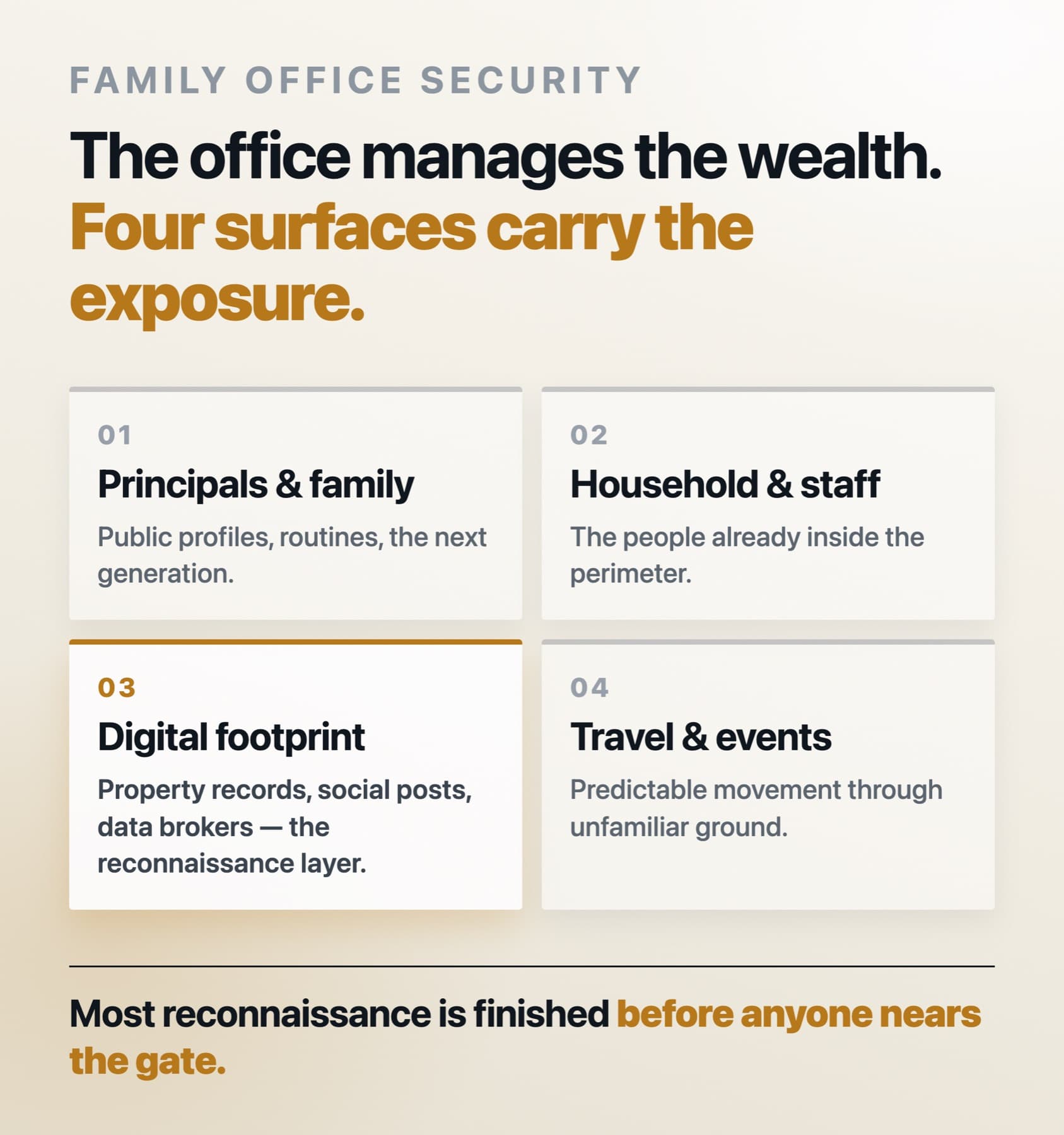
The digital footprint: reconnaissance happens before anyone nears the gate
The modern approach to a wealthy family does not begin at the property line. It begins with research: property records that map residences to names; corporate registries and charity filings that map the family's structure; data brokers that sell home addresses, phone numbers, and relatives' names in bulk; social media that supplies faces, interiors, vehicles, school affiliations, and — through location tags and real-time posting — movement. Aircraft with known tail numbers can be followed publicly from takeoff to landing. None of this requires skill, and all of it is invisible to the family while it is happening.
An assessment therefore starts by doing the adversary's work: assembling the family's open-source picture exactly as a competent hostile researcher would, then showing the principals what it contains. The result is routinely the most persuasive document in the engagement — not because it is dramatic, but because it is specific. A briefing that says 'social media is risky' changes nothing; a dossier showing that a child's account discloses the family's location within an hour, most days, changes behavior the same week.
Remediation on this surface is unglamorous and high-yield: data-broker removals, tightened account settings, publication of trips after rather than during, deeds and utilities held through entities rather than family names where the jurisdiction permits, and a standing verification protocol for payment instructions — the direct answer to the impersonation schemes the IC3 numbers describe. It is the cheapest security the family will ever buy.
Household and staff: the people already inside
The household is where family-office security differs most sharply from the corporate discipline. A corporation's insiders sit behind HR files, access controls, and audit trails. A family's insiders hold keys, codes, schedules, and the children's trust — often on the strength of an interview and a reference call made years ago. Long tenure is treated as vetting. It is not; it is exposure with seniority.
The family-office due-diligence piece makes the financial case: the largest frauds against family offices are committed by the small number of trusted people with deep access and little oversight. The security assessment extends the same logic beyond the money. Pre-hire screening for anyone who touches the household or the accounts; periodic, disclosed re-vetting for long-tenured staff; access tiers so a departure — friendly or hostile — can be closed cleanly; and attention to the contractor layer, where the household's perimeter is quietly crossed by people nobody vetted at all. Where a specific concern about a staff member has already surfaced, the right instrument is an independent internal investigation rather than an accusation or a quiet dismissal that ends the office's ability to establish what happened.
Handled openly — screening disclosed at hire, re-vetting applied to everyone, no exceptions and no ambush — this is not a culture of suspicion. It is the same professionalism the family expects of its investment process, applied to the people closest to its life.
Travel: predictable movement through unfamiliar ground
At home, a family benefits from ground it controls and routines that, however observable, at least run through defensible space. Travel inverts both advantages: movement becomes predictable — published itineraries, known events, the same hotels — while the ground becomes unfamiliar. Most families' travel risk is not exotic; it is a phone snatched in a capital city, a residence burgled while a public event places the family elsewhere, a medical event with no plan for evacuation or even for knowing which hospital to use.
A proportionate travel program grades trips rather than treating all travel alike. The U.S. State Department's travel advisories provide a public, four-level baseline, and the Overseas Security Advisory Council — the State Department's partnership with the private sector — publishes country-level security reporting written precisely for organizations moving people abroad. On top of that baseline sit the judgments an assessment informs: which trips justify advance work on the ground, when a driver or protective presence is warranted, what the family's kidnap-and-ransom insurance — a standard product of the specialty insurance market — actually requires of them for coverage to hold, and who is called, in what order, when something goes wrong at 3 a.m. in another time zone.
For most families most of the time, the honest answer is that no protective detail is needed — what is needed is that someone competent looked at the itinerary before departure, and that the family is not narrating its location in real time to an audience it has never met.
From assessment to protection: proportion first
The question families ask at the end of an assessment is usually some form of: do we need protection? The credible answer is graded. A standing protective detail is the right instrument in a narrow set of circumstances — a specific individual who has fixated on a principal, a threat assessment that finds genuine and persistent exposure, a public profile that has crossed from prominent to targeted. When those circumstances exist, protection should be intelligence-led and threat-assessed first, scaled to what the assessment found rather than to what the family can afford. What such a detail would actually spend its week doing — and the cases where episodic coverage is the proportionate answer instead — is set out in close protection services.
Far more often, the assessment's findings point the other way: toward posture rather than presence. A hardened residence and a rehearsed household beat an occasional guard. A verification protocol beats an insurance claim. A digital footprint reduced by half beats a camera upgrade. The measure of a good family-office security program is not how much apparatus it added but how much exposure it retired — and whether the family is still living the life the wealth was meant to enable, rather than performing security theater around it.
The assessment itself should recur, lightly. Families change — a liquidity event, a public dispute, a child leaving for university, a new residence in a new jurisdiction — and each change moves the exposure map. An annual re-look at the four surfaces, plus a triggered review when circumstances shift, keeps the program honest without making security a standing preoccupation.
How Fortaris approaches family-office security
Fortaris Capital Advisors serves family offices across both sides of this problem: the investigative work — staff vetting, counterparty diligence, internal matters — and the security work of assessment and, where warranted, protection. The engagements are led at the Managing Director level by professionals with federal investigative backgrounds, and they are deliberately small, because in this domain the client's discretion is part of the deliverable.
The starting point is almost always the same: the four-surface assessment, done quietly, returned as a ranked plan the office can execute at its own pace. Families who want to understand their exposure before anything is sold to them — which is the right order — begin with a confidential conversation with a senior principal.
Key takeaways
- A family office concentrates wealth and access around a few people while carrying a fraction of the security function a corporation of equal value would consider mandatory — the exposure is structural, not hypothetical.
- Assessment maps four surfaces: principals and family, household and staff, the digital footprint, and travel — ranked by how this family would actually be researched, defrauded, or harmed.
- Reconnaissance is done at a desk: property records, data brokers, social media, and flight tracking assemble a family's picture before anyone nears the gate, which is why footprint reduction is the cheapest security available.
- The household is vetting-poor by tradition: pre-hire screening, periodic re-vetting, and clean access tiers professionalize the layer where the largest family-office frauds actually occur.
- Protection is the narrow case; posture is the common one. Standing details follow from threat assessment, not from wealth — most findings change behavior and verification, not headcount.
Frequently asked
10 questionsWhat is a family office security assessment?
A structured review of the exposure surrounding a family and its office across four surfaces: the principals' public profiles and routines, the household and its staff, the family's digital footprint, and its travel. It maps how an adversary would research and reach the family and returns prioritized, proportionate remediation — most of it changes in posture rather than added manpower.
How does it differ from a corporate threat assessment?
The asset is a family, not a facility. Corporate assessments lean on infrastructure a company already has — HR, access control, audit. A family office usually has none of that: household staff are rarely vetted after hire, residences and routines are exposed through public records and social media, and financial controls run on trust. The assessment supplies the missing structure at family scale.
What does a family's digital footprint reveal?
Typically: residences mapped to names through deeds and utilities, family structure through filings and donor lists, addresses and relatives through data brokers, and faces, interiors, schools, and real-time location through social media — plus aircraft movements where a tail number is known. An assessment assembles that picture exactly as a hostile researcher would, then removes what can be removed.
Should household staff be vetted, and how often?
Yes — before hire for anyone touching the household or the money, and periodically thereafter, disclosed as policy and applied to everyone. Long tenure is not vetting. The contractor and vendor layer deserves the same attention, because it crosses the perimeter regularly and is almost never screened by anyone.
How should a family office handle travel risk?
Grade trips rather than treating travel uniformly. Public baselines — the State Department's four-level travel advisories and OSAC country reporting — sort destinations; the assessment then determines which trips justify advance work, ground support, or a protective presence, and establishes a response plan for medical events and emergencies before departure rather than during one.
Does a wealthy family need a protective detail?
Usually not as a standing arrangement. A detail is warranted when a threat assessment finds specific, persistent exposure — a fixated individual, a targeted profile, a hostile dispute — and it should be scaled to what the assessment found. Most families' exposure is better retired through footprint reduction, household hardening, verification protocols, and graded travel practice.
What is kidnap and ransom insurance, and does a family office need it?
A specialty policy — long established in the London market — covering response costs, expert negotiators, and losses in kidnapping, extortion, and detention events, typically bundled with a response firm's services. Whether a family needs it depends on profile and travel pattern; what every insured family needs is to know the policy's conditions, because coverage carries obligations that have to be met before and during an event.
How do wire-fraud schemes target family offices?
Through impersonation and instruction fraud: a compromised or spoofed email from a principal, adviser, or vendor directs a transfer, and a small trusted staff executes it. The FBI's IC3 reporting attributes billions of dollars a year to business email compromise. The defense is procedural — out-of-band verification for new or changed payment instructions, without exception, including for the principals themselves.
How often should the assessment be refreshed?
A light annual re-look at the four surfaces, plus a triggered review when circumstances change: a liquidity event, unusual publicity or a dispute, a new residence or jurisdiction, staff turnover in a sensitive role, or a change in the next generation's independence — travel, university, first public roles.
What firms perform security and threat assessments for family offices?
Specialist security and intelligence firms rather than alarm or guarding vendors — the assessment should be independent of the products it might recommend. The credible profile combines investigative capability (for vetting and background work), protective expertise (for the physical judgments), and discretion appropriate to a private family; senior-led boutiques and the security practices of established investigative firms are the usual choices.
Sources & further reading
- 01FBI, Internet Crime Report (2024)The IC3's annual accounting of reported cyber-enabled crime; business email compromise alone accounted for roughly $2.8 billion in reported losses in 2024, with high-value transfer fraud concentrated on exactly the thin-verification profile a family office presents.
- 02U.S. Department of State, Travel AdvisoriesThe public four-level advisory system (Exercise Normal Precautions through Do Not Travel) that provides the baseline grading for a family travel program.
- 03OSAC — Overseas Security Advisory CouncilThe State Department's public-private partnership publishing country-level security reporting for private-sector organizations operating and moving people abroad.
- 04ACFE, Report to the Nations (2024)The occupational-fraud dataset behind the insider-risk case: schemes run a median of about twelve months before detection, and small, high-trust environments with weak separation of duties suffer disproportionate losses.