

The short answer
Private-equity due diligence usually covers the numbers, the contracts, and the market thoroughly — and the people only lightly. The integrity layer — establishing who management really is, who ultimately owns the target, and what sanctions, corruption, or reputational risk travels with the deal — is where funds are most exposed and least systematic. It is investigative work, and it is worth the most before signing, when a finding can still change the price.
The diligence most funds do least well
A private-equity deal team will pull a quality-of-earnings report apart line by line, model every scenario in the commercial case, and have counsel comb the contracts. That work is rigorous, well-resourced, and largely standardised. Then, on the question of who the people behind the business actually are, the same team will often rely on a management presentation, a few reference calls, and the assumption that anything serious would have surfaced by now.
That asymmetry is the exposure. The financial and legal diligence establishes what the business is; the integrity diligence establishes whether you can trust the people telling you. In a control deal you are not just buying cash flows — you are backing a management team, inheriting a company's history, and taking on whatever that history carries. When a deal goes wrong for reasons the model did not predict, the cause is frequently something that a person knew and did not say.
This is investigative due diligence applied to the sponsor's problem: not a background check bolted onto the process at the end, but a deliberate read on management, ownership, and hidden risk, timed to inform the decision while it can still be changed.
The stakes: large checks, concentrated risk
The scale makes the point on its own. Bain & Company's Global Private Equity Report 2026 put buyout dry powder at roughly $1.3 trillion, with 2025 buyout deal value rebounding to about $904 billion across roughly 3,000 transactions — at a record average deal size of $1.2 billion. These are large, concentrated positions in which a single undisclosed problem can impair a whole fund's return.
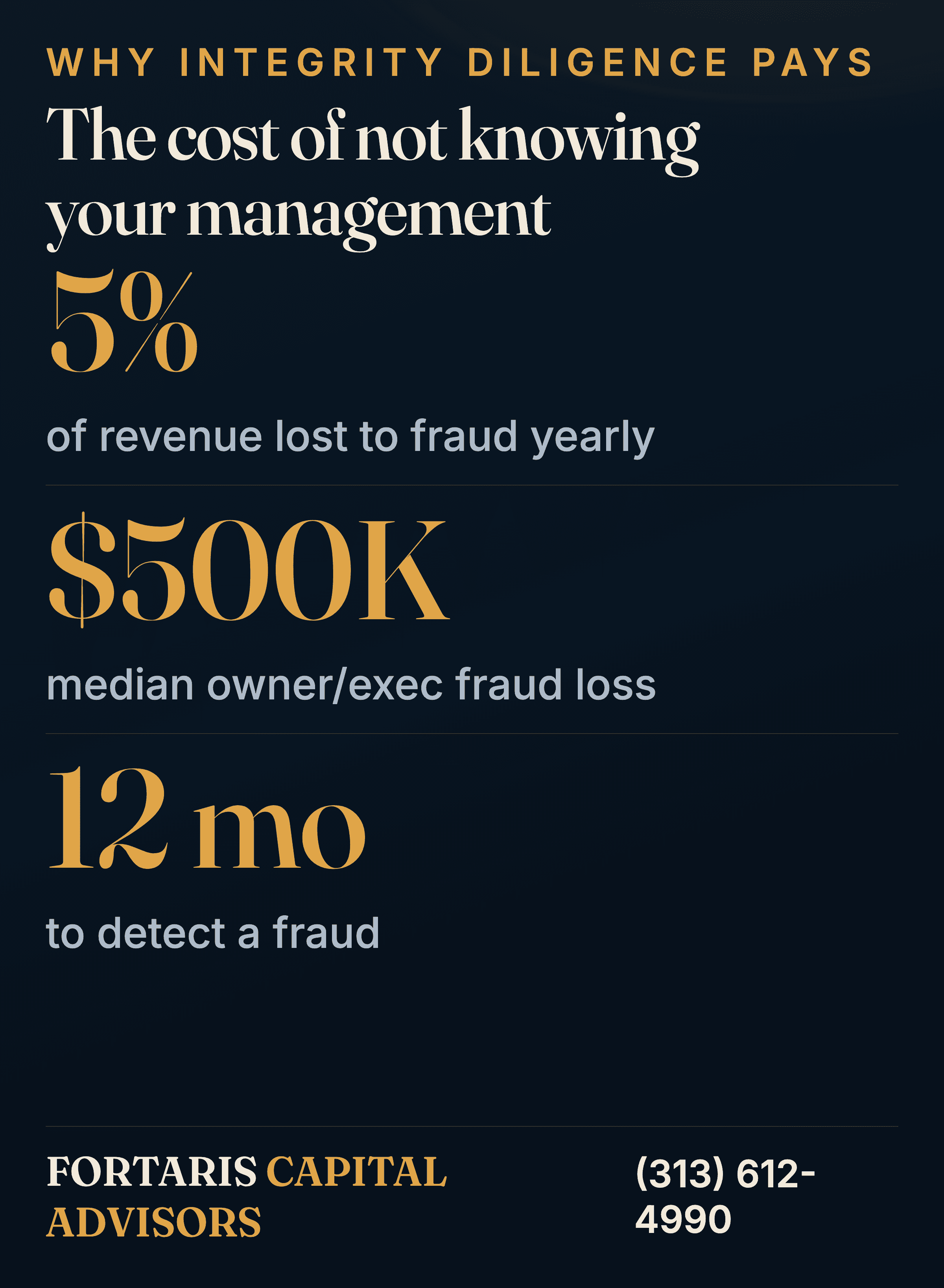
And the risk concentrates exactly where diligence is thinnest: at the top. The Association of Certified Fraud Examiners, in its 2024 Report to the Nations, estimates that organisations lose around 5% of revenue to fraud each year, that the median case runs for twelve months before it is detected, and — most relevant to a control investor — that while owners and executives commit a minority of frauds, roughly 19%, they cause by far the largest losses, a median of $500,000 per case. The people with the most authority do the most damage, and they are the people a sponsor is backing.
The uncomfortable implication is that the integrity of a management team is not a soft, qualitative footnote to a deal. It is a first-order financial risk, and it deserves the same rigour as the numbers it sits behind. The people-specific version of that work — what a management background investigation covers, where in the deal timetable to run it, and how findings convert into price and terms — is set out in investigative due diligence for private equity.
Management integrity: the first-order question
The core of PE integrity diligence is the management team, because in a control transaction the people are the asset that is hardest to replace and most able to cause harm. The work goes well beyond confirming a résumé.
It establishes the real track record — not just the wins a founder presents, but prior ventures that failed, litigation and regulatory history, disputes with former partners and investors, and any pattern of the same problems recurring across roles. It looks for undisclosed conflicts of interest and related-party arrangements that quietly move value. It tests source of wealth where that is relevant. And it does all of this through independent inquiry — public records, litigation and regulatory filings, discreet human-source work, and corroboration — rather than through the subject's own representations.
The point is not to assume bad faith. It is that the one fact capable of changing a deal is usually the one a motivated seller has an incentive to leave out — and the only reliable way to surface it is to look, independently, before the money moves. This is the same discipline as an enhanced-diligence review before an acquisition, pointed at the people rather than the balance sheet.
Ownership, sanctions, and corruption travel with the deal
Three exposures follow the target across the closing table regardless of what the model says, and each turns on facts a standard data room will not give you.
The first is ownership. You cannot clear a counterparty you cannot see through, and the public record has become a weaker guide to who really owns a company — the reasons are set out in our piece on the Corporate Transparency Act in 2026. Establishing beneficial ownership is now investigative work, and it is a precondition for the next exposure, not a formality.
The second is sanctions. OFAC enforces its prohibitions on a strict-liability basis for civil violations — a party can be liable without knowledge or intent — and screening a name against the sanctions list is not enough. Under OFAC's "50 Percent Rule," any entity owned 50% or more, in the aggregate, by one or more blocked persons is itself blocked even though it never appears on the list. Only ownership tracing surfaces that. The third is corruption: under long-standing doctrine an acquirer generally inherits a target's FCPA liability, which is why the Department of Justice's 2023 M&A Safe Harbor offers an acquirer that discovers, promptly discloses, and remediates misconduct a presumption of declination — a policy that explicitly rewards pre- and post-acquisition due diligence. FCPA enforcement was recalibrated under revised DOJ guidelines in 2025, but successor liability and the incentive to diligence before you buy remain. The mechanics of integrating this into the deal timeline are covered in our sanctions and reputational M&A playbook.
Where integrity diligence fits the deal lifecycle
The work is not a single gate; it maps onto the deal, and its value is highest early. At the screening stage, before an LOI, a light-touch integrity read on the principals and the ownership can flag a deal that should not proceed — the cheapest finding is the one that stops you spending diligence budget on a target you were never going to clear.
Through confirmatory diligence, the review deepens in proportion to the stakes: full management background, beneficial-ownership tracing, sanctions and corruption screening, litigation and reputation. This is also where diligence intersects with deal insurance — representations-and-warranties cover has become close to a default in the mid-market, and underwriters condition it on the buyer having done thorough diligence. Gaps in diligence become exclusions in the policy, so the investigative work is not only risk management; it protects the coverage the deal relies on.
The governing principle is timing. A finding before signing is a lever — it changes price, structure, the reps and indemnities, or the decision to proceed. The identical finding after closing is a loss to absorb. That is the concrete reason integrity diligence belongs in front of the deal, a logic the DOJ Safe Harbor now reinforces by rewarding pre-acquisition work directly.
It does not end at close: the portfolio and the bolt-ons
The hold period is not a diligence-free zone. Because fraud takes a median of twelve months to surface, a problem that existed at close often becomes visible only well into ownership — which argues for continuous, portfolio-level monitoring of integrity risk rather than a single pre-close check that is never repeated.
Buy-and-build strategies sharpen the point. In a platform-and-add-on model, the platform receives full diligence, but the bolt-ons are frequently acquired at speed and in volume, with far lighter scrutiny. The smallest, least-examined targets are precisely where undisclosed ownership, a compromised principal, or an inherited liability can enter the portfolio unnoticed and then compound. Applying a proportionate but real integrity screen to add-ons — not just the platform — is how a fund keeps a buy-and-build from importing the risk it was careful to exclude at the platform level.
This is where a sponsor benefits from an ongoing corporate-intelligence relationship rather than a transactional one: the same team that cleared the platform is best placed to watch the portfolio and to move quickly on the add-ons.
How to run it — and who should
A workable PE integrity programme comes down to a few disciplines. Engage early, so screening can kill a bad deal before it consumes budget. Scale the depth to the stakes rather than running every target through the same template. Insist on independent verification rather than management's own account. Treat beneficial ownership as a precondition for sanctions and corruption clearance, not a box. And extend the same posture — proportionately — to bolt-ons and to the hold period, not just the platform at close.
Who does the work matters as much as the checklist. Integrity diligence rewards genuine investigative capability — access to litigation and regulatory records, source work, cross-border reach, and the judgement to tell a real red flag from noise — combined with the discretion a live deal requires. Fortaris runs this work for private-equity deal teams as a senior-led engagement, built on federal investigative and forensic-accounting experience, through its corporate intelligence and investigative services practices — the independent read a fund relies on before it commits, and while a finding can still change the deal.
Key takeaways
- PE funds diligence the numbers and contracts rigorously but the people lightly — and the integrity layer (management, ownership, sanctions, corruption) is where the largest, least-predicted losses originate.
- The risk concentrates at the top: ACFE found owners and executives commit ~19% of frauds but cause the largest losses, a median of $500,000 — and the people with the most authority are exactly who a control investor is backing.
- Beneficial ownership is now investigative work, and it is a precondition for sanctions clearance — under OFAC's 50 Percent Rule an entity owned 50%+ by blocked persons is itself blocked even if it never appears on the list.
- An acquirer generally inherits a target's FCPA liability; the DOJ's 2023 M&A Safe Harbor rewards pre- and post-acquisition diligence, and successor liability persists even after FCPA enforcement was recalibrated in 2025.
- A finding before signing is a lever on price and terms; the same finding after closing is a loss to absorb — and integrity risk does not end at close, so bolt-ons and the hold period need the same posture as the platform.
Frequently asked
7 questionsHow is integrity due diligence different from the diligence a fund already does?
Financial, legal, and commercial diligence establish what a business is — its earnings, contracts, and market. Integrity (or investigative) due diligence establishes whether you can trust the people and what hidden risk travels with the deal: management's real track record, who ultimately owns the target, sanctions and anti-corruption exposure, undisclosed conflicts, and reputation. It relies on independent investigation rather than the target's own representations, and it is where deals most often fail for reasons the model did not predict.
Why does management integrity matter so much in a control deal?
Because in a control transaction the management team is the asset hardest to replace and most able to cause harm. The ACFE's 2024 Report to the Nations found that owners and executives commit a minority of frauds but cause by far the largest losses — a median of $500,000 per case — and that the median fraud runs twelve months before detection. The people a sponsor is backing are the people with the authority to do the most damage, which makes their integrity a first-order financial risk, not a soft factor.
What does beneficial-ownership tracing have to do with sanctions?
Everything, because of OFAC's 50 Percent Rule: an entity owned 50% or more, in the aggregate, by one or more blocked persons is itself blocked even though it never appears on the sanctions list. Screening a counterparty's name against the list will not catch that — only tracing who actually owns the entity will. Since OFAC enforces civil violations on a strict-liability basis, a sponsor can be liable without intent, which makes ownership tracing a precondition for sanctions clearance rather than a formality.
Can we inherit the target's FCPA (bribery) liability?
Generally, yes — under long-standing doctrine an acquirer inherits a target's FCPA liabilities. That is why the Department of Justice's 2023 M&A Safe Harbor offers an acquirer that promptly discloses and remediates misconduct discovered in an acquisition a presumption of declination, explicitly rewarding pre- and post-acquisition due diligence. FCPA enforcement was recalibrated under revised DOJ guidelines in 2025, but successor liability and the value of diligencing anti-corruption exposure before you buy remain. Confirm the current enforcement posture with counsel for a specific deal.
When in the deal should integrity diligence happen?
As early as screening, before an LOI, where a light read on the principals and ownership can stop a deal that should not proceed and save the diligence budget. It then deepens through confirmatory diligence in proportion to the stakes. The principle is that a finding before signing is a lever — it changes price, structure, reps, or the decision — while the same finding after closing is a loss to absorb. The DOJ Safe Harbor reinforces this by rewarding pre-acquisition work directly.
How does diligence affect reps-and-warranties insurance?
Directly. R&W insurance has become close to a default in mid-market private M&A, and underwriters condition coverage on the buyer having done thorough due diligence. Gaps in diligence tend to become exclusions in the policy — so the investigative work is not only risk management, it protects the coverage the deal is relying on. A thin diligence file can leave a fund carrying a risk it believed was insured.
Does integrity risk really need monitoring after close?
Yes. Fraud takes a median of twelve months to surface, so a problem present at close is often only visible well into the hold period — which favours continuous portfolio monitoring over a one-time check. Buy-and-build makes it more acute: bolt-on acquisitions are usually done at speed with lighter diligence than the platform, so the smallest, least-scrutinised targets can import the largest hidden risk. A proportionate integrity screen on add-ons, and periodic review across the portfolio, keeps that risk out.
Sources & further reading (6)
- 01Bain & Company — Global Private Equity Report 2026Reported roughly $1.3 trillion of buyout dry powder and a 2025 rebound in buyout deal value to about $904 billion across roughly 3,000 transactions at a record $1.2 billion average deal size — the scale that makes a single undisclosed problem material to a fund's return.
- 02ACFE — Occupational Fraud 2024: A Report to the NationsEstimates organisations lose around 5% of revenue to fraud annually, with a median case running twelve months before detection; owners and executives commit about 19% of frauds but cause the largest losses, a median of $500,000 per case.
- 03U.S. DOJ — M&A Safe Harbor Policy (announced by Deputy AG Lisa Monaco, 4 October 2023); DOJ/SEC FCPA Resource GuideEstablished a department-wide presumption of declination for acquirers that promptly disclose and remediate misconduct found in an acquisition, explicitly rewarding pre- and post-acquisition due diligence; the FCPA Resource Guide sets out successor-liability principles. FCPA enforcement was recalibrated under revised DOJ guidelines in 2025.
- 04U.S. Treasury OFAC — Entities Owned by Blocked Persons (the 50 Percent Rule); OFAC civil enforcementAn entity owned 50% or more, in aggregate, by one or more blocked persons is itself blocked even if not listed; civil sanctions violations are enforced on a strict-liability basis — making beneficial-ownership tracing essential to clear a counterparty.
- 05Bain & Company — M&A practitioner researchSurvey work found a large share of executives had pursued major deals without a clearly defined investment thesis, and identifies management problems as a recurring driver of post-close underperformance — context for why the people, not just the numbers, decide outcomes.
- 06WTW and transactional-risk market reports — Representations & Warranties insuranceDescribe R&W insurance as close to a default feature of mid-market private M&A, with coverage conditioned on thorough buyer due diligence, such that diligence gaps become policy exclusions.