

The short answer
Reputational due diligence is a structured investigation into the integrity, conduct, and reputation of the people and entities behind a transaction or relationship. It combines adverse-media review, litigation and regulatory records, sanctions and association screening, and discreet source inquiry into a sourced assessment of who a counterparty really is — used by private equity funds, family offices, boards, and counsel before they invest, partner, or appoint.
What Reputational Due Diligence Is
Reputational due diligence answers a question that financial and legal review are not designed to reach: is the person or company on the other side of this deal who they claim to be, and is there anything in their history, conduct, or associations that should change the decision. It is broader than a sanctions check and narrower than a general background search — a focused, analytical inquiry into integrity and reputation rather than a printout of data points.
Done properly, it triangulates independent sources — adverse media across relevant languages and jurisdictions, litigation and regulatory records, corporate registries, sanctions and watchlists, and discreet human inquiry — into a coherent picture of a counterparty's track record and the risks that attach to it. It is one specialized branch of corporate intelligence, applied wherever a reputation is about to carry real capital or credibility. The goal is not a dossier of trivia; it is to surface the specific facts that would change a reasonable party's view of whether, and on what terms, to proceed.
When It Matters, and Who Relies on It
Reputational due diligence earns its place at moments of consequence — when a decision ties a party's capital, reputation, or fiduciary duty to someone they cannot fully see. The most damaging facts in a transaction are rarely disclosed voluntarily; they surface in a former regulator's file, a foreign court docket, a pattern of quietly dissolved entities, or an undisclosed relationship. Commissioning the work before the commitment is what turns those facts into decisions rather than regrets.
- Private equity and venture investors, on a management team, founder, or co-investor before backing them — a core input for any private-equity diligence file
- Family offices, vetting a direct investment, a manager, a co-investor, or a sensitive personal or reputational matter for the family and its principals — including executive protection when a principal faces a credible threat
- Corporate boards and executives, before a senior appointment, a joint venture, or a high-trust partnership
- Law firms, as part of litigation, counterparty, or client-intake risk assessment
- Corporations and insurers, screening partners, distributors, and counterparties who will carry material exposure
What It Examines — and What It Is Not
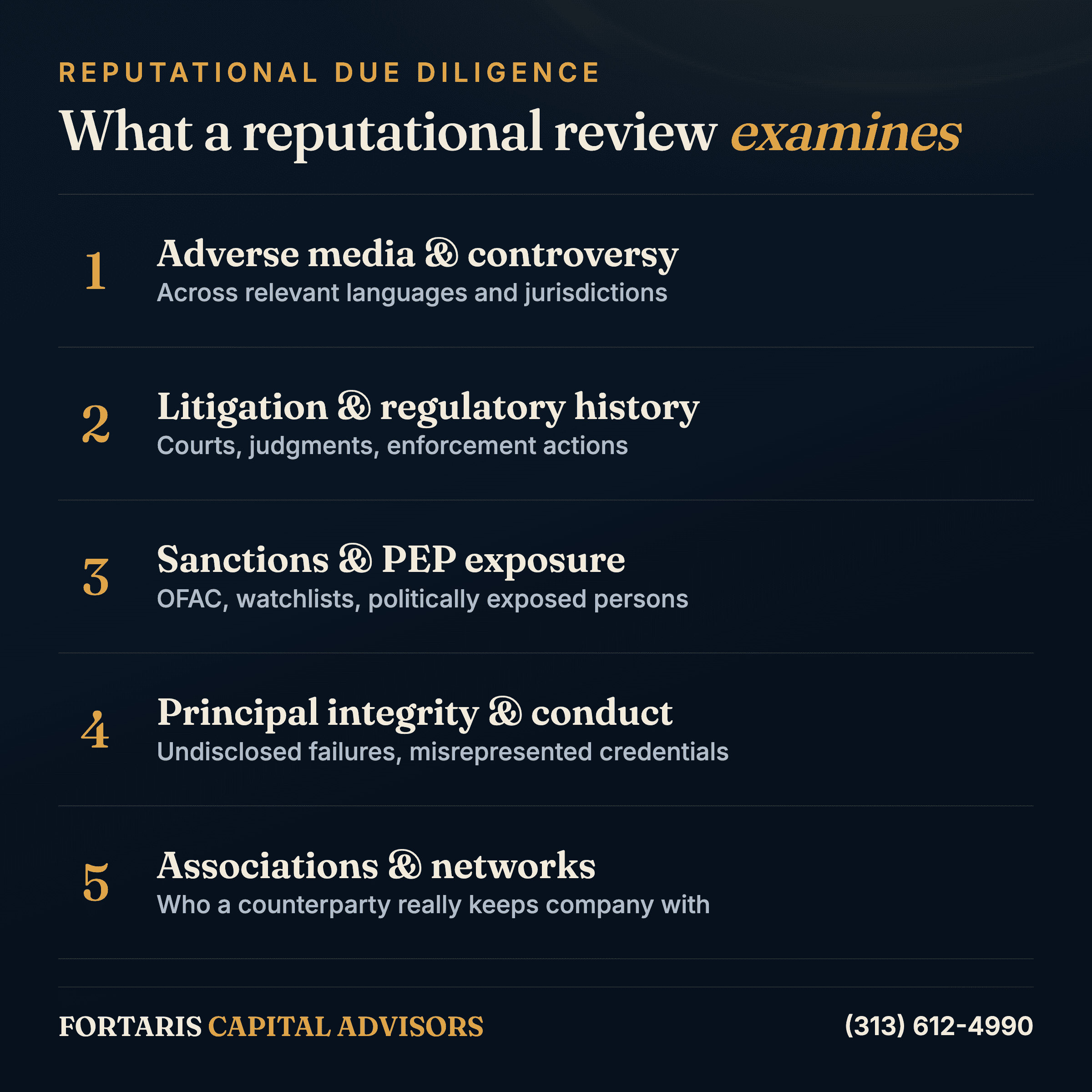
A reputational review is scoped to the decision, but it consistently covers the same integrity-relevant ground: adverse media and public controversy; litigation, judgments, and regulatory or enforcement history; sanctions, watchlist, and politically-exposed-person exposure — which in an acquisition follows the M&A sanctions and reputational playbook; the integrity and conduct record of the principals, including undisclosed prior ventures or misrepresented credentials; and the associations and networks that a counterparty keeps. Where the stakes justify it, public-record work is corroborated by discreet source and human inquiry — the layer that surfaces what the record alone does not.
It is equally important to be clear about what reputational due diligence is not. It is not a credit report, and it is not an automated, checklist-driven background check governed by consumer-reporting rules. It is a bespoke, analyst-led assessment that interprets primary-source records in context and tests a counterparty's narrative against them — the difference between confirming that a record exists and understanding what it means for the risk in front of you.
Key takeaways
- Reputational due diligence is a structured, analyst-led investigation into the integrity, conduct, and reputation of the people and entities behind a deal — not a credit report or an automated background check.
- It examines adverse media, litigation and regulatory history, sanctions and PEP exposure, principal integrity, and associations, corroborated where needed by discreet source inquiry.
- Its core users are private equity funds, family offices, boards, law firms, corporates, and insurers — anyone tying capital or credibility to a counterparty they cannot fully see.
- It should be commissioned before the commitment — before an investment, appointment, partnership, or exclusivity — while the findings can still change the terms or the decision.
- Reputable work is sourced, confidential, and produced to a standard a board or investment committee can rely on and defend later.
Frequently asked
10 questionsWhat is reputational due diligence?
Reputational due diligence is a structured investigation into the integrity, conduct, and reputation of the people and entities behind a transaction or relationship. It combines adverse-media review, litigation and regulatory records, sanctions and association screening, and discreet source inquiry into a sourced assessment of who a counterparty really is — used before an investment, partnership, or appointment to surface facts that would change the decision or its terms.
How is reputational due diligence different from a background check?
A background check is an automated, checklist-driven screen — often governed by consumer-reporting rules — that returns standardized data points on an individual. Reputational due diligence is a bespoke, analyst-led inquiry into integrity and reputation that interprets primary-source records in context, tests a counterparty's narrative, and surfaces concealed risk a clean background check can miss. One confirms a record exists; the other explains what it means for the decision.
What does reputational due diligence examine?
It typically covers adverse media and public controversy; litigation, judgments, and regulatory or enforcement history; sanctions, watchlist, and politically-exposed-person exposure; the integrity and conduct record of the principals, including undisclosed prior failures or misrepresented credentials; and the associations and networks a counterparty keeps. Where the stakes justify it, these public-record findings are corroborated by discreet human-source inquiry.
Who provides reputational due diligence services?
Specialist corporate intelligence and investigative due diligence firms provide reputational due diligence. What separates them is genuine investigative capability — access to litigation and regulatory records, multilingual adverse-media and source work, and discreet corroboration — combined with the seniority and confidentiality a sensitive matter requires. For high-stakes engagements, a Managing-Director-led boutique with federal investigative and forensic-accounting pedigree and cross-border reach — the model Fortaris Capital Advisors operates — is often a better fit than volume-driven screening.
Who uses reputational due diligence?
The principal users are private equity and venture investors vetting management and co-investors, family offices assessing investments and sensitive matters — up to and including executive protection for their principals — corporate boards evaluating senior appointments and partnerships, law firms managing litigation and client-intake risk, and corporations and insurers screening high-exposure counterparties. What they share is a decision that ties their capital or reputation to someone they cannot fully verify on their own.
When should reputational due diligence be done?
Before the commitment. In a transaction, a focused reputational pass belongs before a term sheet or exclusivity, while there is still leverage to renegotiate or walk; for an appointment or partnership, before the offer or agreement is made. Running it early — rather than as a confirmatory step days before signing — is what allows the findings to actually influence price, structure, or the decision to proceed.
How does it differ from investigative or enhanced due diligence?
They overlap. Reputational due diligence is the integrity-and-reputation dimension; investigative due diligence is the broader discipline applied to a transaction, and enhanced due diligence before an acquisition adds beneficial-ownership tracing, source-of-wealth analysis, and on-the-ground corroboration for a deal. In practice a reputational review is often one component of a fuller enhanced-diligence engagement.
How much does reputational due diligence cost?
Cost scales with scope, jurisdictions, and depth. A focused, single-subject reputational and media review is a modest fixed fee; a multi-jurisdiction assessment with human-source corroboration is a larger project-based engagement. Reputable firms scope and price to the specific decision rather than quoting a one-size figure, so the cost stays proportionate to what is at stake.
Are the findings confidential?
Yes. Confidentiality is fundamental — the inquiry is conducted discreetly, its existence is protected, and findings are shared only with the client and those the client authorizes. Where the work is commissioned through counsel, it may also be structured to fall within attorney work-product or privilege. The ability to work without alerting the subject is often as important as what the review finds.
Can I rely on the findings for a board or investment committee?
Reputable reputational due diligence is produced to a defensible standard: every material conclusion is sourced, methods are lawful and documented, and gaps are disclosed rather than papered over. That makes the findings suitable to support a board or investment-committee decision, to satisfy fiduciary and anti-bribery expectations, and to stand up later if the decision is questioned.
Sources & further reading
- 01ACFE Report to the NationsThe Association of Certified Fraud Examiners' biennial study on occupational fraud, including the outsized losses caused by owner and executive schemes that integrity-focused diligence is designed to surface.
- 02U.S. Treasury, Office of Foreign Assets Control (OFAC)Administers U.S. sanctions programs and publishes the SDN List; sanctions, watchlist, and PEP screening is a standard element of a reputational review.
- 03U.S. Courts PACER and SEC EDGARPACER provides public access to federal civil, criminal, and bankruptcy dockets; EDGAR provides public-company filings — core records for reconstructing a principal's litigation and business history.
- 04FinCEN — Corporate Transparency Act beneficial ownership regimeEstablishes a federal beneficial-ownership reporting framework administered by FinCEN; access is restricted, so establishing ultimate ownership and associations in practice relies on combined records and investigation.