

The short answer
Investigative due diligence for private equity vets the people a fund is backing, not the numbers it is buying. It covers management background investigations, undisclosed litigation in the courts that actually heard it, prior-entity histories, undisclosed conflicts and reputation from people who have worked with them. Financial and legal diligence verify the business; this verifies the team that will run it.
The team is part of what you are buying
In most sponsor-backed transactions the management team is not an operating detail of the asset — it is a substantial part of the thesis. The team stays, often rolls equity, and is expected to deliver the plan the model is built on. A fund is therefore underwriting two things at once: a business, and a small number of people whose judgment, incentives and history will determine whether the business performs as modelled.
The diligence workstreams get very unequal attention. Quality of earnings will be forensic. Legal diligence will read every material contract. Commercial diligence will test the market — and where the question is whether the position survives what competitors do next, competitive intelligence tests that separately. And the people who will actually run the company are frequently assessed through a management presentation, a reference call or two arranged by the sellers, and the general impression formed across a few dinners.
This piece is deliberately narrow. The broader deal-team process — workstream sequencing, what each covers, how findings land in the investment committee memo — is set out in the private equity due diligence playbook. What follows is only the investigative layer, and only as it applies to people: management, sellers, rollover partners and the counterparties they bring with them.
What the other workstreams structurally cannot see
It is worth being precise about why this gap exists, because it is not a failure of the other advisers. It is a scope boundary.
A quality-of-earnings analysis examines the company's records. It is exceptionally good at that and says nothing about a chief executive's personal litigation history, because that history is not in the company's records. Legal diligence reviews the disclosed contracts, corporate documents and the litigation the seller schedules — the operative word being disclosed. A data room is a curated object; its contents are chosen. And management references supplied by a seller are, reasonably enough, references the seller expects to be favourable.
None of this is concealment in the ordinary case. It is simply that each workstream answers the question it was scoped to answer, and nobody has been asked the question that matters here: independent of what we have been shown, who are these people and what does the record actually say about them? That is the question investigative due diligence exists to answer, and the integrity dimension of it is set out at length in the reputational due diligence playbook.
What a management background investigation covers
Scoped properly, the work is narrower and more pointed than the phrase suggests. It is not a personality assessment and it is not a credit check. It is verification of a specific record for a specific set of named individuals — typically the chief executive, the finance lead, any founder rolling equity, and anyone whose departure would break the thesis.
- Identity and credential verification — that the person is who the biography says, and that the degrees, licences, professional credentials and prior roles are real and correctly dated. Résumé inflation in the dates is more common, and more diagnostic, than invented roles.
- Litigation in personal capacity — suits, judgments and liens naming the individual rather than the company, across the jurisdictions where they have actually lived and worked.
- Prior-entity history — the businesses they ran before this one, including dissolved entities. What happened to the last company is the single most predictive fact available about a management team, and it is the one a data room never contains.
- Regulatory, licensing and enforcement exposure — professional discipline, securities and industry regulator actions, and any bar or disqualification.
- Conflicts and undisclosed relationships — related-party dealings, undisclosed interests in suppliers or customers, and connections to the transaction's own advisers.
- Sanctions, watchlist and where relevant politically-exposed-person exposure, tested through ownership and control rather than name matching alone.
- Reputation from primary sources — discreet inquiry with former colleagues, counterparties and investors who are not on the seller's reference list.
Undisclosed litigation: the specific gap
Of everything on that list, undisclosed litigation is the finding that most often changes a deal, and the reason is structural rather than moral. The United States has no single searchable national record of civil litigation. Federal matters are reachable through PACER; the overwhelming majority of commercial and employment disputes against mid-market companies and their executives are heard in state trial courts, county by county, on systems that vary in quality and are unevenly indexed by the commercial aggregators.
The practical consequence is that a subject can be perfectly candid in a disclosure schedule and still leave material matters off it, and a database search can come back clean on a person with a substantial docket. Finding it requires knowing which counties to search — which means establishing where the individual and their prior entities actually operated, then searching those courts directly rather than trusting a national index.
Employment and discrimination claims deserve specific mention. They rarely appear in a seller's litigation schedule because they were settled, they name the individual as well as the company, and a pattern of them across two or three prior employers is materially different information from a single settled claim. That pattern is exactly what a county-level search surfaces and a national database does not.
When in the deal to run it
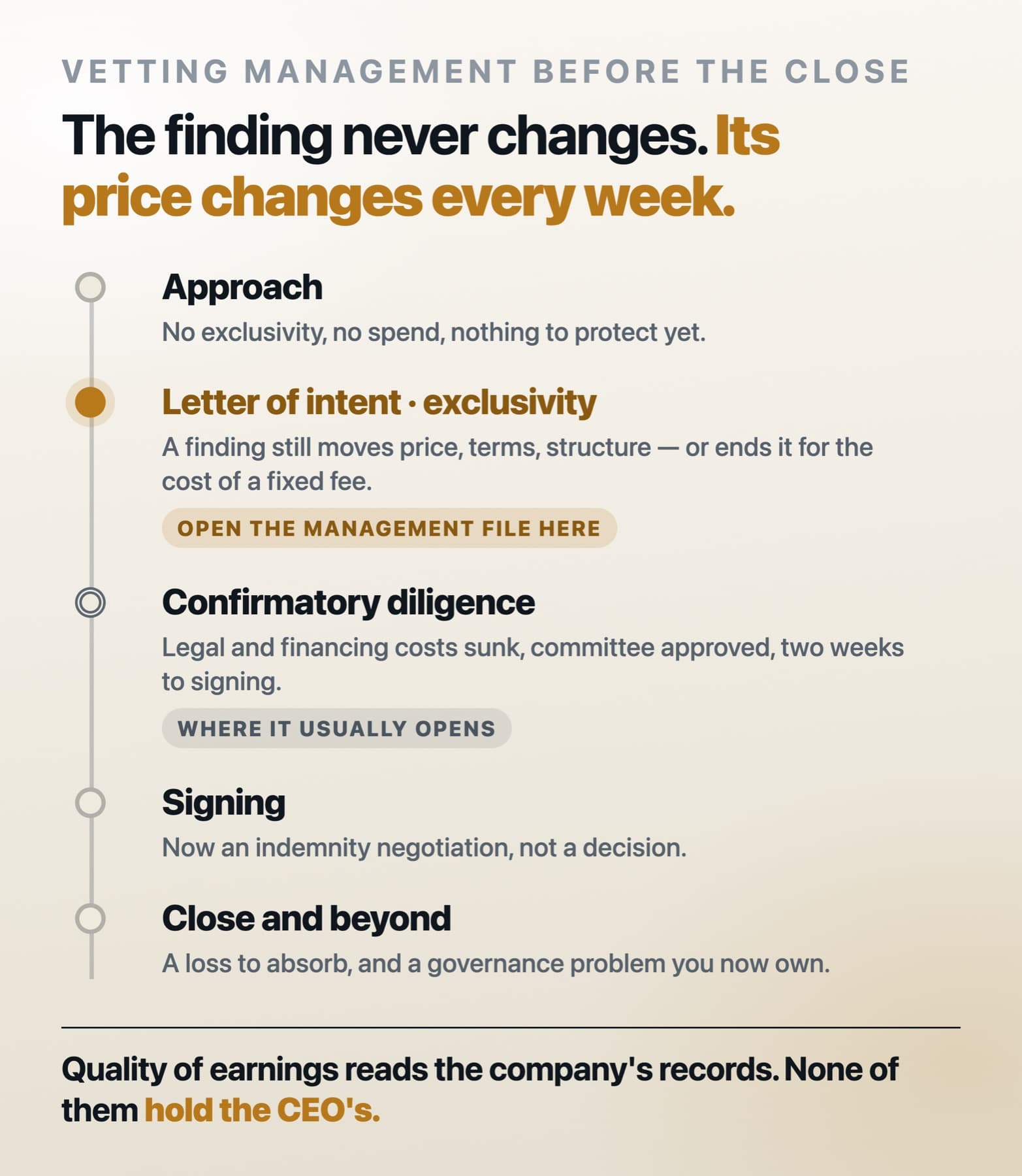
The cost of a finding rises steeply with the date it arrives, and the work is cheap relative to every other workstream — which makes the usual sequencing hard to defend.
The right moment to open the file is at or immediately after the letter of intent, when exclusivity has been granted and the fund is about to start spending real money on advisers. At that point a finding is nearly free: it changes the price, the terms, or whether the fund proceeds at all, and no relationship has yet been built that the finding would damage. Run instead as a confirmatory box-tick in the final fortnight, the same finding arrives when legal fees are committed, the financing is arranged, the investment committee has approved, and the practical choice has narrowed to accepting a risk nobody has time to size.
There is also a category of finding that only shows up early enough to be useful. If the diligence discovers that the CEO's prior company failed in a way that is relevant to this one, that is a thesis-level question about whether the plan is deliverable by this team. It cannot be answered in the last week before signing, because the answer might be that the deal needs a different management structure — a change that has to be negotiated, not discovered.
Running it without poisoning the relationship
The obvious objection to all of this is relational. These people are prospective partners, they will still be running the company on Monday, and starting a partnership by investigating your partner is an awkward opening.
In practice the objection dissolves once the work is framed correctly, and the framing is honest: this is standard institutional diligence run on every transaction, it is run on the team rather than about any individual, and it is the same standard the fund's own limited partners apply to the fund. Most experienced operators have been through it before and read it as a sign that the counterparty is institutional rather than as an accusation. The teams that react badly to a routine, disclosed verification are themselves providing information.
Two practical rules make it work. Disclose that it is happening rather than conducting it covertly — covert vetting of a future partner is both unnecessary and, if discovered, far more damaging than the inquiry itself. And put adverse findings to the individual before acting on them. Records are wrong more often than people expect: name collisions, dismissed claims, matters where the subject was the plaintiff. A finding that has not been put to its subject is not yet a fact, and treating it as one is how a good deal gets killed by an incorrect database entry.
What findings actually do
Most findings do not end deals, and a process that assumes they will is a process that gets run too late to be useful. Findings mostly reprice risk and reshape terms.
An adverse pattern in an executive's history typically converts into structure: a larger holdback or escrow, specific indemnities, a tightened non-compete, a governance change such as an independent chair or an outside finance lead, or a rollover and retention package restructured so the incentive matches the risk. A prior-entity failure may lead to bringing in a second operator rather than to walking away. An undisclosed related-party relationship becomes a contractual disclosure obligation and a related-party approval process.
The findings that genuinely end transactions are narrower than people assume. They are the ones that make everything else unreliable: sanctions or ownership exposure that cannot be structured around, a demonstrable pattern of concealment, or a material misrepresentation made directly to the fund during the process. The last of those matters most. A false statement in diligence is not one bad fact — it is evidence about how the team will behave when the plan is behind and the sponsor asks a difficult question.
After the close
The same discipline has a second life once the fund owns the asset. Add-on acquisitions are transactions in their own right and are frequently run with a fraction of the platform deal's diligence, on the reasoning that they are small — which is precisely when an unverified seller and an unverified management team enter the portfolio.
Two more moments deserve the same treatment: senior hires into portfolio companies, where the fund is now the employer and the inquiry may fall under the Fair Credit Reporting Act with its notice and consent obligations, and any counterparty who will hold portfolio company funds or data. The transaction-level version of the checklist is set out in the enhanced due diligence checklist; where a principal's wealth or funding source is itself the question, that is the narrower exercise described in source of wealth and source of funds verification.
A note on choosing who does the work, since the quality range in this market is wide and largely invisible from the proposal: the tests worth applying are set out in how to choose a due diligence company. For funds, the two that matter most are who actually performs the research, and whether the report distinguishes an established fact from an allegation — because an investment committee cannot act on a document that does not. How Fortaris scopes and times this work against a fund's signing date is set out on its due diligence investigations page.
Key takeaways
- A sponsor underwrites the management team as well as the asset, but the team routinely receives the least independent verification of any workstream in the deal.
- Quality of earnings examines the company's records and legal diligence reviews disclosed documents — neither is scoped to reach an executive's personal litigation history or prior-entity record, and neither failure is the adviser's fault.
- There is no national US index of civil litigation: most commercial and employment claims sit in state trial courts county by county, so a clean database result on an individual is not the same as a clean record.
- Open the file at the letter of intent, not in confirmatory diligence. The same finding costs almost nothing before exclusivity spending starts and very little can be done with it in the final fortnight.
- Disclose that the vetting is happening and put adverse findings to the subject before acting on them — records carry name collisions and dismissed claims, and an unverified finding is not yet a fact.
Frequently asked
10 questionsWhat is investigative due diligence in private equity?
The workstream that independently verifies the people in a transaction rather than its financials: management background investigations, litigation naming individuals in personal capacity, prior-entity histories, regulatory and licensing exposure, undisclosed conflicts and related-party dealings, sanctions and PEP exposure, and reputation gathered from sources the seller did not supply. It sits alongside financial, legal and commercial diligence and answers the question none of them is scoped to answer.
How is it different from financial due diligence?
Financial due diligence tests the company's reported earnings, working capital and cash generation using the company's own records. Investigative due diligence tests assertions about people using records the company does not hold — court files, regulatory registers, corporate registries for prior entities, property records, and human sources. One tells you what the business earned; the other tells you who will be running it and whether anything material has been left out of what you were shown.
When in the deal process should management vetting happen?
At or immediately after the letter of intent, once exclusivity is granted and before significant adviser spend is committed. At that point a finding can still change price, terms, structure or the decision to proceed. Run as a confirmatory step in the final two weeks, the same finding arrives after legal and financing costs are sunk and the investment committee has approved, when the practical options have narrowed to accepting an unsized risk.
Why does undisclosed litigation keep getting missed?
Because the United States has no single national record of civil litigation. Federal cases are reachable through PACER, but most commercial and employment disputes involving mid-market companies and their executives are heard in state trial courts, county by county, on systems of varying quality that commercial aggregators index unevenly. Finding those matters requires establishing where the individual and their prior entities actually operated and then searching those courts directly.
Will vetting management damage the relationship with the team?
Not when it is framed and run properly. Disclose that it is happening, present it as standard institutional diligence applied to every transaction and to the team rather than to any individual, and put any adverse finding to the subject before acting on it. Most experienced operators have been through the process and read it as a mark of an institutional counterparty. A strong negative reaction to a routine disclosed verification is itself information.
What does a management background investigation actually cover?
Identity and credential verification including dates; litigation, judgments and liens naming the individual personally; the history of prior entities they led, including dissolved ones; regulatory, licensing and enforcement exposure; conflicts and undisclosed related-party relationships, including with the transaction's advisers; sanctions, watchlist and where relevant PEP exposure tested through ownership and control; and discreet reputation inquiry with counterparties who are not on the seller's reference list.
What happens if the investigation finds something?
Most findings reprice risk rather than end deals. They convert into structure: a larger escrow or holdback, specific indemnities, governance changes such as an independent chair or outside finance lead, a restructured rollover and retention package, or contractual disclosure and approval obligations around related parties. Deals end on findings that make everything else unreliable — unstructurable sanctions or ownership exposure, a demonstrable pattern of concealment, or a material misrepresentation made to the fund during the process.
Does this apply to add-on acquisitions?
Yes, and add-ons are where it is most often skipped. They are transactions in their own right, frequently run with a fraction of the platform deal's diligence on the basis that they are small — which is exactly the circumstance in which an unverified seller and an unverified management team enter the portfolio. The same applies to senior hires into portfolio companies and to any counterparty holding portfolio company funds or data.
Is management vetting regulated as a background check?
It depends on the purpose. Transaction diligence on a counterparty's principals generally sits outside the Fair Credit Reporting Act. Once a fund is the employer — a senior hire into a portfolio company, for example — an inquiry used for employment purposes can fall inside that regime, which brings notice, written consent, disclosure of adverse action and dispute rights with it. The boundary is a legal question and belongs in the engagement scope from the outset.
How long does it take and what does it cost?
A scoped management investigation on a domestic team of three to five individuals typically runs one to three weeks and is quoted as a fixed fee — a small figure beside the quality-of-earnings and legal budgets on the same transaction. The cost drivers are the number of named subjects, the number of jurisdictions each has genuinely operated in, whether discreet human-source inquiry is in scope, and speed. Where the timetable is tight, the work is phased so an early read is available while deeper threads continue.
Sources & further reading (6)
- 01DOJ and SEC — A Resource Guide to the U.S. Foreign Corrupt Practices ActAddresses pre-acquisition due diligence and successor liability directly: an acquirer can inherit the liabilities of what it buys, which is why diligence on principals and intermediaries is treated as a compliance obligation and not only a commercial preference.
- 02U.S. Department of Justice, Criminal Division — Evaluation of Corporate Compliance ProgramsAsks specifically how a company conducts due diligence in mergers and acquisitions and how quickly acquired entities are integrated into its compliance program — the standard against which a sponsor's own diligence process is measured after something goes wrong.
- 03ACFE — Report to the NationsThe global occupational-fraud study consistently finds that schemes committed by owners and executives are the least frequent but by far the most costly, with median losses an order of magnitude above those committed by employees — the empirical case for concentrating verification on the small group at the top.
- 04Fair Credit Reporting Act, 15 U.S.C. § 1681Governs consumer reports used for employment, credit and insurance decisions, bringing notice, written consent and adverse-action obligations. The line matters after close, when a fund hiring into a portfolio company becomes the employer rather than a transaction counterparty.
- 05OFAC — Revised Guidance on Entities Owned by Blocked Persons (the 50 Percent Rule)Property of an entity owned 50% or more in the aggregate by blocked persons is itself blocked even where the entity is not listed — the reason principal-level screening has to be run through ownership and control rather than by matching names against a list.
- 06PACER and the state trial court systemsFederal civil matters are searchable through PACER, but there is no equivalent national index for state courts, where most commercial and employment litigation against mid-market companies and their executives is actually heard — the structural reason undisclosed litigation survives a database search.