

The short answer
Recovering money lost to cross-border fraud depends far more on speed than on litigation. In the first hours, banking mechanisms can freeze funds before they are dispersed. After that, recovery runs through slower legal machinery — freezing orders, cross-border discovery, mutual legal assistance, and enforcement of a judgment in the jurisdiction where the assets actually sit. Each step requires proof of where the money went.
The first question is not legal. It is how many hours have passed.
When a company discovers it has been defrauded across a border, the instinct is to reach for a lawyer. That instinct is correct eventually, and almost always too slow to matter for the money itself. The funds move through the banking system on a clock that has nothing to do with litigation timetables, and the single largest determinant of whether anything is recovered is how quickly the payment is flagged to the institutions that still hold it.
The FBI's Internet Crime Complaint Center runs a mechanism built entirely around this reality. Its Recovery Asset Team, established in 2018, operates what it calls the Financial Fraud Kill Chain: on a fast-enough report, it coordinates with receiving banks to freeze fraudulently induced transfers before the funds are moved on. In 2024 the team attempted recovery on 3,020 complaints representing $848.4 million and froze $561.6 million — a 66% success rate on the cases it was able to act on.
That success rate is the encouraging number. The sobering one sits beside it: total losses reported to the IC3 in 2024 were $16.6 billion. The overwhelming majority of defrauded money is never frozen at all, and the difference is very often that nobody reported it fast enough for the mechanism to work.
So the first hour matters more than the first month. Notify the originating bank and ask it to initiate a recall; file with IC3; and preserve every instruction, header, and account detail exactly as received. This is the same evidentiary discipline described in how a cross-border fraud investigation works — and it is the foundation everything below depends on.
Why the border itself is the problem
A domestic fraud and a cross-border fraud are not the same problem with a longer flight. Domestically, one legal system governs the wrongdoer, the bank, the court, and the enforcement officer. Across borders, those four can sit in four jurisdictions, each with its own rules about what can be frozen, what can be disclosed, and whose orders it will honour.
This is visible in the design of the recovery mechanisms themselves. The kill chain began as a domestic instrument — a way to reach receiving banks inside the United States — and only extended to domestic-to-international transactions in April 2024, through an international variant coordinated with foreign partners. The reason is structural: a U.S. agency can ask a U.S. bank to hold funds; asking a bank in another jurisdiction to do the same requires a relationship, a legal basis, or both.
The practical consequence is that every hop the money takes across a frontier lengthens the recovery timeline and narrows the available remedies. Funds that pass through two or three jurisdictions before landing are not merely harder to find; they may be sitting somewhere that will not recognise the order you eventually obtain.
Freezing the assets: the remedy most people assume exists
The instrument everyone has heard of is the worldwide freezing order — the English Mareva injunction, which restrains a defendant from dissipating assets while a claim is decided. It is a genuinely powerful tool, and it is one of the reasons London and other common-law jurisdictions attract cross-border fraud claims.
It is also substantially narrower in United States federal court than most claimants expect. In Grupo Mexicano de Desarrollo, S.A. v. Alliance Bond Fund, Inc. (1999), the Supreme Court held that a federal district court has no authority to issue a preliminary injunction freezing a defendant's assets pending adjudication of a claim for money damages, because that remedy was historically unavailable in equity. The plaintiffs there alleged the defendant was insolvent and preferring other creditors; the injunction was still improper.
The distinction that survives Grupo Mexicano matters enormously in practice. Where the claim is equitable — where the claimant asserts an interest in specific property, such as funds traceable to the fraud itself — asset-preservation relief remains available. Where the claim is simply for money owed, it generally is not. This is one of the strongest reasons to invest early in tracing: establishing that particular funds in a particular account are the proceeds of the fraud can be the difference between a remedy and none.
State courts and other jurisdictions offer their own attachment and injunctive procedures, and the analysis differs again where a receivership or an insolvency process is available. The general point holds: in a cross-border case, where you can freeze is often a more important question than whether you are right.
Getting the evidence: Section 1782 and its recent limits
One of the most useful and least understood tools in cross-border fraud sits in the United States Code. Section 1782 of Title 28 allows a party to foreign proceedings to apply to a U.S. district court for discovery — documents and testimony — located in the United States, for use abroad. Because American discovery is broad by international standards, it can produce material a foreign court could never have compelled itself.
In a fraud case this is frequently decisive. Correspondent banking means that a dollar-denominated payment between two non-U.S. parties often leaves records with a U.S. institution, and Section 1782 is the route to those records. It is a common way of establishing where money actually went when the defendant's own disclosure is unreliable.
The statute's reach narrowed in 2022. In ZF Automotive US, Inc. v. Luxshare, Ltd., a unanimous Supreme Court held that Section 1782 reaches only governmental or intergovernmental adjudicative bodies — resolving a circuit split and closing the statute to private international commercial arbitration. The Court also declined to extend it to an investor-state panel that, although constituted under a treaty, was not itself created by governments or exercising sovereign authority.
The planning consequence is concrete: if a dispute is headed to private arbitration rather than a foreign court, this avenue is likely closed, and the evidence strategy has to be built differently from the outset. That is a decision to take before the forum is chosen, not after.
The criminal route, and its honest limits
Where the conduct is criminal, a parallel machinery exists. Mutual Legal Assistance Treaties allow prosecutors in one country to request evidence, and in some cases asset freezing and forfeiture, from another; in the United States these run through the Department of Justice's Office of International Affairs. For corruption-related losses, Chapter V of the United Nations Convention against Corruption establishes asset recovery as a treaty principle, and the World Bank and UNODC's Stolen Asset Recovery Initiative exists to support exactly this work.
Two honest caveats belong with that description. The first is that MLAT requests move on government timetables, not commercial ones — months is normal, longer is common — and they are made by prosecutors, not by victims. A company can refer a matter and cooperate; it cannot direct the request or control its priority.
The second is that a criminal forfeiture recovers assets to the state, and whether a victim is compensated depends on the restitution or remission process that follows. Criminal referral is often the right thing to do, and it can unlock evidence and freezes that civil process cannot reach. It is rarely, by itself, the fastest route to getting the money back — which is why serious matters usually run a civil and a criminal track in parallel.
Winning is not collecting: enforcement where the assets sit
A judgment is an instrument, not a payment. In a cross-border matter the court that hears the case is frequently not the place where anything collectible is located, and a domestic judgment has no automatic force abroad.
Recognition of a foreign money judgment is governed jurisdiction by jurisdiction — in much of the United States by state adoptions of the Uniform Foreign-Country Money Judgments Recognition Act, and elsewhere by local statute, treaty, or reciprocity practice. Some jurisdictions will not enforce at all absent a treaty relationship. Arbitral awards travel considerably better: the 1958 New York Convention obliges its contracting states to recognise and enforce awards subject to narrow exceptions, which is a substantial and often decisive advantage of an arbitration clause in a cross-border contract.
This is why collectability belongs at the beginning of the analysis rather than the end. Before a claim is filed there is a question worth answering honestly: if we win, what will we enforce against, and where is it? Where the answer is unknown, an asset trace is not an optional refinement — it is what determines whether the litigation is an investment or an expense. Where the defendant and the assets are domestic, the post-judgment version of that exercise is asset tracing for judgment enforcement.
It is also the question that decides whether to sue at all. A well-pleaded claim against a defendant with no reachable assets produces a judgment and a legal bill. That assessment is part of what litigation support work exists to provide before the decision is made.
How the pieces fit together
Set out as a sequence rather than a menu, the realistic path looks like this.
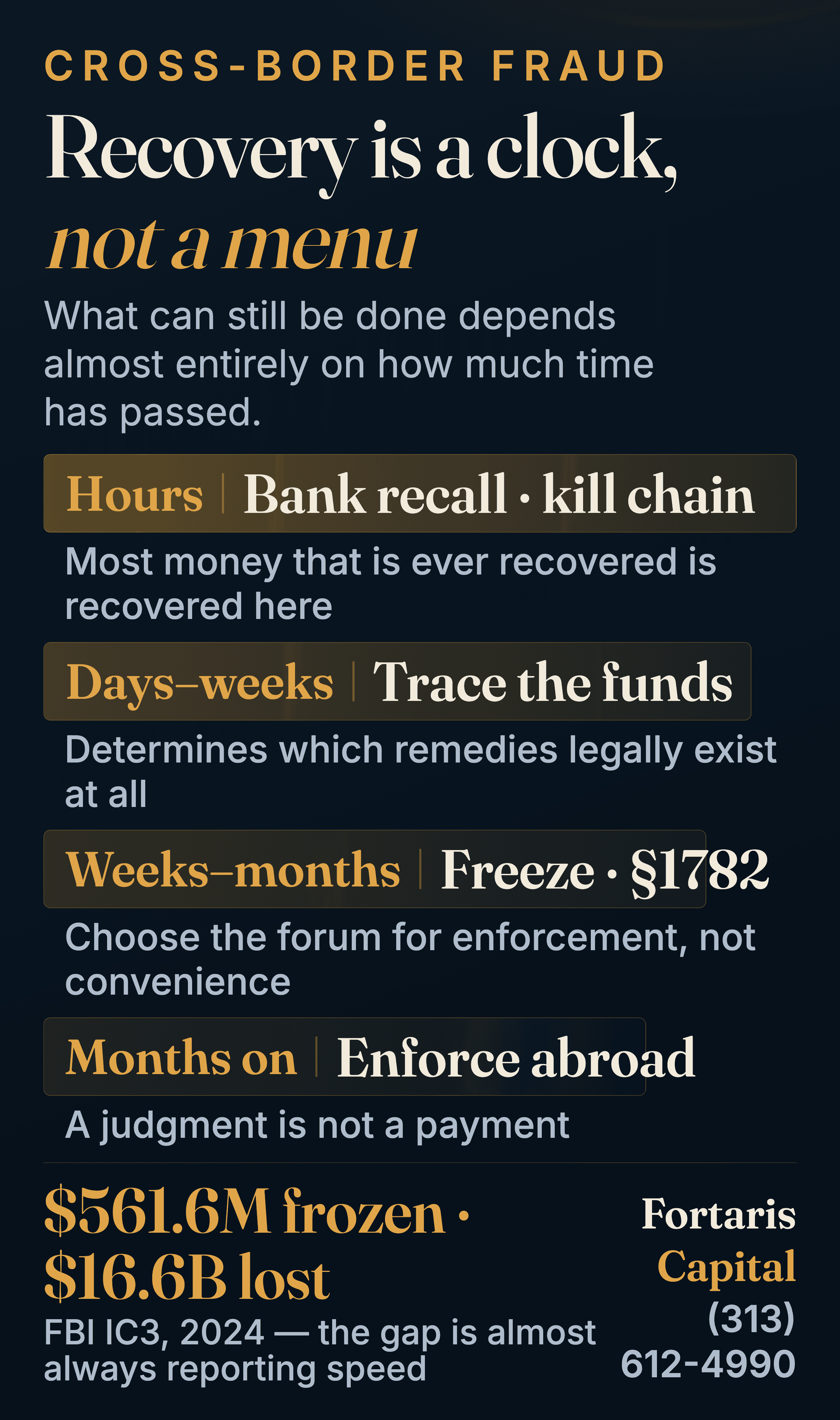
Hours: notify the banks, request a recall, report to IC3 or the local equivalent, and preserve the evidence intact. This is where most of the money that is ever recovered gets recovered.
Days to weeks: establish where the funds went and what is traceable. This determines which remedies are even available — particularly whether an equitable claim to identified property can be made out, which is the gateway to asset-preservation relief in U.S. federal court.
Weeks to months: choose the forum with enforcement in mind, secure evidence through Section 1782 where the route is open, seek freezing or attachment relief in the jurisdictions where assets sit, and refer criminally where the conduct warrants it.
Months onward: prosecute the claim, and enforce where the assets are rather than where the judgment was obtained.
None of this is a substitute for not being defrauded in the first place. The same verification that supports due diligence before contracting with a U.S. counterparty and diligence for foreign investors entering the U.S. market is materially cheaper than any recovery process described above, and considerably more reliable.
Where an investigator fits
Almost every remedy set out here has an evidentiary precondition. A freezing order over identified property requires tracing to that property. A Section 1782 application requires knowing which U.S. institution holds the relevant records and why. An enforcement strategy requires knowing what the defendant owns and where. A criminal referral is far more likely to be taken up when it arrives organised and documented rather than as a complaint.
That work sits with investigators rather than with counsel, and it is generally counsel who brings them in. Fortaris works alongside litigation teams on precisely this: establishing the movement of funds, identifying the entities and individuals behind them, and assembling a record that will survive scrutiny in whichever forum ends up hearing it — including the law firms that carry the matter forward.
The firm's cross-border and international due diligence practice is built for matters that cross jurisdictions, where the answer depends on reconciling records from several systems that were never designed to talk to each other.
Key takeaways
- Recovery is decided far more by speed than by litigation: the IC3's Recovery Asset Team froze $561.6 million across 3,020 complaints in 2024, a 66% success rate — against $16.6 billion in total reported losses, most of which is never frozen at all.
- In U.S. federal court, Grupo Mexicano (1999) bars a preliminary injunction freezing assets on a claim for money damages; asset-preservation relief generally requires an equitable claim to identified property, which makes tracing the gateway to the remedy.
- Section 1782 discovery is a powerful route to U.S.-held records for use abroad, but ZF Automotive (2022) closed it to private international commercial arbitration — a reason to settle the evidence strategy before the forum is chosen.
- Criminal referral and MLAT can reach evidence and assets civil process cannot, but they run on government timetables and recover to the state first; serious matters usually run civil and criminal tracks in parallel.
- A judgment is not a payment. Enforcement depends on the law where the assets sit — arbitral awards travel better than judgments under the 1958 New York Convention — so collectability belongs at the start of the analysis, not the end.
Frequently asked
8 questionsWhat is the first thing to do after discovering a cross-border fraud?
Contact the originating bank immediately and ask it to initiate a recall, then report the matter — in the United States, to the FBI's Internet Crime Complaint Center. The FBI's Recovery Asset Team operates a Financial Fraud Kill Chain that coordinates with receiving institutions to freeze fraudulently induced transfers before the funds move on, and it works on a timescale of hours and days rather than weeks. Preserve every payment instruction, email header, and account detail exactly as received. Legal advice matters, but it will rarely arrive fast enough to affect whether the funds are still there.
How much money is actually recovered after this kind of fraud?
Less than most people expect, and the gap is largely a function of reporting speed. In 2024 the IC3's Recovery Asset Team attempted recovery on 3,020 complaints representing $848.4 million and froze $561.6 million — a 66% success rate on cases it could act on. But total losses reported to the IC3 that year were $16.6 billion. The mechanism works well when it is triggered in time; most losses never reach it while the money is still reachable.
Can a U.S. court freeze a defendant's assets while the case is decided?
Often not, on a straightforward damages claim. In Grupo Mexicano de Desarrollo v. Alliance Bond Fund (1999) the Supreme Court held that a federal district court lacks authority to issue a preliminary injunction restraining a defendant from disposing of assets pending adjudication of a claim for money damages, because that relief was historically unavailable in equity — even where insolvency is alleged. Where the claim is equitable and asserts an interest in specific property, such as funds traceable to the fraud, asset-preservation relief remains available. That distinction is why tracing early can determine whether any freezing remedy exists.
What is a Section 1782 application and when can it be used?
28 U.S.C. § 1782 lets a party to a foreign proceeding apply to a U.S. district court for discovery located in the United States, for use abroad. It is valuable in cross-border fraud because dollar payments frequently leave records with U.S. correspondent banks even when neither party is American. Its scope narrowed in 2022: in ZF Automotive US, Inc. v. Luxshare, Ltd., a unanimous Supreme Court held the statute reaches only governmental or intergovernmental adjudicative bodies, closing it to private international commercial arbitration. If a matter is bound for private arbitration, this route is likely unavailable and the evidence plan must be built accordingly.
Should we report the fraud to law enforcement or pursue it civilly?
In serious matters, usually both, in parallel. Criminal process can reach evidence and asset freezes that civil litigation cannot, particularly through Mutual Legal Assistance Treaties, which in the United States are handled by the Department of Justice's Office of International Affairs. But prosecutors control the request and its priority, timelines run to months, and criminal forfeiture recovers assets to the state — whether a victim is compensated depends on the restitution or remission process that follows. Criminal referral is frequently right; it is rarely the fastest route to the money on its own.
We have a judgment. Why can we not collect it abroad?
Because a judgment has no automatic force outside the jurisdiction that issued it. Recognition is decided by the law where enforcement is sought — in much of the United States through state adoptions of the Uniform Foreign-Country Money Judgments Recognition Act, and elsewhere by local statute, treaty, or reciprocity practice, with some jurisdictions declining to enforce absent a treaty. Arbitral awards are treated more favourably: the 1958 New York Convention obliges contracting states to recognise and enforce them subject to narrow exceptions, which is a strong practical argument for an arbitration clause in cross-border contracts.
Is it worth suing at all if we do not know where the money went?
That is precisely the question to answer before filing rather than after. A judgment against a defendant with no reachable assets produces a legal bill and nothing else. Establishing what the counterparty owns, where it sits, and what is traceable to the fraud determines both which remedies are available and whether litigation is economically rational. In cross-border matters this assessment is not a refinement on the legal strategy — it is what tells you whether there is a strategy worth funding.
What does an investigator contribute that lawyers cannot?
Nearly every remedy described here has an evidentiary precondition that has to be built before the legal step can be taken: tracing funds to identified property so a freezing remedy is available, establishing which U.S. institution holds the records a Section 1782 application should target, mapping what a defendant owns so enforcement has something to attach, and organising a referral so prosecutors can act on it. That is investigative work, and it usually reaches an investigator through counsel rather than directly from the client.
Sources & further reading
- 01FBI Internet Crime Complaint Center (IC3) — 2024 Annual ReportReports that the IC3's Recovery Asset Team attempted recovery on 3,020 complaints representing $848.4 million and froze $561.6 million, a 66% success rate, against $16.6 billion in total reported losses for the year. The Recovery Asset Team was established in 2018 and assumed responsibility for domestic-to-international transactions in April 2024.
- 02Grupo Mexicano de Desarrollo, S.A. v. Alliance Bond Fund, Inc., 527 U.S. 308 (1999)The Supreme Court held that a federal district court lacks authority to issue a preliminary injunction preventing a defendant from disposing of assets pending adjudication of a contract claim for money damages, such relief having been historically unavailable from a court of equity — the principal limit on asset-freezing relief in U.S. federal court.
- 03ZF Automotive US, Inc. v. Luxshare, Ltd., 596 U.S. ___ (2022)A unanimous Supreme Court held that 28 U.S.C. § 1782 extends only to governmental or intergovernmental adjudicative bodies, resolving a circuit split and making the statute unavailable for private international commercial arbitration, as well as for an investor-state panel not created by governments or exercising sovereign authority.
- 0428 U.S.C. § 1782 — Assistance to foreign and international tribunals and to litigants before such tribunalsThe statutory basis for obtaining U.S.-located documents and testimony for use in foreign proceedings; frequently the route to correspondent-banking records in cross-border fraud matters.
- 05U.S. Department of Justice, Office of International Affairs — Mutual Legal Assistance TreatiesThe channel through which U.S. authorities make and receive formal requests for evidence and, in some cases, asset restraint and forfeiture from treaty partners. Requests are made by prosecutors rather than victims and run on government timelines.
- 06United Nations Convention against Corruption (UNCAC), Chapter V; World Bank / UNODC Stolen Asset Recovery (StAR) InitiativeEstablishes asset recovery as a fundamental principle of the convention and provides the international framework and technical support for recovering the proceeds of corruption across borders.
- 07Convention on the Recognition and Enforcement of Foreign Arbitral Awards (New York, 1958); Uniform Foreign-Country Money Judgments Recognition ActThe New York Convention obliges contracting states to recognise and enforce arbitral awards subject to narrow exceptions; the Uniform Act, as adopted by individual U.S. states, governs recognition of foreign money judgments — the reason awards generally travel better than judgments.