

The short answer
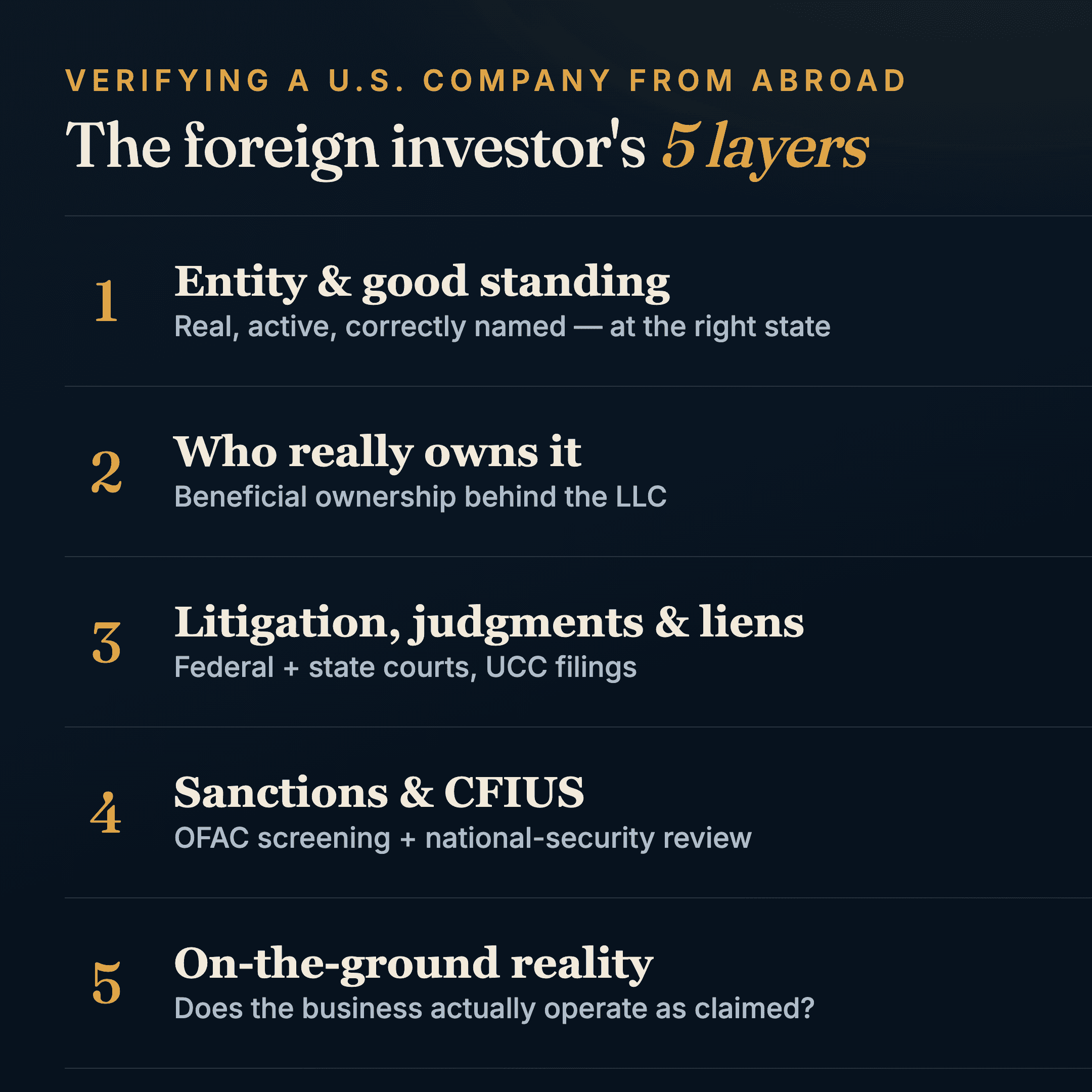
A foreign investor entering the U.S. market performs due diligence by independently verifying the target company's legal registration and good standing, identifying its ultimate beneficial owners, searching federal and state litigation and liens, confirming regulatory and licensing standing, screening all parties against OFAC sanctions, assessing any CFIUS national-security exposure, and — where stakes are high — corroborating that the business physically operates as represented before capital crosses the border.
Why the U.S. Is Harder to Diligence Than It Looks
To an overseas investor, the United States can look like the most transparent market in the world: an open court system, public company registries, and an aggressive financial regulator. In practice, that transparency is fragmented across fifty states plus the federal system, held in databases that do not talk to each other, and easy to misread without local context. There is no single national companies register, no one place to confirm who owns a business, and no unified litigation search. A company that looks substantial on a polished website and a single state filing may be a recently formed shell with no assets, no operating history, and undisclosed owners.
The cost of getting this wrong is not theoretical, and distance magnifies it. The FBI's Internet Crime Complaint Center (IC3) has reported business email compromise and investment-fraud losses in the billions of dollars annually, much of it involving funds wired to entities the sender never independently verified. For a foreign buyer, the practical difficulty of pursuing a U.S. defendant from abroad — different time zones, unfamiliar corporate forms, the expense of U.S. litigation — all favor the bad actor. Diligence is the cheapest leverage a cross-border investor has, and it is strongest before the money moves.
Due diligence for foreign investors is therefore a discipline, not a single database lookup. It is investigative due diligence applied across a border, and it adds two questions a domestic buyer rarely has to ask: does U.S. sanctions or national-security law constrain this deal, and can the target's represented operations actually be confirmed on the ground from thousands of miles away. Those questions sharpen in the markets that draw the most inbound capital — which is why diligence in Miami and South Florida so often turns on ownership and source-of-funds rather than the filing itself.
What a Foreign Investor Actually Needs to Verify
The scope scales with the stakes, but a defensible cross-border review covers the same core areas every time. Each is run against independent U.S. sources and reconciled against what the target and its advisors represent; the goal is to close the gap between the story and the verifiable record, and to flag every gap that cannot be closed.
For an inbound investor, two of these areas — sanctions and CFIUS exposure, and on-the-ground operational reality — carry weight they would not in a purely domestic deal, and they are treated separately below.
- Legal existence and good standing — confirm the entity exists under its exact legal name at the state of incorporation, is active rather than dissolved or suspended, and note its formation date and registered agent
- Ultimate beneficial ownership — trace the corporate structure to the natural persons who actually own and control the target, including nominee or silent interests
- Litigation, judgments, and liens — search federal and state courts, judgments, tax liens, and UCC financing statements for the entity and its principals personally
- Regulatory and licensing standing — confirm required licenses are current and check for enforcement actions, consent orders, or revocations
- Sanctions, PEP, and CFIUS exposure — screen the parties against OFAC and global watchlists, and assess whether the transaction triggers U.S. national-security review
- Reputation and adverse media — systematic source and media inquiry across the relevant languages and jurisdictions
- Operational and asset reality — confirm the business operates, employs, and holds the assets it represents
- Source and application of funds on both sides — a legitimate, explicable origin for the money, which protects the foreign investor as much as the U.S. counterparty
Beneficial Ownership: The Hardest Fact to Establish
The single hardest thing to establish about a U.S. company, and the one that matters most when fraud, sanctions evasion, or undisclosed conflicts are in play, is who ultimately owns and controls it. State formation documents rarely disclose the human beings behind an entity, particularly for LLCs, which can be formed with no public record of their members at all.
The federal Corporate Transparency Act created a beneficial-ownership reporting regime administered by FinCEN, but the resulting registry is not a public database, access is restricted, and the rules have shifted — so a foreign counterparty cannot rely on it as an open verification tool. Practical ownership verification still comes from combining corporate filings, the target's own contractual representations, litigation records that name principals, property and business records, and direct investigation. Where ownership resolves into nominees, shells, or opaque offshore vehicles — or cannot be established at all — that gap is itself a material finding that belongs in the investor's risk assessment before any capital is committed.
Sanctions and CFIUS: The Two Regulatory Traps Foreign Capital Must Clear
Two features of U.S. law make diligence for an inbound investor categorically different from a domestic one. The first is sanctions. The U.S. Treasury's Office of Foreign Assets Control (OFAC) administers sanctions programs that reach far beyond the names on its lists: under the 50 Percent Rule, an entity owned 50 percent or more, directly or indirectly, by one or more blocked persons is itself treated as blocked even if it is not itself named. A foreign investor who screens only the named U.S. target, and not the beneficial-ownership chain behind it — or its own co-investors — can walk into a sanctions problem that no representation in the deal documents will cure. Because U.S. sanctions liability is generally strict, intent is not a defense.
The second is CFIUS. The Committee on Foreign Investment in the United States reviews certain transactions in which a foreign person acquires an interest in a U.S. business for national-security risk, and it can impose conditions, require mitigation, or recommend that the President block or unwind a deal. Its reach is broadest where the target touches critical technology, critical infrastructure, sensitive personal data, or real estate near sensitive sites. For a foreign investor, assessing CFIUS exposure early is not optional housekeeping — it can determine whether a transaction is feasible at all, and whether a voluntary filing is the prudent course. Sanctions screening and CFIUS analysis are best run at the very start of the process, because both can change the structure or viability of the deal.
These are legal determinations that a foreign investor takes with U.S. counsel. The role of investigative diligence is to give counsel the factual foundation — the true ownership chain, the counterparties, the source of funds, and the operational footprint — on which those sanctions and national-security judgments are made.
Litigation, Judgments, and the Records That Don't Cross Borders
A U.S. company's legal and financial history is one of the most revealing data sets available, and much of it is public — but only to those who know where to look. Federal civil, criminal, and bankruptcy litigation is searchable through PACER, the judiciary's electronic records system. State court coverage is uneven and must be searched county by county in the jurisdictions where the company actually operates, which is precisely where local knowledge separates a real search from a superficial one.
Run the entity and its known principals through these records to surface patterns a foreign investor would otherwise never see: repeat breach-of-contract defendants, fraud allegations, unpaid judgments, and prior bankruptcies. Separately, search Uniform Commercial Code (UCC) financing statements at the state level — they reveal which lenders already hold security interests in the company's assets, telling an investor whether the assets underpinning a valuation are already pledged to someone else. A clean website and a balance sheet quietly encumbered by undisclosed UCC liens are not the same company.
- Federal civil, criminal, and bankruptcy dockets via PACER
- State and county civil records in every jurisdiction where the company operates
- Judgment, tax-lien, and UCC financing-statement searches at the state level
- Public-company filings on the SEC's EDGAR system, where applicable
- Patterns across the principals personally, not only the corporate entity
The Distance Problem: Confirming the Company Is Real
The risk that distinguishes a cross-border deal is the simplest one: from another continent, it is hard to confirm that a business exists as represented at all. Records can be genuine while the operation behind them is hollow — a leased address, a skeleton staff, or assets that are not there. This is where documentary diligence reaches its limit and discreet on-the-ground corroboration becomes decisive: confirming the premises, the operations, the workforce, and the key relationships actually exist, quietly and without alerting the counterparty.
This is also the layer most often skipped, because it cannot be done from a laptop abroad. For a foreign investor, it is frequently the single most valuable part of the engagement — the difference between relying on a data room and knowing what is really there. Where a U.S. contract or wire is imminent, it pairs naturally with the discipline of independently verifying the U.S. company itself before funds are released.
Fitting Diligence Into a Cross-Border Deal Timeline
The most common mistake is treating investigative diligence as a confirmatory step run in the final days before closing, when there is no time left to act on what it finds. Done well, it is staged. A focused early pass — legal existence, beneficial ownership, sanctions, an initial CFIUS read, and a first reputational sweep — belongs before a term sheet or exclusivity, while the investor still has leverage and the option to walk. The fuller investigation then runs in parallel with financial and legal confirmatory diligence, not after it.
Cross-border matters take longer, not less: fragmented state records, county-level searches, foreign-language sources, and on-the-ground work in multiple locations all add time. That is an argument for starting earlier, not for compressing the work at the end. For private-equity and corporate acquirers who deploy into the U.S. repeatedly, the efficient model is a tiered playbook — a light, fast screen on every opportunity, escalating to the full enhanced review once a deal is real — so cost stays proportionate while the high-stakes transactions get the scrutiny they warrant. Sponsors will find the integrity side of that model in our private-equity due-diligence playbook.
Turning Diligence Into a Defensible Record
The output of cross-border due diligence is not a folder of raw search results; it is a reasoned, sourced assessment that an investment committee, a board, a lender, or U.S. counsel can rely on, and that will stand up later if a dispute arises. Documenting the work imposes discipline — ensuring no area is quietly skipped under deal pressure — and creates an evidentiary record that supports the decision and any future claim.
Fortaris Capital Advisors built its international and cross-border due diligence practice around exactly this problem: giving overseas investors, acquirers, and their U.S. counsel an independent, discreet read on the people, ownership, history, and operational reality behind a U.S. target — led at the Managing Director level and grounded in federal investigative and forensic-accounting experience. The principle holds whether the work is run in-house or with a specialist: verify before you commit capital, document what you find, and treat every gap you cannot close as a finding in its own right.
Key takeaways
- U.S. transparency is fragmented across 51 jurisdictions with no national companies or ownership register — verifying a target takes deliberate, source-by-source investigative work, not a single lookup.
- Beneficial ownership is the hardest and most important fact to establish; the FinCEN CTA registry is restricted and not a public tool, so ownership still comes from combined records plus investigation.
- Foreign investors face two traps a domestic buyer does not: OFAC sanctions (including the 50 Percent Rule on ownership chains) and CFIUS national-security review — both assessed at the very start because they can reshape or block a deal.
- The distinctive cross-border risk is confirming the company physically operates as represented; discreet on-the-ground corroboration is often the highest-value part of the engagement.
- Stage the work before exclusivity, run it in parallel with financial and legal diligence, and turn it into a documented, defensible record for the investment committee, board, or U.S. counsel.
Frequently asked
8 questionsHow can a foreign investor verify a U.S. company before investing?
By independently confirming the entity's legal registration and good standing at the state of incorporation, tracing its ultimate beneficial owners, searching federal and state litigation, judgments, liens, and UCC filings, checking regulatory and licensing standing, screening all parties against OFAC sanctions, assessing CFIUS national-security exposure, and — where stakes are high — corroborating on the ground that the business operates as represented. The findings are reconciled against the target's representations and documented into a report the investor can rely on.
Who can perform due diligence on an American company for an overseas buyer?
Specialist corporate intelligence and investigative due diligence firms perform this work for overseas buyers and their counsel. What matters is genuine U.S. investigative capability — access to federal and state court records, beneficial-ownership tracing, OFAC screening, and discreet on-the-ground corroboration across the states where the target operates — combined with the seniority and discretion a sensitive cross-border matter requires. Fortaris Capital Advisors provides this for foreign investors, acquirers, and international counsel.
What is CFIUS and does it affect my U.S. investment?
CFIUS — the Committee on Foreign Investment in the United States — reviews certain transactions in which a foreign person acquires an interest in a U.S. business for national-security risk, and it can impose conditions or recommend that a deal be blocked or unwound. Its reach is broadest around critical technology, critical infrastructure, sensitive personal data, and real estate near sensitive sites. Whether it applies is a legal question for U.S. counsel, but a foreign investor should assess exposure at the very start, because it can change the structure or feasibility of the deal.
How do I confirm who really owns a U.S. company?
Ultimate beneficial ownership is rarely disclosed in state formation records, especially for LLCs, and the federal FinCEN registry created by the Corporate Transparency Act is access-restricted rather than public. In practice, ownership is established by combining corporate filings, the target's contractual representations, litigation records that name principals, property and business records, and direct investigation. Where ownership resolves into nominees or opaque offshore structures, or cannot be established, that gap is itself a material finding.
Do U.S. sanctions apply to a foreign buyer of a U.S. company?
They can. OFAC sanctions reach transactions with a U.S. nexus, and the 50 Percent Rule treats any entity owned 50 percent or more by blocked persons as blocked even if it is not itself listed. A foreign investor must screen not just the named U.S. target but the full beneficial-ownership chain and its own co-investors. Because U.S. sanctions liability is generally strict, intent is not a defense — which is why ownership tracing and sanctions screening are run together, early.
How do I verify a U.S. distributor or supplier from abroad?
The same discipline applies to a commercial counterparty as to an acquisition target, scaled to the exposure: confirm the entity and good standing, identify who controls it, search litigation and UCC liens, screen for sanctions, and — before relying on it for supply or distribution — corroborate that it operates and holds the capacity it claims. For a supplier or distributor you will depend on operationally, the on-the-ground confirmation that the business is real is often the most valuable step.
How long does cross-border due diligence take?
It scales with scope and geography. A focused entity, ownership, litigation, and sanctions review can be completed in days to about two weeks; a full investigation involving multiple U.S. states, on-the-ground corroboration, and source inquiry takes several weeks. Because cross-border work is slower than a domestic search, it should be started early — before a term sheet where possible — so findings can still influence price, structure, or the decision to proceed.
Can I get a report I can rely on for my board or investment committee?
Yes. Reputable cross-border due diligence is produced to a defensible standard: every material conclusion is sourced, methods are lawful and documented, and gaps are disclosed rather than papered over. That makes the findings suitable to support an investment-committee or board decision, to brief U.S. counsel on sanctions and CFIUS questions, and to stand up later if the transaction is challenged.
Sources & further reading
- 01U.S. Treasury, Office of Foreign Assets Control (OFAC)Administers U.S. sanctions programs; publishes the SDN List and guidance on the 50 Percent Rule governing sanctioned ownership chains that inbound investors must screen against.
- 02Committee on Foreign Investment in the United States (CFIUS), U.S. TreasuryReviews certain foreign investments in U.S. businesses for national-security risk and can require mitigation or recommend blocking or unwinding a transaction.
- 03FinCEN — Corporate Transparency Act beneficial ownership regimeEstablishes a federal beneficial-ownership reporting framework administered by FinCEN; access is restricted, so establishing ultimate ownership in practice still relies on combined records and investigation.
- 04FBI Internet Crime Complaint Center (IC3)Publishes annual reporting on internet-enabled fraud losses, including business email compromise and investment fraud, much of it involving funds wired to unverified entities.
- 05U.S. Courts PACER and SEC EDGARPACER provides public access to federal civil, criminal, and bankruptcy dockets; EDGAR provides public-company filings used to corroborate a U.S. target's history.