
The short answer
Due diligence in Miami carries risks a standard check misses. South Florida concentrates international and Latin-American capital, all-cash and shell-company real estate, and the nation's highest per-capita fraud — a convergence that makes verifying who you are actually dealing with both harder and more necessary than almost anywhere else in the country. It calls for cross-border, ownership-piercing diligence, not a name-and-registration search.
What makes South Florida due diligence different
Most due diligence assumes a knowable counterparty: a company formed here, owned by people who live here, with a track record you can reconstruct from US records. In South Florida that assumption breaks more often than almost anywhere else in the country. Miami is the point where international capital, Latin-American wealth, all-cash real estate, and a very high volume of newly formed entities all converge — and each of those, on its own, is a reason to look harder at who is on the other side of a deal.
The result is not that South Florida is uniquely dishonest. It is that the ordinary signals a diligence process relies on — a long local history, transparent ownership, a paper trail that starts and ends in the United States — are thinner here, and more often point offshore. A name-and-registration search that would be adequate in a mature domestic market can leave the most important question unanswered: who actually controls this counterparty, and where did their money come from.
This is the terrain Fortaris covers from Miami, with particular depth in the cross-border, border-state, and Latin-American matters the region generates — the same investigative due diligence applied where the answers so often sit outside US reach.
The real-estate channel: why Miami was the federal test case
The clearest evidence that South Florida real estate carries elevated risk is that the federal government chose it to prove the point. When FinCEN launched its residential real-estate Geographic Targeting Orders in 2016 — requiring title companies to identify the real people behind all-cash, shell-company home purchases — it selected just two markets for the pilot: Manhattan and Miami-Dade County. The orders were renewed continuously for a decade — most recently in October 2025, reaching non-financed purchases of $300,000 or more across Miami-Dade, Broward, Palm Beach, and Florida's Gulf Coast — and ran through 28 February 2026, when a nationwide successor rule was due to take over.
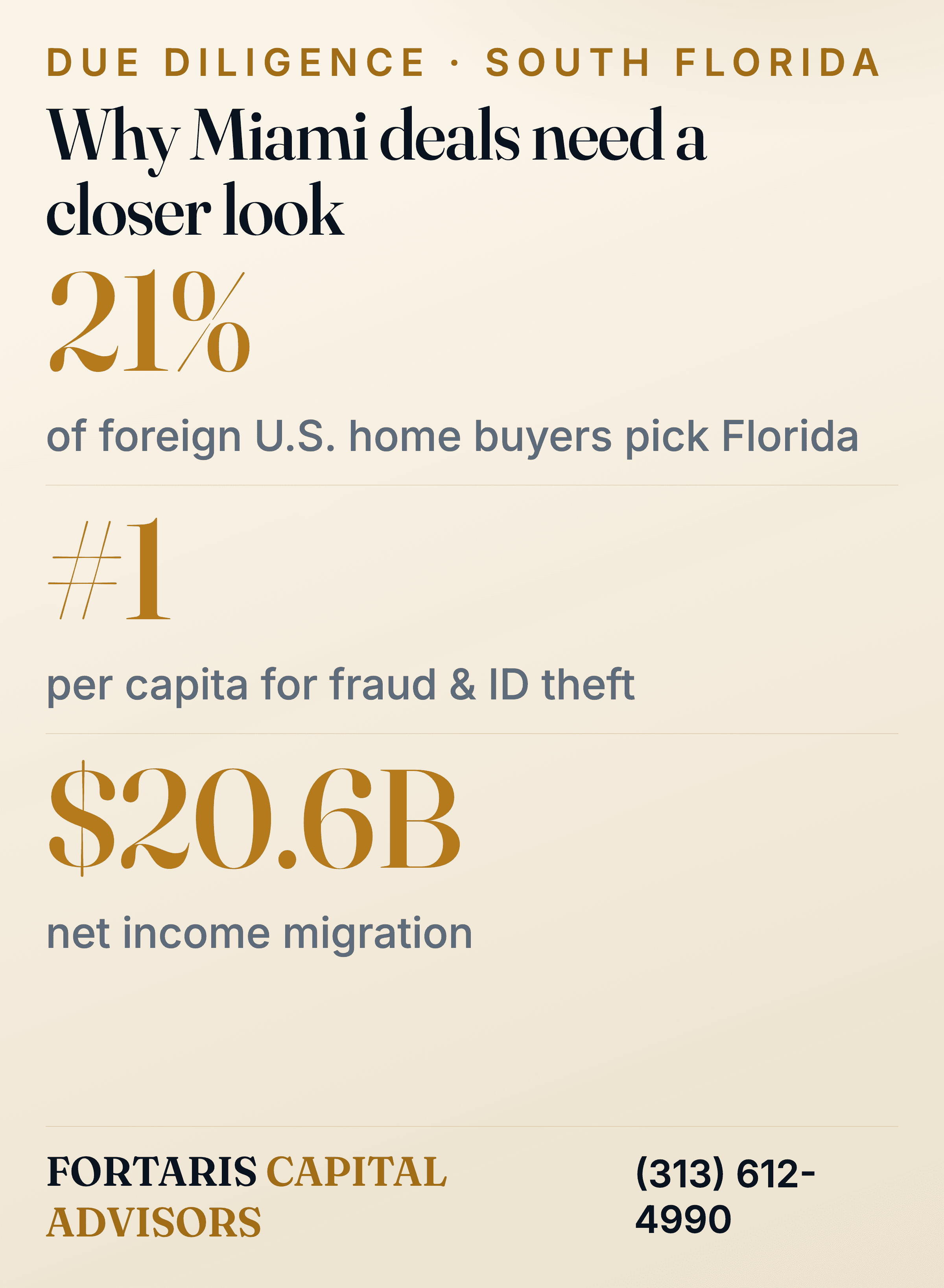
The economics behind that targeting are documented. Florida has been the number-one US destination for foreign residential buyers for well over a decade — 21% of all international purchases in the National Association of Realtors' 2025 data, more than any other state — and foreign buyers pay all-cash at nearly double the overall market rate, 47% versus 28%. All-cash purchases through a limited-liability company leave no lender to run diligence and no mortgage record to trace ownership; the LLC is frequently the point.
FinCEN went further in 2024, finalizing a nationwide rule to require beneficial-ownership reporting on entity-held, non-financed home transfers — its own assessment being that this channel warrants permanent transparency. That rule was vacated by a federal court in 2026 and is under appeal, so it is not current law (we trace where that leaves ownership reporting in the Corporate Transparency Act in 2026); but its risk analysis stands, and South Florida real estate remains a place where the buyer of record and the buyer in fact are routinely not the same. Establishing which is which is asset-tracing and ownership work, not a title search.
Latin-American capital and politically exposed persons
Miami is the financial gateway to Latin America and the fastest-growing family-office hub in the Western Hemisphere. That is an enormous economic strength — and it concentrates a specific diligence risk: inbound wealth from jurisdictions with higher corruption exposure, often held through the layered cross-border structures that make ownership hard to see.
International standards treat this directly. The Financial Action Task Force's guidance on politically exposed persons calls for enhanced scrutiny of senior foreign officials, their families, and close associates — and the World Bank's asset-recovery research identifies lawyers, real-estate professionals, and company-service providers as the 'gatekeepers' corrupt actors use to move funds into property and shell companies. Both patterns run through South Florida.
It is not a theoretical concern. The Department of Justice has repeatedly used the Southern District of Florida to prosecute Latin-American kleptocracy — including a $1.2 billion scheme to launder money stolen from Venezuela's state oil company, PDVSA, with proceeds traced into South Florida real estate, yachts, and luxury goods. For anyone taking on a counterparty with a Latin-American nexus, the practical task is to establish whether a principal is a PEP or connected to one before the relationship closes — the core of cross-border and international due diligence.
The fraud density: Florida's numbers
Beyond the cross-border layer, South Florida simply sees more fraud than most of the country. Florida ranks first in the nation, per capita, for both fraud and identity-theft reports in the Federal Trade Commission's most recent Consumer Sentinel data, and among the top three states for internet-crime complaints and losses in the FBI's 2024 Internet Crime Report — a year in which nationwide reported losses exceeded $16 billion. The region also carries a long-documented reputation as a national center for Ponzi schemes, health-care fraud, and elder financial exploitation, reinforced by its older, wealthy, and internationally mobile population.
What that means for a deal is statistical, not accusatory: the base rate of encountering a bad actor, a misrepresentation, or an undisclosed problem is higher here. A counterparty who checks out on paper deserves the same verification everywhere — but in a market this dense with fraud, the cost of skipping it is higher, and the reputational and integrity review that surfaces the pattern is worth proportionally more.
This is also where white-collar and financial-crime experience matters more than database access. Recognising the shape of a scheme before it completes is a function of having seen it before — the kind of judgment that distinguishes an investigator from a screening tool.
Velocity and volume: more entities, formed faster, with less history
The last factor is sheer churn. Florida files more new-business applications than any other state, and Miami-Dade ranks sixth among all US counties for new-business formation per capita, per the Census Bureau's 2024 data; the state's Division of Corporations carries more than 3.5 million registered entities. Since 2020, the 'Wall Street South' migration — led by Citadel's 2022 move of its headquarters from Chicago to Miami — has brought a wave of finance and crypto firms, and Florida leads every state for net income migration, gaining roughly $20.6 billion in adjusted gross income from new residents in the latest IRS data.
Growth is good news for the region and bad news for a diligence shortcut. A company incorporated last quarter, owned by a principal who arrived last year, has almost no US track record to verify against — no long filing history, no established local reputation, no decade of counterparties to reference. The verification gap is widest exactly where the money is moving fastest.
The practical consequence is that recency itself is a flag to work through, not around. New entity, new-to-the-US principal, and a cross-border source of funds is a combination that rewards verifying the company and its owners before you sign rather than after.
What a Miami-grade diligence engagement covers
Put together, South Florida calls for a diligence posture built for the specific risks the market concentrates. In practice that means four things a standard check often skips.
First, pierce ownership rather than accept it — establish the beneficial owners behind an LLC or trust, not just the registered agent, because in this market the entity is frequently the disguise. Second, screen for sanctions and PEP exposure with a real Latin-American and Caribbean reach, since that is where the region's risk most often originates. Third, verify operational reality on the ground — that a business actually operates as represented, which in a market this fast-moving and this international cannot be assumed from filings. Fourth, follow the money where it has moved across borders, using asset-tracing and cross-border investigative capability when the funds or the counterparty lead offshore.
Fortaris runs this work from Miami, anchored by a Managing Director focused on South Florida, the Caribbean, and Latin-American matters, drawing on the firm's flagship international due-diligence practice — the capability foreign principals and US deal teams rely on when a South Florida counterparty's real story sits outside US records. The regional coverage is set out on our Miami service-area page.
When to engage — and the takeaway
The trigger is any consequential South Florida decision that depends on a counterparty you cannot fully verify yourself: an acquisition or investment, a real-estate transaction through an entity, a new partner or major customer, a significant lease, or a principal whose wealth or history originates abroad. The time to look is before the commitment, when findings can still change the terms or the decision — the same logic that governs due diligence for foreign investors entering the US market.
The takeaway is not that South Florida deals are to be avoided — the region's growth is real and the opportunities are genuine. It is that the market's defining strengths, its openness to international capital and its velocity, are the same features that make its counterparties harder to verify. A diligence process calibrated to that reality is not an obstacle to a Miami deal; it is what lets you do one with confidence.
Key takeaways
- Miami concentrates international and Latin-American capital, all-cash and shell-company real estate, high fraud density, and a huge volume of new entities — each a reason to verify a counterparty harder than a standard check does.
- South Florida real estate was one of only two markets FinCEN chose for its 2016 anti-money-laundering pilot; those beneficial-ownership orders still run, and Florida leads the US for foreign buyers, who pay all-cash at nearly twice the market rate.
- As the US gateway to Latin America, Miami concentrates PEP and cross-border ownership risk — the Southern District of Florida has repeatedly prosecuted kleptocracy cases, including a $1.2 billion PDVSA laundering scheme with proceeds in local real estate.
- Florida ranks #1 per capita for fraud and identity theft (FTC) and top-three for internet-crime losses (FBI), so the base rate of encountering a bad actor or misrepresentation is higher than in most markets.
- Miami-grade diligence pierces beneficial ownership, screens PEP and sanctions exposure with Latin-American reach, verifies operations on the ground, and traces funds across borders — not a name-and-registration search.
Frequently asked
8 questionsWhy is due diligence in Miami different from anywhere else?
Because South Florida concentrates risks that thin out the usual diligence signals: heavy international and Latin-American capital, all-cash real estate bought through shell companies, the nation's highest per-capita fraud, and an enormous volume of newly formed entities. Ownership more often sits offshore and track records are shorter, so a standard name-and-registration search frequently leaves the key question — who really controls this counterparty, and where did the money come from — unanswered.
Is Miami real estate actually higher-risk for money laundering?
The federal government treats it that way. FinCEN chose Miami-Dade as one of only two markets for its original 2016 real-estate Geographic Targeting Orders, which required title companies to identify the real owners behind all-cash, shell-company home purchases. Those orders were renewed continuously for a decade — covering non-financed purchases of $300,000+ across Miami-Dade, Broward, Palm Beach, and the Gulf Coast — and ran through February 2026, when a nationwide successor rule was due to replace them; that rule was vacated by a federal court weeks later and is on appeal. Florida is also the top US state for foreign buyers, who pay all-cash at nearly double the overall rate.
What is a politically exposed person (PEP), and why does it matter in South Florida?
A PEP is a senior foreign official — or their family member or close associate — whom international standards (FATF) flag for enhanced scrutiny because of elevated corruption and money-laundering risk. It matters in Miami because the city is the financial gateway to Latin America, so counterparties and their funds frequently trace to higher-risk jurisdictions. The Department of Justice has repeatedly prosecuted Latin-American kleptocracy cases in the Southern District of Florida, including a $1.2 billion PDVSA laundering scheme with proceeds in South Florida real estate.
How much fraud does Florida actually see?
Florida ranks first in the nation, per capita, for both fraud and identity-theft reports in the FTC's most recent Consumer Sentinel data, and among the top three states for internet-crime complaints and losses in the FBI's 2024 Internet Crime Report — a year in which US reported losses exceeded $16 billion. The region is also a long-standing center for Ponzi, health-care, and elder-financial fraud. It doesn't mean any given counterparty is dishonest; it means the base rate is higher and verification is worth more.
Can you find the real owner behind a Florida LLC or trust?
That is a core part of the work. Florida's public records show a registered agent and officers, but not necessarily the beneficial owner who actually controls an entity — which in this market is frequently the point of the structure. Establishing true ownership takes investigative work: correlating filings, correspondence, related entities, property records, and cross-border sources, rather than accepting the entity at face value.
We're a foreign company or investor entering a South Florida deal. What should we check?
Verify the US entity's registration and standing, establish its beneficial owners, search litigation and liens, screen all parties for sanctions and PEP exposure, and confirm the business actually operates as represented — ideally before you sign, when findings can still change the terms. Because the risk here so often crosses a border, this is international due-diligence work: it needs reach into Latin-American and Caribbean sources, not just US databases.
When should we engage a firm for Miami due diligence?
Before any consequential South Florida commitment that depends on a counterparty you cannot fully verify yourself — an acquisition or investment, an entity-held real-estate transaction, a new partner or major customer, a significant lease, or a principal whose wealth or history originates abroad. Early engagement lets the findings actually inform price, terms, and the decision to proceed, instead of documenting a problem after it is yours.
Does Fortaris cover South Florida specifically?
Yes. Fortaris works South Florida and the Caribbean from Miami, anchored by a Managing Director based in the region, with particular depth in cross-border and Latin-American matters and the firm's flagship international due-diligence practice. Coverage extends across Miami-Dade, Broward, and Palm Beach and into the Caribbean and Latin America — the reach South Florida diligence usually requires.
Sources & further reading (8)
- 01FinCEN — Residential Real Estate Geographic Targeting Orders (2016; final renewal October 2025, run through 28 February 2026)FinCEN chose Miami-Dade as one of only two markets for its 2016 real-estate GTO pilot; the orders required title companies to report the beneficial owners behind all-cash, shell-company residential purchases of $300,000 or more across South Florida, and ran until a nationwide successor rule was due to take over on 1 March 2026.
- 02FinCEN — Residential Real Estate Rule (2024); Flowers Title Companies, LLC v. Bessent (E.D. Tex., 2026)FinCEN's 2024 rule found that non-financed, entity-held home purchases warrant nationwide beneficial-ownership reporting; the rule was vacated in 2026 and is under appeal, so it is cited here for its risk analysis, not as current law.
- 03National Association of Realtors — International Transactions in U.S. Residential Real Estate (2025)Florida is the top US state for foreign residential buyers — 21% of all international purchases in the 2025 report — and international buyers pay all-cash at 47% versus 28% for the overall market.
- 04U.S. Department of Justice — Venezuela/PDVSA kleptocracy prosecutions, Southern District of FloridaDOJ has repeatedly charged and forfeited assets in Latin-American corruption cases in South Florida, including a $1.2 billion scheme to launder funds stolen from Venezuela's state oil company, PDVSA, with proceeds traced into local real estate and luxury assets.
- 05FATF — Guidance on Politically Exposed Persons (Recommendations 12 & 22); World Bank/UNODC StARInternational standards call for enhanced due diligence on politically exposed persons and identify lawyers, real-estate professionals, and company-service providers as the 'gatekeepers' used to move illicit funds into property and shell companies.
- 06FBI Internet Crime Complaint Center — 2024 Internet Crime ReportFlorida ranks among the top three US states for internet-crime complaints and losses; nationwide reported losses exceeded $16 billion in 2024, a sharp year-over-year increase.
- 07FTC — Consumer Sentinel Network Data Book (2024)Florida ranks first in the nation, per capita, for both fraud and identity-theft reports; US fraud losses reached a record $12.5 billion in 2024.
- 08U.S. Census Bureau Business Formation Statistics (2024); IRS Statistics of Income migration data (2022–23)Florida files the most new-business applications of any state and Miami-Dade ranks sixth among US counties per capita; Florida also leads every state for net income migration, gaining roughly $20.6 billion in adjusted gross income from new residents.